

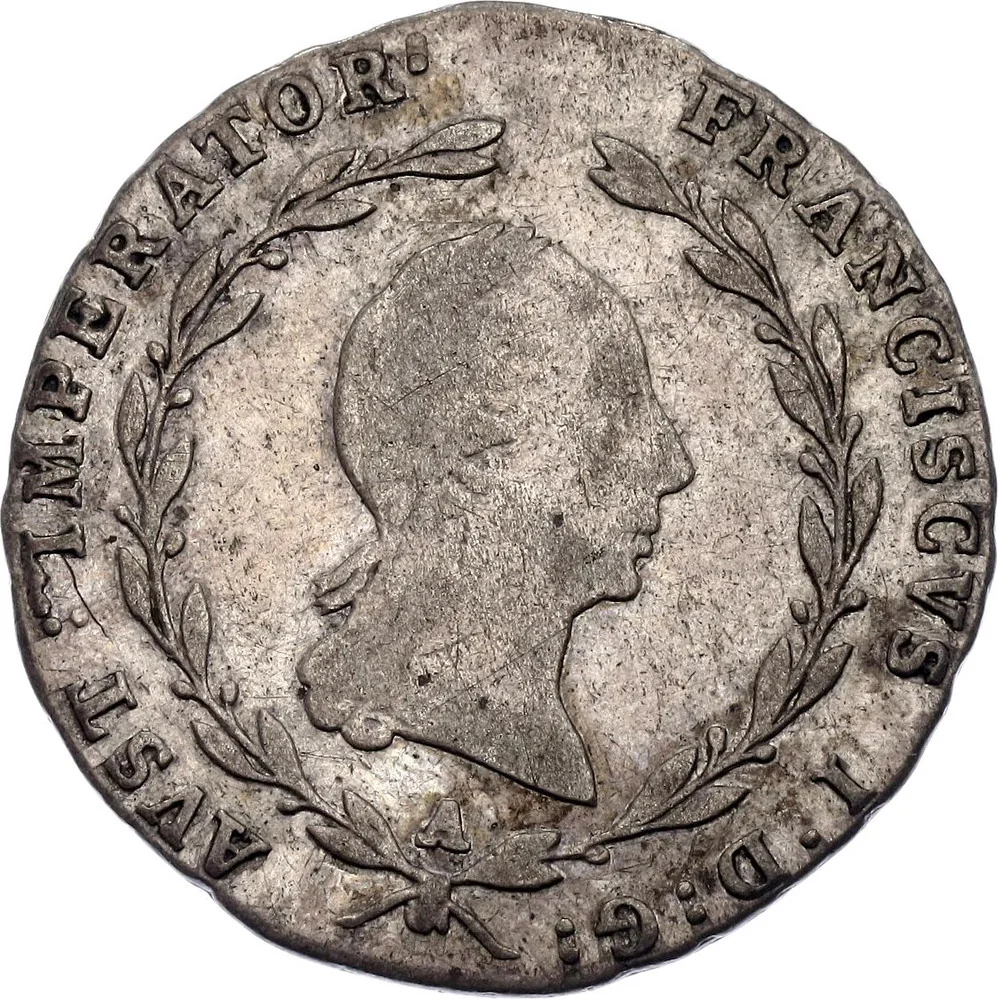
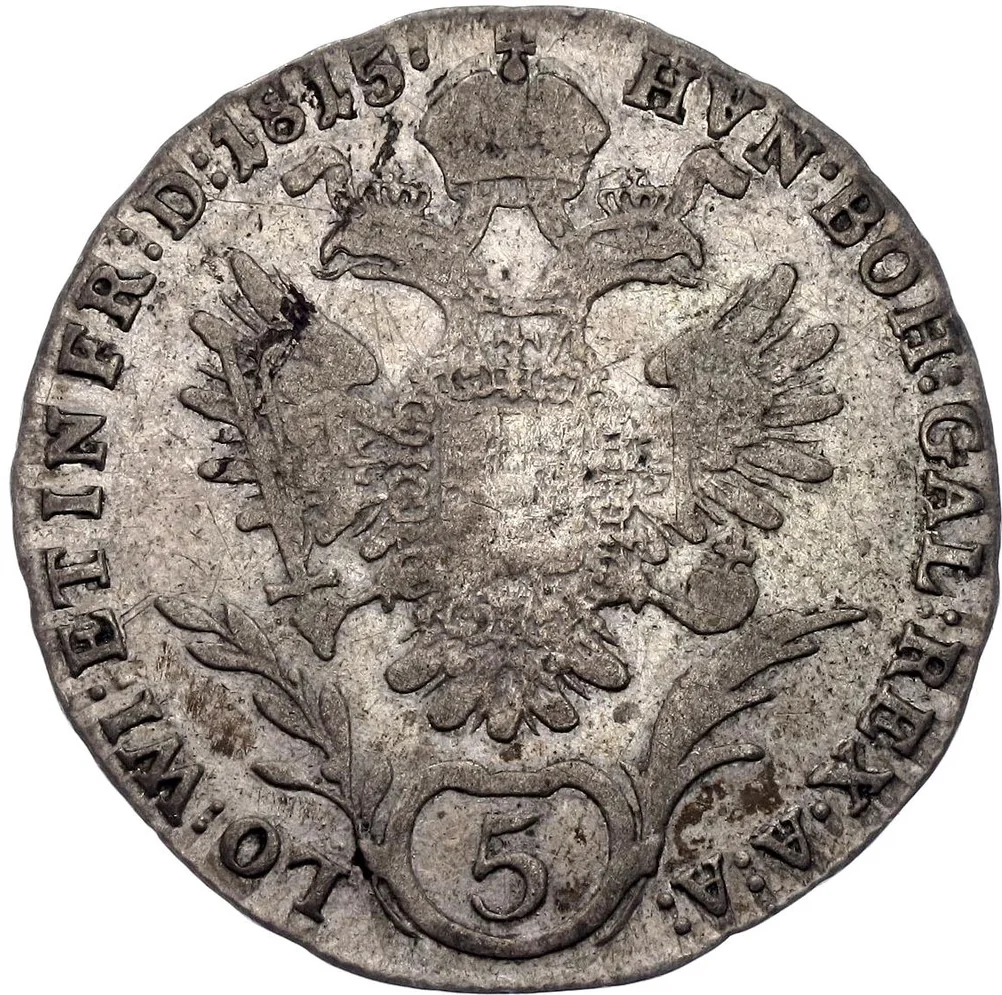
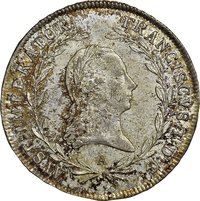
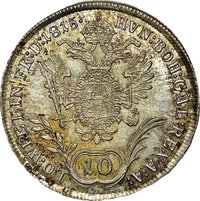
5 Kreuzer – Austrian Empire
Austria
Context
Year: 1815
Country: Austria 
Issuer: Austrian Empire
Ruler: Francis I of Austria
Currency:
(1754—1857)
Demonetized: Yes
Material
References
KM: #Click to copy to clipboard2122
Numista: #23831
Mints
| Name | Mark |
|---|---|
| Münze Österreich | A |
Mintings
| Year | Mint Mark | Mintage | Quality | Collection |
|---|---|---|---|---|
| 1815 | A | — |
Historical background
Following the Napoleonic Wars and the Congress of Vienna in 1815, the Austrian Empire's currency situation was one of profound instability and complexity. The state treasury was effectively bankrupt, burdened by massive war debts and the costs of maintaining a vast multinational empire. The primary circulating currency was the paper Bancozettel, issued by the Wiener Stadtbanco. Originally introduced in 1762, these banknotes had been printed in enormous quantities to finance the wars, leading to severe depreciation and a loss of public confidence. By 1815, the paper gulden had lost roughly two-thirds of its value against its nominal silver standard, creating a chaotic system of dual pricing (in silver and paper) and widespread economic hardship.
The Empire's monetary geography further complicated matters. There was no unified, empire-wide currency system. While the Conventionsmünze (a silver standard used for large transactions and accounting) provided a theoretical anchor, actual circulation varied greatly across the crown lands. Historic silver thalers, kreuzers, and regional coins circulated alongside the depreciated paper notes, with exchange rates fluctuating wildly. This fragmentation hindered trade and economic integration within the empire itself, as merchants and officials constantly had to navigate between different metallic and paper values.
Recognizing the crisis, the government under Emperor Francis I and his minister Count Stadion made stabilization a priority. In 1816, the year after the Congress, they founded the Privilegirte Oesterreichische National-Bank as a new central bank tasked with restoring confidence. Its first major action was the "Finanz-Patent" of 1816, which initiated a partial state bankruptcy. This law fixed the devalued paper gulden at one-fifth of its face value in silver and began a slow, painful process of redemption, aiming to eventually restore convertibility. Thus, the 1815 moment was a critical juncture—the low point of monetary chaos that prompted the structural reforms which would define Austria's financial landscape for the next decades.
The Empire's monetary geography further complicated matters. There was no unified, empire-wide currency system. While the Conventionsmünze (a silver standard used for large transactions and accounting) provided a theoretical anchor, actual circulation varied greatly across the crown lands. Historic silver thalers, kreuzers, and regional coins circulated alongside the depreciated paper notes, with exchange rates fluctuating wildly. This fragmentation hindered trade and economic integration within the empire itself, as merchants and officials constantly had to navigate between different metallic and paper values.
Recognizing the crisis, the government under Emperor Francis I and his minister Count Stadion made stabilization a priority. In 1816, the year after the Congress, they founded the Privilegirte Oesterreichische National-Bank as a new central bank tasked with restoring confidence. Its first major action was the "Finanz-Patent" of 1816, which initiated a partial state bankruptcy. This law fixed the devalued paper gulden at one-fifth of its face value in silver and began a slow, painful process of redemption, aiming to eventually restore convertibility. Thus, the 1815 moment was a critical juncture—the low point of monetary chaos that prompted the structural reforms which would define Austria's financial landscape for the next decades.
⭐ Rare