

5 kreuzer – Austrian Empire
Add to wishlist
Austria
Context
Years: 1837–1848
Country: Austria
Issuer: Austrian Empire
Ruler: Ferdinand I
Currency:
(1754—1857)
Demonetized: Yes
Total mintage: 130,000
Material
References
KM: #
Numista: #33656
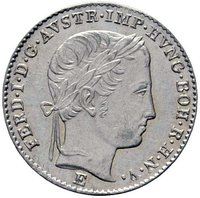
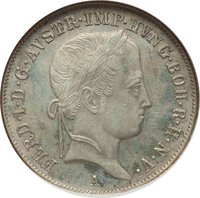
Obverse
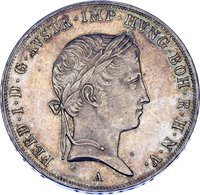
Description:
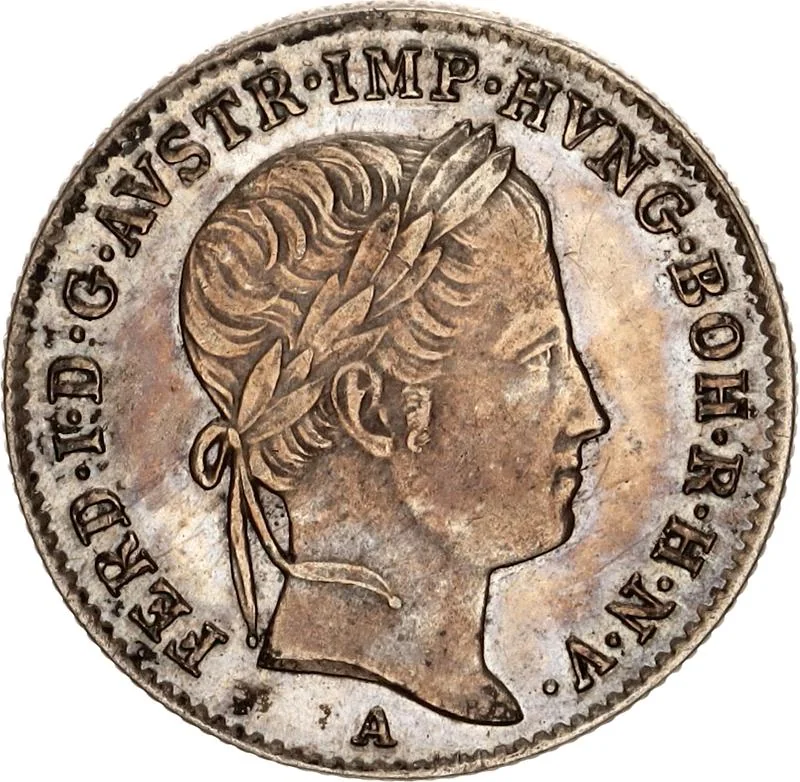
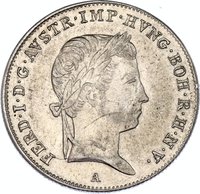
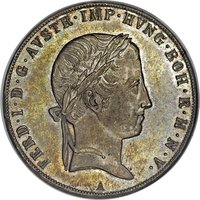
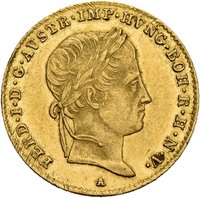
Portrait of Emperor Ferdinand I of Austria facing right, with the legend: "Ferdinand I Dei Gratia Austriae Imperator Hungariae Bohemiae Rex Hujus Nominis Quintus."
Inscription:
FERD I D G AVST IMP HVNG BOH R H N V
Translation:
FERDINANDUS I DEI GRATIA AUGUSTUS IMPERATOR HUNGARIAE BOHEMIAE REX ARCHIDUX AUSTRIAE
Script: Latin
Language: Latin
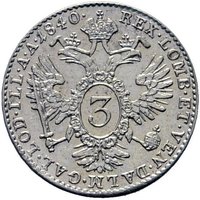
Reverse
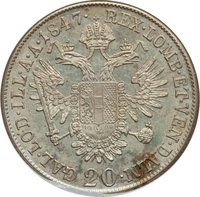
Description:
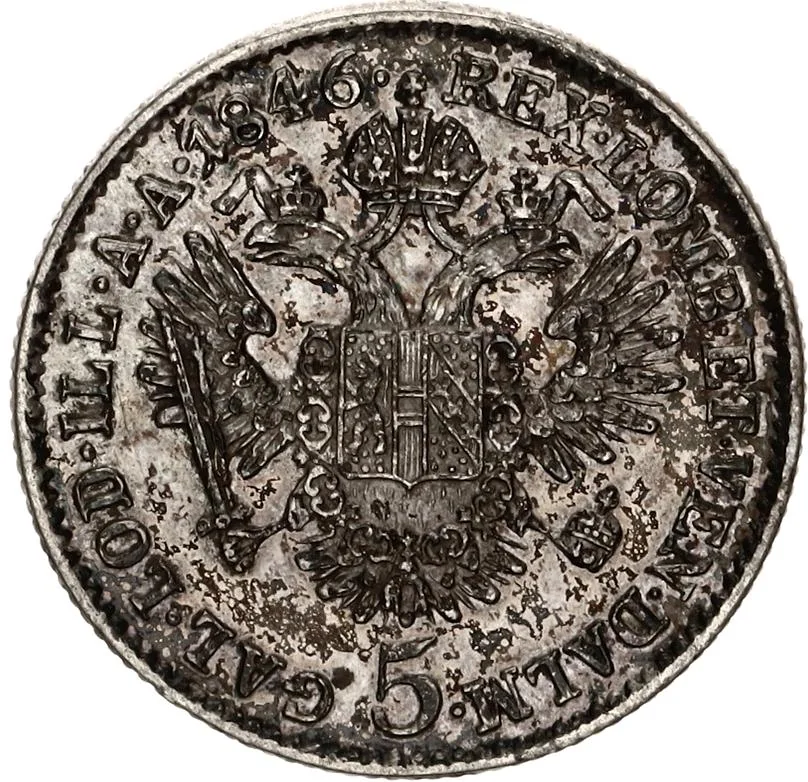
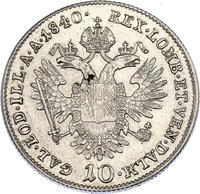
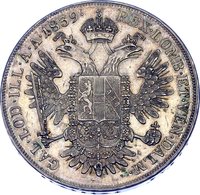
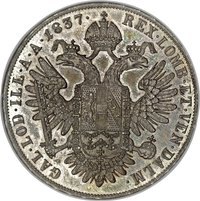
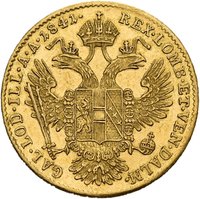
Imperial double-headed eagle with sword, sceptre, and orb, bearing a shield of Habsburg, Austria, and Lorraine on its breast, encircled by the Golden Fleece collar. Value below. Legend (from 1h): "Rex Lombardiae et Venetiae, Dalmatiae, Galiciae Lodomeriae Ilyriae Archidux Austriae".
Inscription:
REX LOMB ET VEN DALM GAL LOD ILL A A 1838
Translation:
King of Lombardy and Venice, Dalmatia, Galicia, Lodomeria, Illyria, etc. 1838
Script: Latin
Language: Latin
Edge
Reeded
Mints
| Name | Mark |
|---|---|
| Münze Österreich | A |
| Kremnica | B |
| Prague | C |
Mintings
Historical background
In 1837, the Austrian Empire’s currency situation was characterized by a state of controlled instability, operating under the Conventionsthaler (Konventionsthaler) system established in 1753. This system was based on a silver standard, defining the Conventionsthaler as a specific weight of fine silver. However, decades of state financial pressure, particularly from the Napoleonic Wars, had led to the chronic issuance of paper money (Bancozettel) not fully backed by silver. By 1837, this resulted in a persistent dual-currency system: a depreciated paper currency used for everyday transactions and a more valuable silver currency for international trade and large contracts, with an unstable exchange rate between them.
The government, under Minister of Finance Count Karl von Kübeck, was in the midst of a long-term stabilization effort. A key step had been the establishment of the Privileged Austrian National Bank (Österreichische Nationalbank) in 1816, tasked with restoring currency value. Its primary tool was the introduction of a new, credible silver-backed paper currency called Einlösungsscheine (redemption notes), which circulated alongside the old Bancozettel. By 1837, this process was ongoing but incomplete; the goal was to gradually withdraw the discredited old paper money and unify the monetary system on a sounder basis, though public confidence remained fragile.
Consequently, the economic landscape in 1837 was one of transition and complexity. Businesses and individuals had to navigate the values of multiple concurrent forms of money, which created uncertainty for commerce and planning. The empire’s diverse lands, from the industrializing Austrian and Bohemian crownlands to the more agrarian Hungarian territories, felt these pressures unevenly. While Kübeck’s policies were slowly steering the empire toward the Vienna Currency (Wiener Währung) reform fully implemented in the 1850s, the currency situation in 1837 remained a tangible legacy of past fiscal crises and a significant challenge to the empire’s economic modernization.
The government, under Minister of Finance Count Karl von Kübeck, was in the midst of a long-term stabilization effort. A key step had been the establishment of the Privileged Austrian National Bank (Österreichische Nationalbank) in 1816, tasked with restoring currency value. Its primary tool was the introduction of a new, credible silver-backed paper currency called Einlösungsscheine (redemption notes), which circulated alongside the old Bancozettel. By 1837, this process was ongoing but incomplete; the goal was to gradually withdraw the discredited old paper money and unify the monetary system on a sounder basis, though public confidence remained fragile.
Consequently, the economic landscape in 1837 was one of transition and complexity. Businesses and individuals had to navigate the values of multiple concurrent forms of money, which created uncertainty for commerce and planning. The empire’s diverse lands, from the industrializing Austrian and Bohemian crownlands to the more agrarian Hungarian territories, felt these pressures unevenly. While Kübeck’s policies were slowly steering the empire toward the Vienna Currency (Wiener Währung) reform fully implemented in the 1850s, the currency situation in 1837 remained a tangible legacy of past fiscal crises and a significant challenge to the empire’s economic modernization.
🌟 Uncommon