

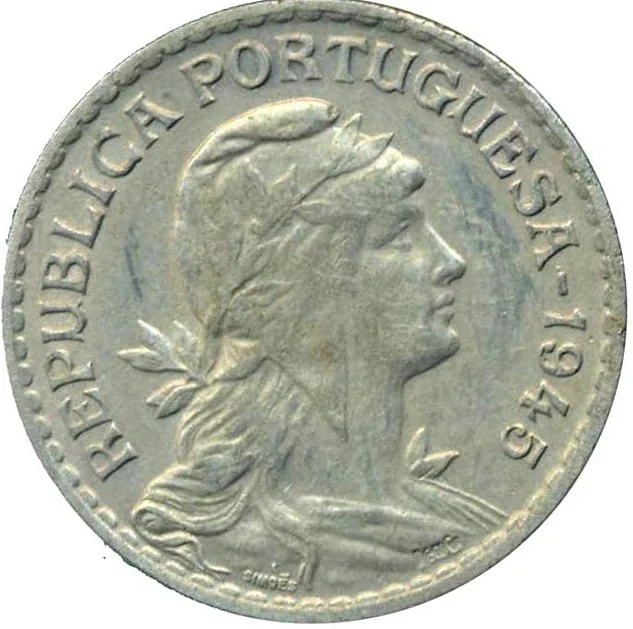
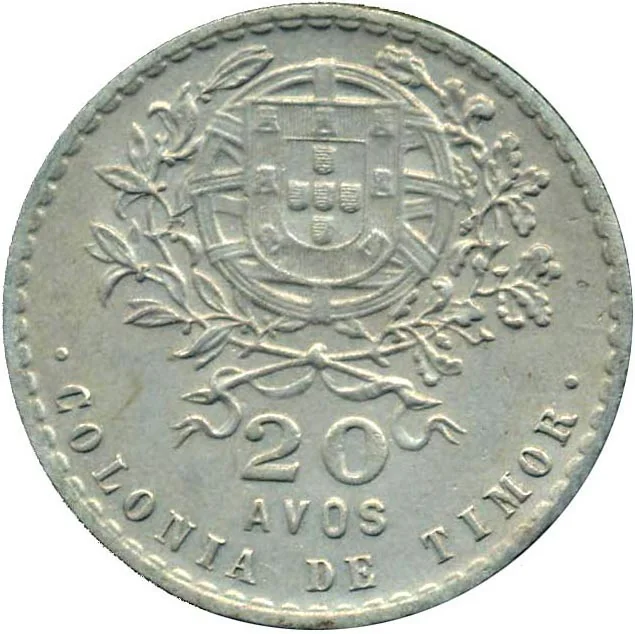
20 avos – Portuguese Timor
Add to wishlist
Timor-Leste
Context
Year: 1945
Country: Timor-Leste
Issuer: Portuguese Timor
Period:
(1910—1951)
Currency:
(1894—1959)
Demonetized: Yes
Total mintage: 50,000
Material
Diameter: 26.8 mm
Weight: 8 g
Shape: Round
Composition: Nickel brass
Magnetic: No
Technique: Milled
Alignment: Coin alignment
flip
References
KM: #
Numista: #33589
Obverse
Inscription:
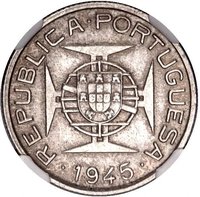
REPUBLICA PORTUGUESA
1945
1945
Translation:
PORTUGUESE REPUBLIC
1945
1945
Script: Latin
Language: Portuguese
Reverse
Inscription:
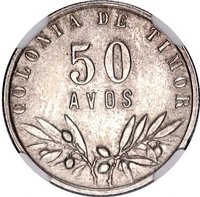
20 AVOS
.COLONIA DE TIMOR.
.COLONIA DE TIMOR.
Translation:
Twenty Avos. Colony of Timor.
Script: Latin
Languages: Portuguese, Latin
Edge
Reeded
Mints
| Name | Mark |
|---|---|
| Imprensa Nacional - Casa da Moeda | — |
Mintings
| Year | Mint Mark | Mintage | Quality | Collection |
|---|---|---|---|---|
| 1945 | — | 50,000 |
Historical background
In 1945, Portuguese Timor (present-day Timor-Leste) was emerging from a devastating and unique wartime occupation. Unlike other Portuguese territories, it had been invaded and jointly occupied by Allied (Australian and Dutch) and Japanese forces from 1942 to 1945, leading to fierce fighting, famine, and significant destruction of infrastructure. This conflict severely disrupted the colonial economy and its existing monetary system, which was based on the Portuguese Timor Pataca. The Pataca was pegged to, and often circulated alongside, the Portuguese Escudo, but the war had severed normal trade and administrative links with Lisbon.
The immediate post-war currency situation was one of dislocation and transition. During the occupation, Japanese occupation currency (the "Japanese Gulden") had been forcibly introduced, but it became worthless after Japan's surrender. The returning Portuguese administration, led by Governor Óscar Ruas, faced the urgent task of reasserting monetary control and stabilizing the economy amidst widespread scarcity. The primary solution was to reintroduce the Portuguese Escudo as the official currency, aiming to reintegrate the colony into Portugal's financial sphere and facilitate reconstruction aid.
However, the escudo's establishment was not instantaneous or seamless. The physical shortage of currency notes and coins was a major problem, compounded by the territory's ruined transportation and communication networks. Barter remained common in many areas. Furthermore, the Australian military, which assisted in the interim period, likely used Australian pounds, adding another temporary currency to the mix. Thus, 1945 was a year of monetary flux, defined by the Portuguese colonial government's struggle to replace worthless occupation notes with a stable, legitimate currency while grappling with the profound economic scars of war.
The immediate post-war currency situation was one of dislocation and transition. During the occupation, Japanese occupation currency (the "Japanese Gulden") had been forcibly introduced, but it became worthless after Japan's surrender. The returning Portuguese administration, led by Governor Óscar Ruas, faced the urgent task of reasserting monetary control and stabilizing the economy amidst widespread scarcity. The primary solution was to reintroduce the Portuguese Escudo as the official currency, aiming to reintegrate the colony into Portugal's financial sphere and facilitate reconstruction aid.
However, the escudo's establishment was not instantaneous or seamless. The physical shortage of currency notes and coins was a major problem, compounded by the territory's ruined transportation and communication networks. Barter remained common in many areas. Furthermore, the Australian military, which assisted in the interim period, likely used Australian pounds, adding another temporary currency to the mix. Thus, 1945 was a year of monetary flux, defined by the Portuguese colonial government's struggle to replace worthless occupation notes with a stable, legitimate currency while grappling with the profound economic scars of war.
⭐ Somewhat Rare