

1 Peso – Dominican Republic
Dominican Republic
Context
Years: 1939–1952
Issuer: Dominican Republic 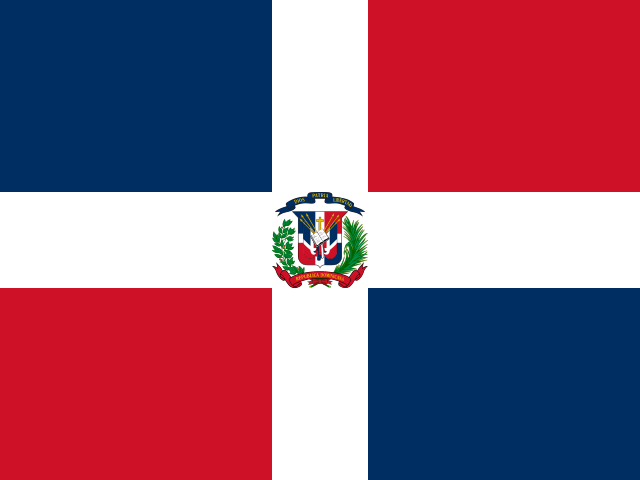
Period:
(1922—1965)
Currency:
(since 1937)
Total mintage: 35,000
Material
References
KM: #Click to copy to clipboard22
Numista: #33153
Value
Exchange value: 1 DOP
Bullion value: $69.28
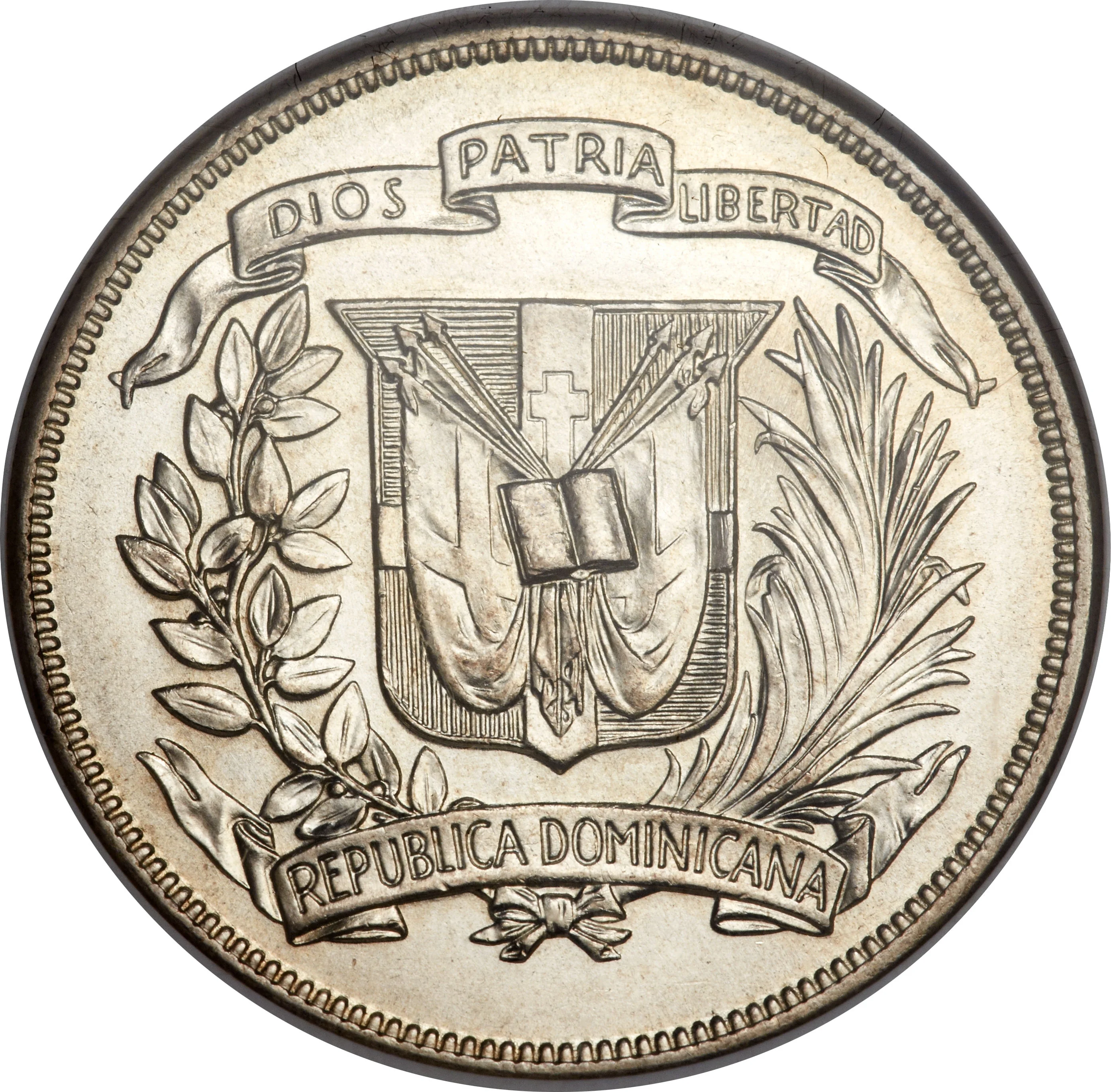
Obverse
Description:
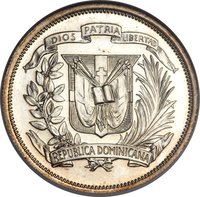
Heraldic emblem
Inscription:
DIOS PATRIA LIBERTAD
REPUBLICA DOMINICANA
REPUBLICA DOMINICANA
Translation:
God, Fatherland, Liberty
Dominican Republic
Dominican Republic
Script: Latin
Language: Spanish
Engraver: Casimiro Nemesio de Moya
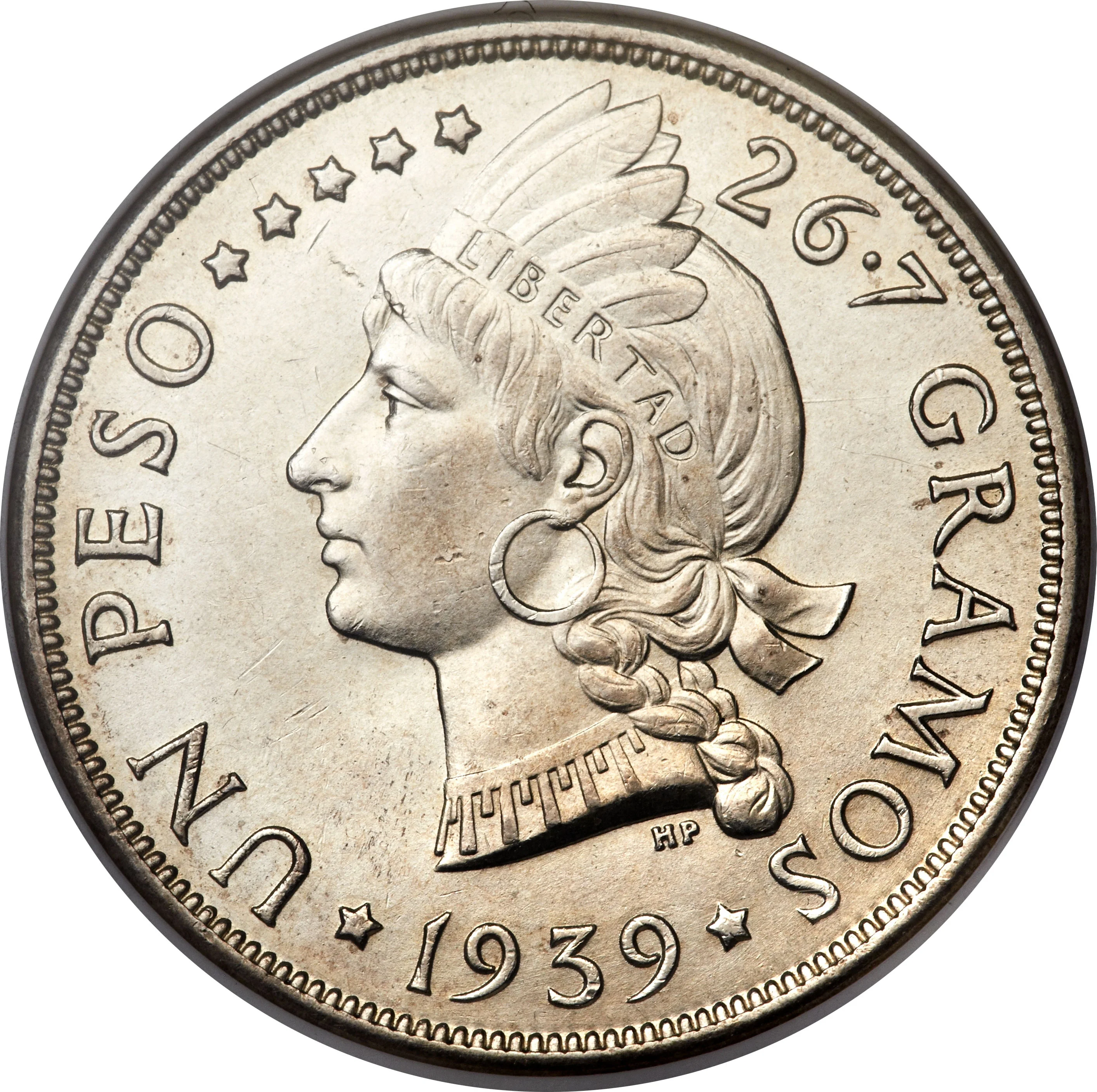
Reverse
Description:
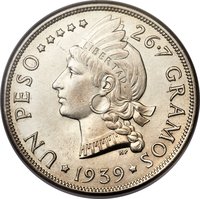
Indian "Liberty" head left. Denomination, weight, year.
Inscription:
UN PESO
26.7 GRAMOS
26.7 GRAMOS
Translation:
One Peso
26.7 Grams
26.7 Grams
Script: Latin
Language: Spanish
Engraver: Thomas Humphrey Paget
Edge
Reeded
Categories
| Symbols> Coat of Arms |
| Symbol> Allegory |
Mints
| Name | Mark |
|---|---|
| United States Mint of Philadelphia | — |
Mintings
| Year | Mint Mark | Mintage | Quality | Collection |
|---|---|---|---|---|
| 1939 | — | 15,000 | ||
| 1939 | — | — | Proof | |
| 1952 | — | 20,000 |
Historical background
In 1939, the Dominican Republic's currency system was characterized by a period of relative stability under the authoritarian rule of Rafael Trujillo, but it was a stability built upon a foundation of strict control and isolation from global financial turbulence. The official currency was the Dominican peso (DOP), which was pegged to the US dollar at a fixed rate of 1:1. This peg, established in 1905 during the country's financial receivership under the US, provided a crucial anchor for trade and investment, primarily with the United States, which dominated the Dominican economy. The National Bank (Banco Nacional), effectively an instrument of the Trujillo regime, managed the currency and held substantial gold and dollar reserves to back the peso, ensuring its convertibility.
However, this formal stability masked underlying economic realities. The Dominican economy was overwhelmingly agrarian, dependent on sugar, cocoa, and coffee exports, with profits heavily concentrated in the hands of the Trujillo family and its associates. While the official exchange rate was fixed, the regime maintained strict capital controls and a complex system of import licenses. This bureaucratic apparatus served to conserve foreign exchange, protect the peg, and allow the state to direct economic activity for its own benefit. Furthermore, the global context of the late 1930s—the aftermath of the Great Depression and the onset of World War II in Europe—created external pressures, disrupting traditional trade patterns and commodity prices.
Consequently, 1939 represents a point of artificial calm before significant change. The fixed parity with the dollar provided a veneer of solidity, but the system's resilience was untested by the coming global upheaval. The outbreak of World War II would soon place new strains on the economy, leading to inflationary pressures and shortages in the early 1940s that would eventually force the government to abandon the gold standard and adjust its monetary policies, though always within the tight framework of Trujillo's centralized control.
However, this formal stability masked underlying economic realities. The Dominican economy was overwhelmingly agrarian, dependent on sugar, cocoa, and coffee exports, with profits heavily concentrated in the hands of the Trujillo family and its associates. While the official exchange rate was fixed, the regime maintained strict capital controls and a complex system of import licenses. This bureaucratic apparatus served to conserve foreign exchange, protect the peg, and allow the state to direct economic activity for its own benefit. Furthermore, the global context of the late 1930s—the aftermath of the Great Depression and the onset of World War II in Europe—created external pressures, disrupting traditional trade patterns and commodity prices.
Consequently, 1939 represents a point of artificial calm before significant change. The fixed parity with the dollar provided a veneer of solidity, but the system's resilience was untested by the coming global upheaval. The outbreak of World War II would soon place new strains on the economy, leading to inflationary pressures and shortages in the early 1940s that would eventually force the government to abandon the gold standard and adjust its monetary policies, though always within the tight framework of Trujillo's centralized control.
🌟 Limited