

5 Centavos – Dominican Republic
Dominican Republic
Context
Year: 1944
Issuer: Dominican Republic 
Period:
(1922—1965)
Currency:
(since 1937)
Total mintage: 2,000,000
Material
References
KM: #Click to copy to clipboard18a
Numista: #15458
Value
Exchange value: 0.05 DOP
Obverse
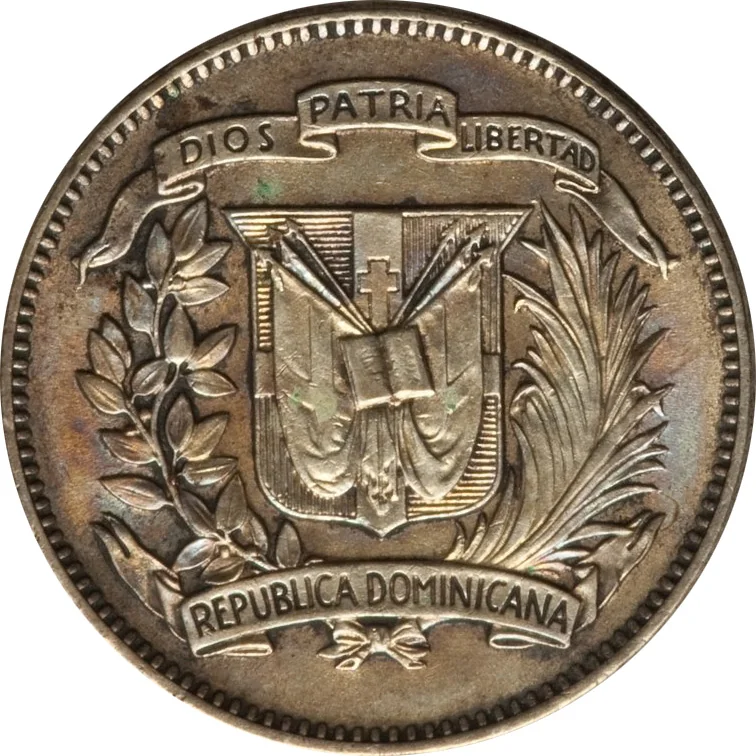
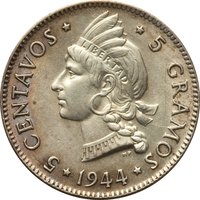
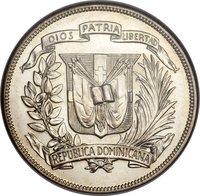
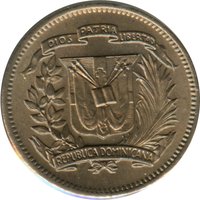
Description:
Heraldic emblem
Inscription:
DIOS PATRIA LIBERTAD
REPUBLICA DOMINICANA
REPUBLICA DOMINICANA
Translation:
God, Fatherland, Liberty
Dominican Republic
Dominican Republic
Script: Latin
Language: Spanish
Engraver: Casimiro Nemesio de Moya
Reverse
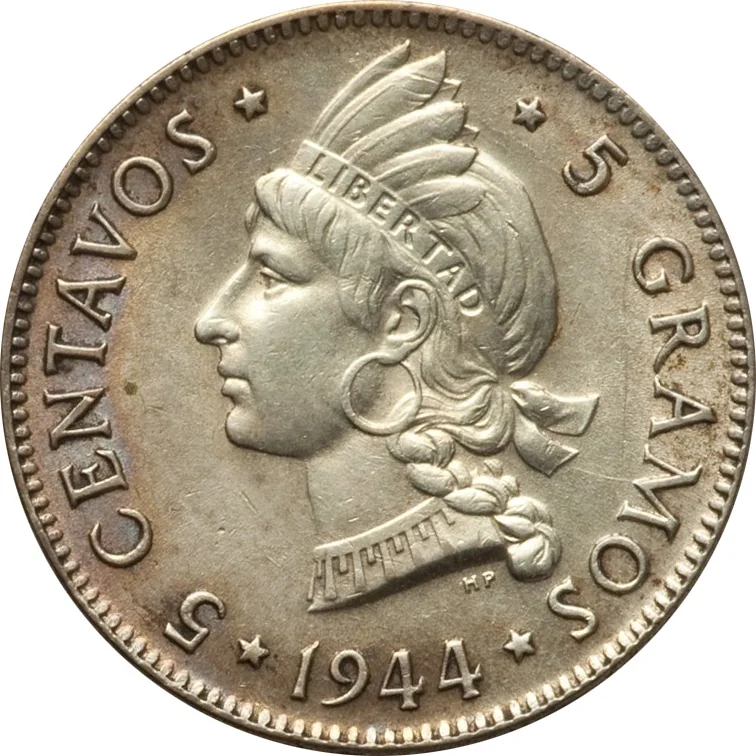
Description:
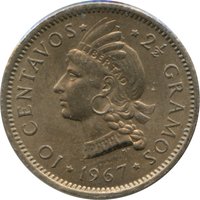
Indian "Liberty" head left. Denomination, weight, year.
Inscription:
* 5 CENTAVOS *
* 5 GRAMOS *
LIBERTAD
* 5 GRAMOS *
LIBERTAD
Translation:
5 CENTAVOS
5 GRAMS
LIBERTY
5 GRAMS
LIBERTY
Script: Latin
Language: Spanish
Engraver: Thomas Humphrey Paget
Edge
Plain
Categories
| Symbol> Allegory |
| Symbols> Coat of Arms |
Mints
| Name | Mark |
|---|---|
| United States Mint of Philadelphia | — |
Mintings
| Year | Mint Mark | Mintage | Quality | Collection |
|---|---|---|---|---|
| 1944 | — | 2,000,000 |
Historical background
In 1944, the Dominican Republic's currency situation was defined by the enduring legacy of the Peso Oro, a currency established in 1937 under the authoritarian rule of Rafael Trujillo. This monetary reform was a central pillar of Trujillo's drive for national economic sovereignty and control, replacing the fragmented system of notes issued by private banks and the U.S. dollar, which had circulated widely. The Peso Oro was nominally backed by and convertible to gold, though in practice its stability was heavily managed by the state. This move consolidated monetary authority entirely within the Trujillo-controlled Central Bank, founded in 1947 but prepared for during this period, which allowed the regime to direct credit and finance its own projects.
The year 1944 fell within the economic boom of the Second World War, which provided a temporary shield for the peso. High global prices for the country's primary exports—sugar, cocoa, and coffee—generated substantial foreign exchange reserves, particularly in U.S. dollars. This influx helped maintain the peso's official parity and provided the Trujillo regime with the hard currency needed for imports and to service foreign debt. Consequently, while many global currencies were under severe stress, the Dominican peso enjoyed a period of relative external stability and artificial strength, underpinned by favorable trade balances rather than purely by its gold backing.
However, this apparent stability was superficial and tightly controlled. The regime maintained a strict system of exchange controls, determining access to foreign currency and effectively insulating the official exchange rate from market pressures. This control allowed Trujillo's government to allocate resources to its favored industries and the personal enterprises of the ruling elite, but it also fostered a nascent black market for dollars. Thus, in 1944, the currency situation reflected a duality: a facade of robust, gold-backed monetary order presented to the world, while internally it functioned as a tool of economic centralization and political power for the Trujillo dictatorship.
The year 1944 fell within the economic boom of the Second World War, which provided a temporary shield for the peso. High global prices for the country's primary exports—sugar, cocoa, and coffee—generated substantial foreign exchange reserves, particularly in U.S. dollars. This influx helped maintain the peso's official parity and provided the Trujillo regime with the hard currency needed for imports and to service foreign debt. Consequently, while many global currencies were under severe stress, the Dominican peso enjoyed a period of relative external stability and artificial strength, underpinned by favorable trade balances rather than purely by its gold backing.
However, this apparent stability was superficial and tightly controlled. The regime maintained a strict system of exchange controls, determining access to foreign currency and effectively insulating the official exchange rate from market pressures. This control allowed Trujillo's government to allocate resources to its favored industries and the personal enterprises of the ruling elite, but it also fostered a nascent black market for dollars. Thus, in 1944, the currency situation reflected a duality: a facade of robust, gold-backed monetary order presented to the world, while internally it functioned as a tool of economic centralization and political power for the Trujillo dictatorship.
🌟 Uncommon