

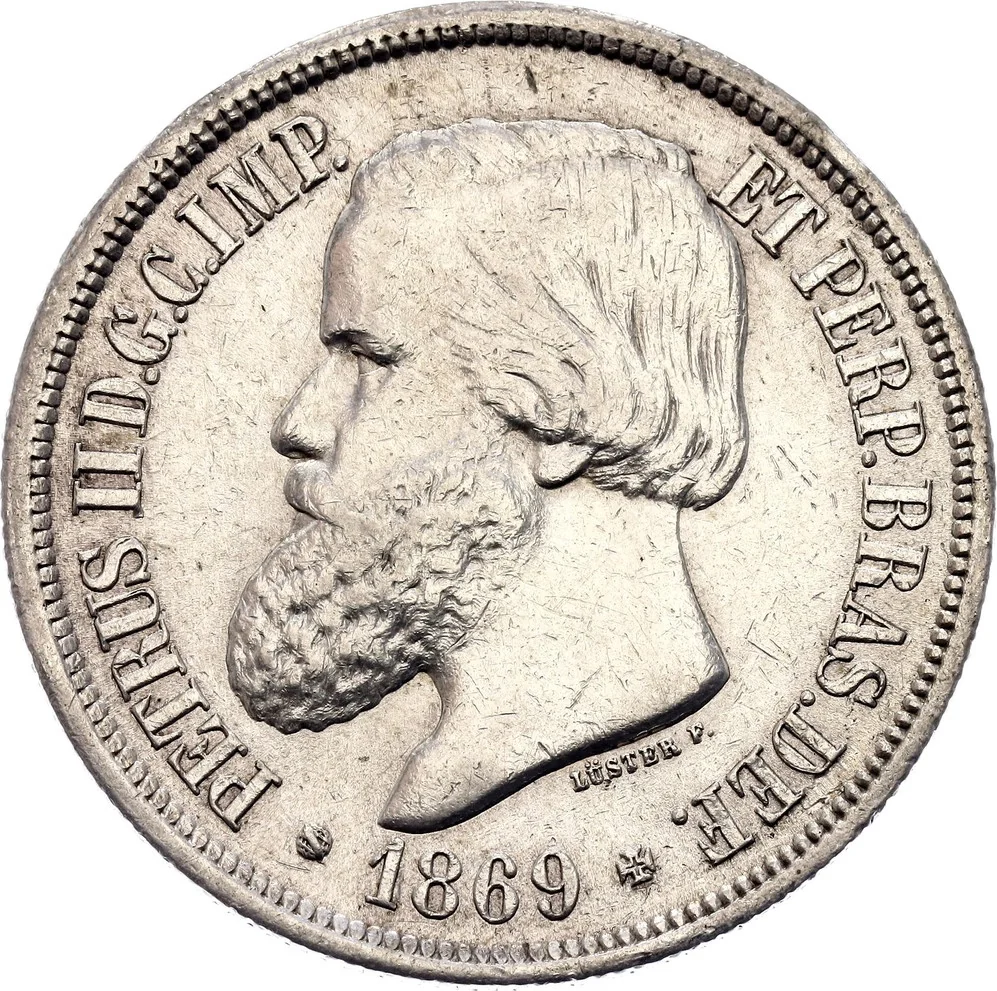

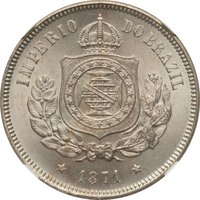
Obverse
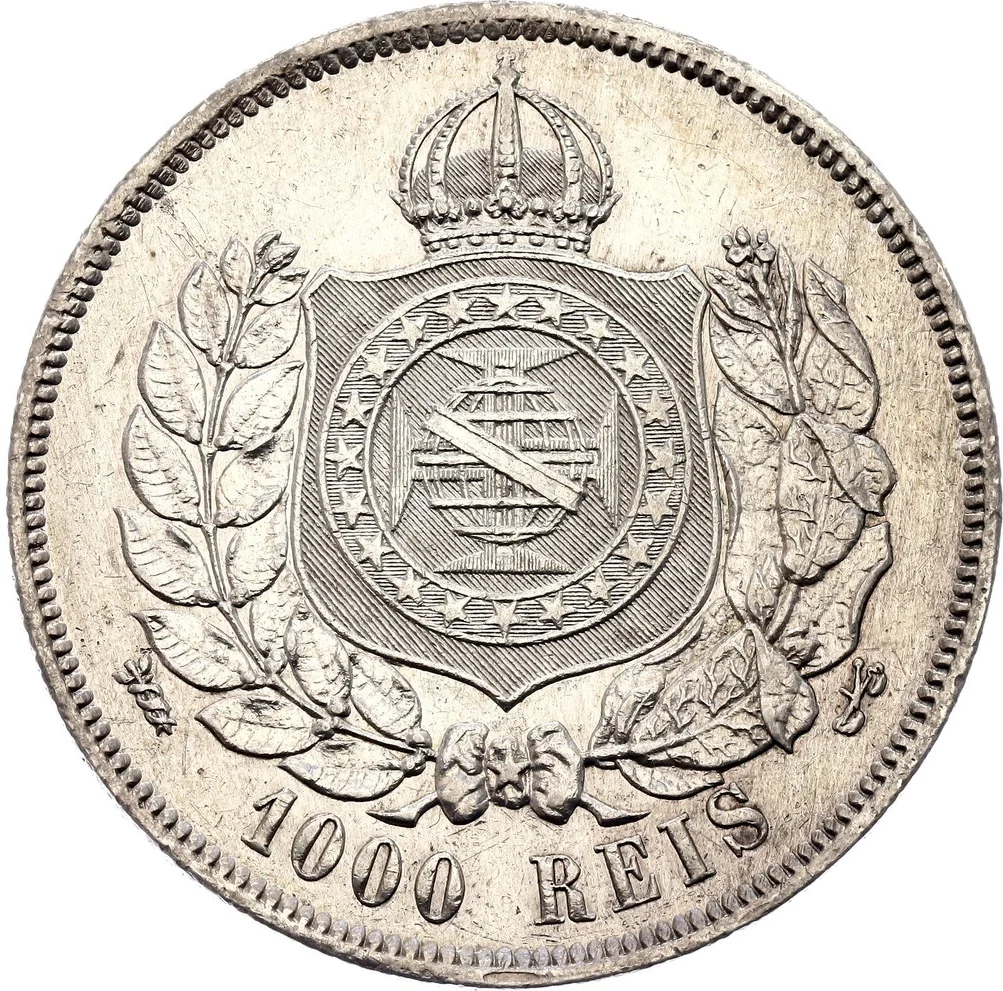
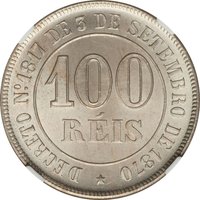
Reverse
Edge
Reeded
Mints
| Name | Mark |
|---|---|
| Casa da Moeda do Brasil | — |
Mintings
| Year | Mint Mark | Mintage | Quality | Collection |
|---|---|---|---|---|
| 1869 | — | — |
Historical background
In 1869, Brazil's currency situation was characterized by significant instability and complexity, rooted in the legacy of the Empire's financial policies. The monetary system operated on a bimetallic standard in law, but in practice, it was dominated by a heavily depreciated paper currency. The primary unit was the mil-réis, but its value was severely undermined by the excessive issuance of treasury notes (papel-moeda) to cover government deficits, particularly those incurred during the costly Paraguayan War (1864-1870). This war, still raging in 1869, placed an enormous fiscal burden on the state, leading to rampant inflation and a wide gap between the value of gold-backed currency and the fluctuating paper money.
The result was a pronounced dual circulation: gold coins and sound commercial bills were used for foreign trade and large transactions, while the depreciated paper notes circulated domestically, eroding purchasing power. The exchange rate against the British pound sterling was volatile and unfavorable, hampering international commerce. Furthermore, regional disparities existed, with coffee-rich provinces like São Paulo enjoying stronger financial conditions due to export revenues, while other areas suffered more acutely from the inflationary pressure. This environment created uncertainty for merchants, planters, and the government alike, complicating economic planning and debt repayment.
Recognizing the crisis, discussions on monetary reform were already underway within political and intellectual circles by 1869. These debates would culminate in the 1870s with the policies of Finance Minister Visconde de Itaboraí, who began the difficult process of stabilizing the currency. However, in the immediate context of 1869, the financial landscape remained one of inflationary pressure, fiscal strain from the ongoing war, and a fragmented currency system that reflected the broader challenges of modernizing the Brazilian economy during the Empire's latter decades.
The result was a pronounced dual circulation: gold coins and sound commercial bills were used for foreign trade and large transactions, while the depreciated paper notes circulated domestically, eroding purchasing power. The exchange rate against the British pound sterling was volatile and unfavorable, hampering international commerce. Furthermore, regional disparities existed, with coffee-rich provinces like São Paulo enjoying stronger financial conditions due to export revenues, while other areas suffered more acutely from the inflationary pressure. This environment created uncertainty for merchants, planters, and the government alike, complicating economic planning and debt repayment.
Recognizing the crisis, discussions on monetary reform were already underway within political and intellectual circles by 1869. These debates would culminate in the 1870s with the policies of Finance Minister Visconde de Itaboraí, who began the difficult process of stabilizing the currency. However, in the immediate context of 1869, the financial landscape remained one of inflationary pressure, fiscal strain from the ongoing war, and a fragmented currency system that reflected the broader challenges of modernizing the Brazilian economy during the Empire's latter decades.
🌟 Limited