

10 Centimes – Tunisia
Tunisia
Context

Material
Diameter: 21 mm
Weight: 4 g
Thickness: 1.5 mm
Shape: Round with a round hole
Composition: Nickel brass
Magnetic: No
Technique: Milled
Alignment: Coin alignment
flip
References
KM: #Click to copy to clipboard243
Numista: #3299
Value
Exchange value: 0.10 TNF
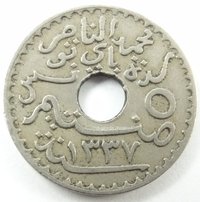
Obverse
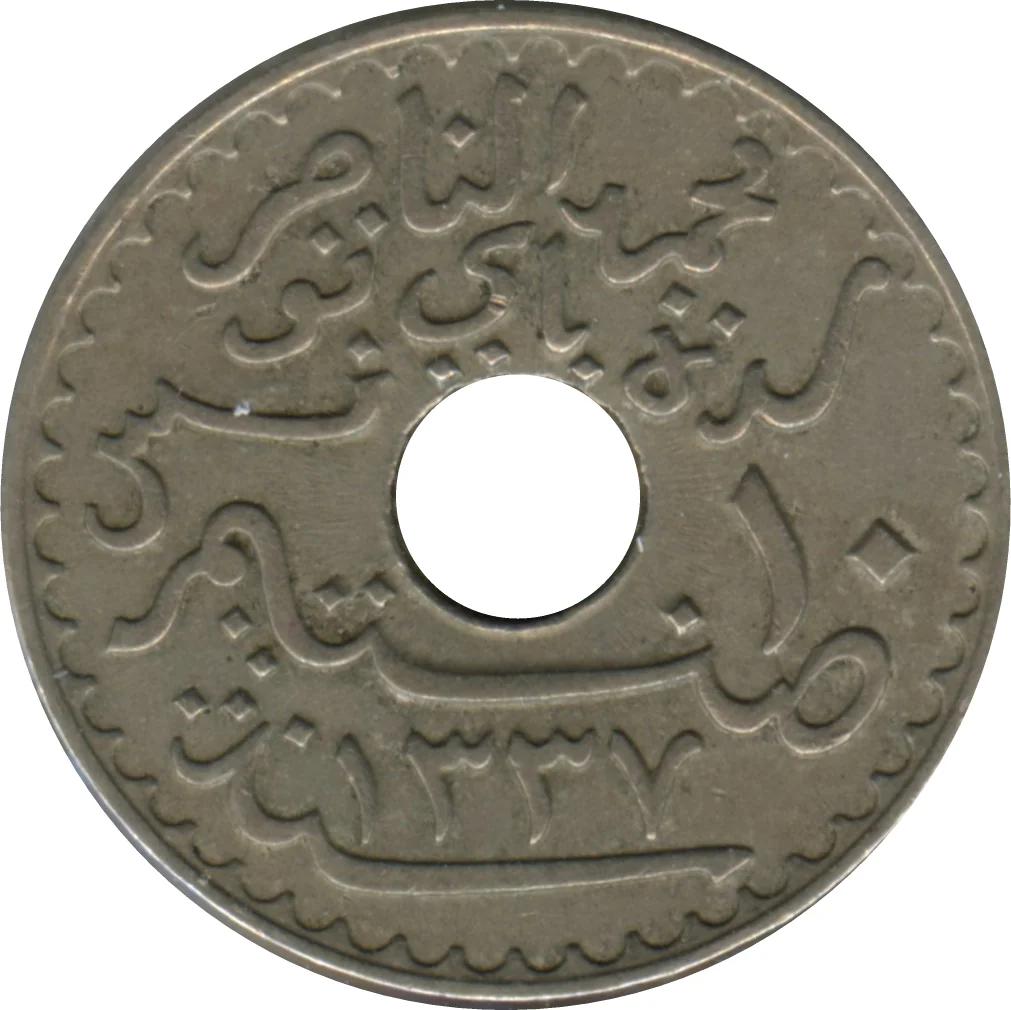
Description:
Inscription with central hole.
Inscription:
محمد الناصر
مدة باي تونس
١٠
صنتيم
١٣٣٧
سنة
مدة باي تونس
١٠
صنتيم
١٣٣٧
سنة
Translation:
Muhammad al-Nasir
Medina of Tunis
10
Centimes
1337
Year
Medina of Tunis
10
Centimes
1337
Year
Script: Arabic
Language: Arabic
Engraver: Henri-Auguste Patey
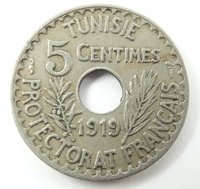
Reverse
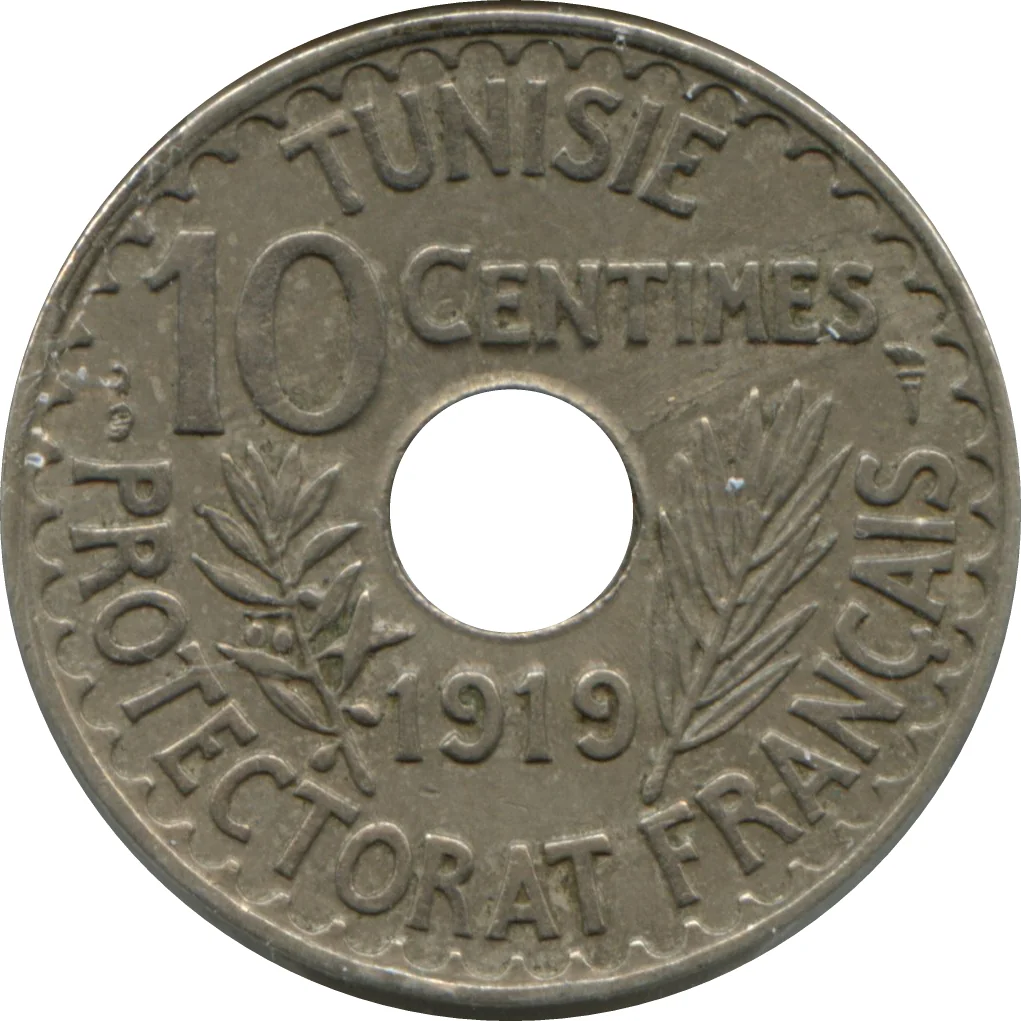
Description:
Value over hole, date, sprigs.
Inscription:
TUNISIE
10 CENTIMES
PROTECTORAT FRANÇAIS
1919
10 CENTIMES
PROTECTORAT FRANÇAIS
1919
Translation:
TUNISIA
10 CENTIMES
FRENCH PROTECTORATE
1919
10 CENTIMES
FRENCH PROTECTORATE
1919
Script: Latin
Language: French
Engraver: Henri-Auguste Patey
Edge
Plain
Mints
| Name | Mark |
|---|---|
| Monnaie de Paris | — |
Mintings
| Year | Mint Mark | Mintage | Quality | Collection |
|---|---|---|---|---|
| 1918 | — | 1,287,507 | ||
| 1919 | — | 2,712,493 | ||
| 1920 | — | 3,000,000 |
Historical background
In 1918, Tunisia's currency situation was a complex legacy of its status as a French protectorate, established in 1881. The monetary system was officially bimetallic, based on both gold and silver, but was effectively dominated by the French franc. The Banque de l'Algérie, which had the right of note issue for Algeria and Tunisia, circulated its Algerian franc notes and coins within the protectorate. This created a de facto currency union with France and its Algerian territory, anchoring Tunisia's economy to the French metropolitan system and facilitating colonial trade and fiscal control.
However, the global context of World War I (1914-1918) profoundly disrupted this arrangement. To finance the war effort, France and the Banque de l'Algérie suspended gold convertibility and significantly increased the issuance of paper money, leading to inflationary pressures. These effects were directly transmitted to Tunisia, causing a decline in the purchasing power of the circulating franc and contributing to economic hardship and rising prices for basic goods. The situation was further complicated by the continued, though diminishing, circulation of older Ottoman and local metallic coins in some sectors, reflecting the incomplete transition to a fully unified colonial currency.
Consequently, by the armistice of 1918, Tunisia's currency was in a state of inflationary flux, entirely tied to a franc that was itself weakened. The system served French administrative and commercial interests but was strained by wartime fiscal policies. This instability set the stage for the monetary reforms of the 1920s, which would more firmly cement the French franc as the sole legal tender and further integrate Tunisia into France's economic orbit, solidifying the financial instruments of colonial rule in the post-war period.
However, the global context of World War I (1914-1918) profoundly disrupted this arrangement. To finance the war effort, France and the Banque de l'Algérie suspended gold convertibility and significantly increased the issuance of paper money, leading to inflationary pressures. These effects were directly transmitted to Tunisia, causing a decline in the purchasing power of the circulating franc and contributing to economic hardship and rising prices for basic goods. The situation was further complicated by the continued, though diminishing, circulation of older Ottoman and local metallic coins in some sectors, reflecting the incomplete transition to a fully unified colonial currency.
Consequently, by the armistice of 1918, Tunisia's currency was in a state of inflationary flux, entirely tied to a franc that was itself weakened. The system served French administrative and commercial interests but was strained by wartime fiscal policies. This instability set the stage for the monetary reforms of the 1920s, which would more firmly cement the French franc as the sole legal tender and further integrate Tunisia into France's economic orbit, solidifying the financial instruments of colonial rule in the post-war period.
Series: 1918 Tunisia circulation coins
🌱 Very Common