

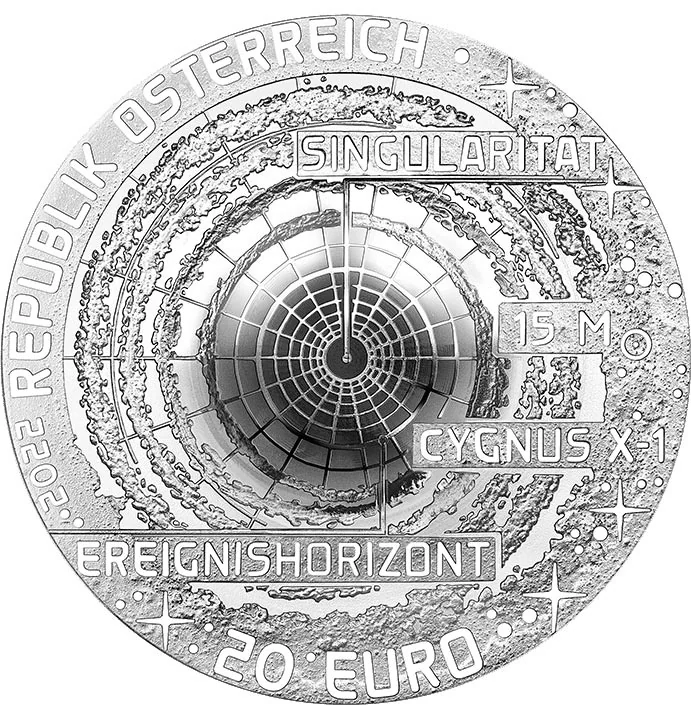

Obverse
Inscription:
REPUBLIK ÖSTERREICH
2022
20 EURO
SINGULARITÄT
15 M
CYGNUS X-1
EREIGNISHORIZONT
2022
20 EURO
SINGULARITÄT
15 M
CYGNUS X-1
EREIGNISHORIZONT
Translation:
REPUBLIC OF AUSTRIA
2022
20 EURO
SINGULARITY
15 M
CYGNUS X-1
EVENT HORIZON
2022
20 EURO
SINGULARITY
15 M
CYGNUS X-1
EVENT HORIZON
Script: Latin
Designer: Helmut Andexlinger
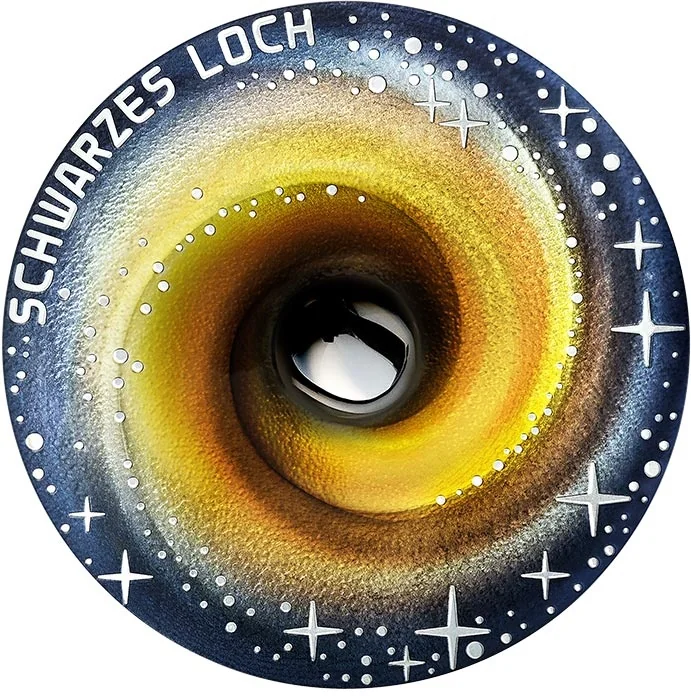
Reverse
Inscription:
SCHWARZES LOCH
Translation:
Black Hole
Script: Latin
Language: German
Designer: Helmut Andexlinger
Edge
Categories
| Space |
Mints
| Name | Mark |
|---|---|
| Münze Österreich | — |
Mintings
| Year | Mint Mark | Mintage | Quality | Collection |
|---|---|---|---|---|
| 2022 | — | 30,000 | Proof |
Historical background
In 2022, Austria, as a member of the Eurozone, navigated a complex currency environment defined by the monetary policy of the European Central Bank (ECB). The primary concern was soaring inflation, which reached a multi-decade high of 8.6% for the year, driven by surging energy prices and supply chain disruptions exacerbated by the war in Ukraine. This inflationary pressure significantly eroded the purchasing power of the euro within Austria, leading to a cost-of-living crisis and intense public debate over wage increases and government support measures.
The euro itself faced significant headwinds in foreign exchange markets during much of 2022. As the ECB initially lagged behind other major central banks, notably the U.S. Federal Reserve, in raising interest rates, the euro depreciated sharply against the US dollar, falling to parity and even below it at times. This depreciation made Austria's critical energy imports—largely priced in dollars—even more expensive, further fueling inflation. However, the currency's weakness provided some offsetting support for Austrian export-oriented industries, a vital pillar of the national economy.
Domestically, there was no discussion of leaving the euro or establishing a national currency, as the euro enjoyed broad public support. The Austrian National Bank (OeNB), operating within the ECB's framework, focused on implementing the transition to higher interest rates initiated in July to combat inflation. The year's currency situation was therefore characterized by the challenges of a shared monetary policy, where Austria's economic stability was directly tied to the ECB's balancing act between controlling inflation and managing a slowing European economy amid geopolitical turmoil.
The euro itself faced significant headwinds in foreign exchange markets during much of 2022. As the ECB initially lagged behind other major central banks, notably the U.S. Federal Reserve, in raising interest rates, the euro depreciated sharply against the US dollar, falling to parity and even below it at times. This depreciation made Austria's critical energy imports—largely priced in dollars—even more expensive, further fueling inflation. However, the currency's weakness provided some offsetting support for Austrian export-oriented industries, a vital pillar of the national economy.
Domestically, there was no discussion of leaving the euro or establishing a national currency, as the euro enjoyed broad public support. The Austrian National Bank (OeNB), operating within the ECB's framework, focused on implementing the transition to higher interest rates initiated in July to combat inflation. The year's currency situation was therefore characterized by the challenges of a shared monetary policy, where Austria's economic stability was directly tied to the ECB's balancing act between controlling inflation and managing a slowing European economy amid geopolitical turmoil.




⭐ Rare