

10 Zlotys – Poland
Poland
Context
Years: 1975–1984
Issuer: Poland 
Period:
(1952—1989)
Currency:
(1949—1994)
Demonetization: 1 January 1995
Total mintage: 136,324,606
Material
Diameter: 25 mm
Weight: 7.7 g
Thickness: 2 mm
Shape: Round
Composition: Copper-nickel
Standard: Silver quarter ounce
Technique: Milled
Alignment: Medal alignment
flip
References
Y: #Click to copy to clipboard73
Numista: #3283
Value
Exchange value: 10 PLZ
Inflation-adjusted value: 72152.74 PLZ
Obverse
Description:
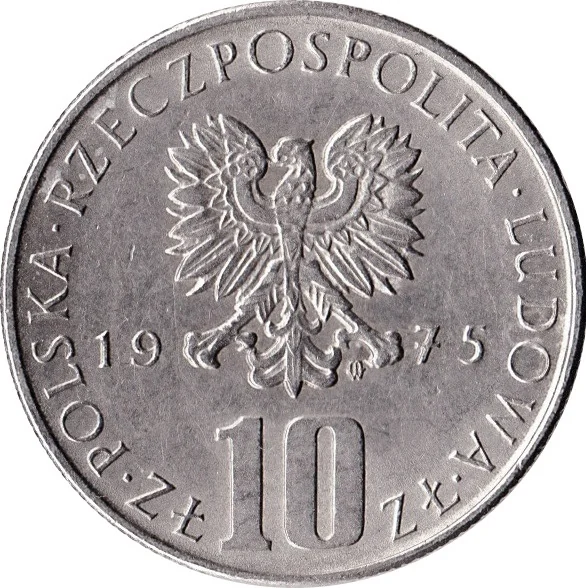
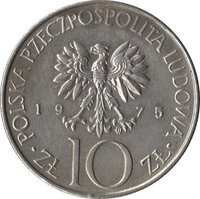
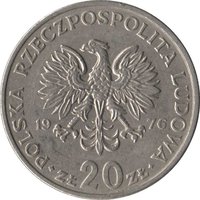
Polish White Eagle, date and value below.
Inscription:
POLSKA · RZECZPOSPOLITA · LUDOWA
19 75
mw
· ZŁ 10 ZŁ ·
19 75
mw
· ZŁ 10 ZŁ ·
Translation:
PEOPLE'S REPUBLIC OF POLAND
19 75
mw
· 10 ZŁ ZŁ ·
19 75
mw
· 10 ZŁ ZŁ ·
Script: Latin
Language: Polish
Engraver: Anna Jarnuszkiewicz
Reverse
Description:
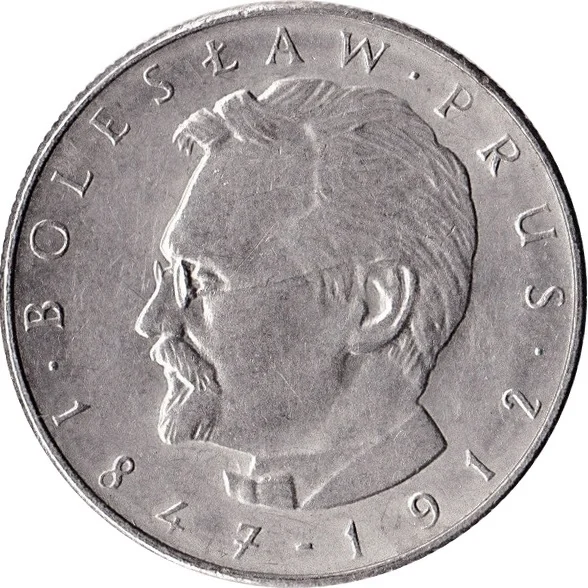
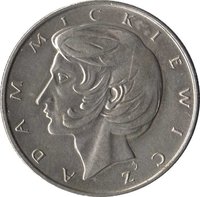
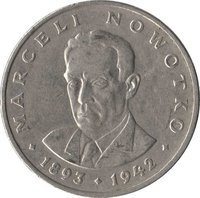
Bolesław Prus facing left.
Inscription:
· BOLESŁAW · PRUS ·
1847 - 1912
1847 - 1912
Translation:
BOLESŁAW · PRUS ·
1847 - 1912
1847 - 1912
Script: Latin
Language: Polish
Engraver: Anna Jarnuszkiewicz
Edge
Reeded
Categories
| Art> Literature |
Mints
| Name | Mark |
|---|---|
| Mint of Poland | (MW) |
Mintings
| Year | Mint Mark | Mintage | Quality | Collection |
|---|---|---|---|---|
| 1975 | MW | 35,000,000 | ||
| 1976 | MW | 20,000,000 | ||
| 1977 | MW | 25,000,000 | ||
| 1978 | MW | 4,007,000 | ||
| 1981 | MW | 5,000 | Proof | |
| 1981 | MW | 2,655,000 | ||
| 1982 | MW | 16,341,406 | ||
| 1982 | MW | 5,000 | Proof | |
| 1983 | MW | 14,247,600 | ||
| 1984 | MW | 19,063,600 |
Historical background
In 1975, Poland's currency situation was characterized by the rigidities and growing imbalances of a centrally planned economy under the communist regime. The official currency, the złoty, was non-convertible and its exchange rate was set administratively by the state, bearing little relation to market forces. While the official rate was fixed at approximately 3.3 złoty to the US dollar for accounting purposes, a vast black market for foreign currency, especially US dollars and Deutsche Marks, operated widely, with rates several times higher. This dual system reflected the severe shortages of hard currency needed to pay for crucial Western imports and technology.
Economically, the mid-1970s was a period of unsustainable expansion fueled by massive foreign borrowing, primarily from the West, initiated by First Secretary Edward Gierek. The government used these loans to finance a consumer boom and ambitious industrial investments, aiming to modernize the economy and placate social unrest. However, this policy led to a rapidly growing external debt without generating sufficient export earnings in hard currency to service it. The złoty's artificial strength on paper masked a deteriorating balance of payments and a mounting debt crisis that would erupt later in the decade.
For ordinary citizens, the currency situation created a complex dual reality. Salaries were paid in złoty, which could purchase domestically produced goods in state shops, though quality was often poor and shortages common. Access to desirable imported goods or luxury items was largely restricted to special hard-currency shops (Pewex and Baltona), where only Western currencies were accepted. This created a profound social divide between those with access to hard currency from relatives abroad or black-market dealings and those reliant solely on złoty, embedding a deep distrust in the national currency and foreshadowing the severe economic crises of the 1980s.
Economically, the mid-1970s was a period of unsustainable expansion fueled by massive foreign borrowing, primarily from the West, initiated by First Secretary Edward Gierek. The government used these loans to finance a consumer boom and ambitious industrial investments, aiming to modernize the economy and placate social unrest. However, this policy led to a rapidly growing external debt without generating sufficient export earnings in hard currency to service it. The złoty's artificial strength on paper masked a deteriorating balance of payments and a mounting debt crisis that would erupt later in the decade.
For ordinary citizens, the currency situation created a complex dual reality. Salaries were paid in złoty, which could purchase domestically produced goods in state shops, though quality was often poor and shortages common. Access to desirable imported goods or luxury items was largely restricted to special hard-currency shops (Pewex and Baltona), where only Western currencies were accepted. This created a profound social divide between those with access to hard currency from relatives abroad or black-market dealings and those reliant solely on złoty, embedding a deep distrust in the national currency and foreshadowing the severe economic crises of the 1980s.
Series: 1975 Poland circulation coins
🌱 Very Common