

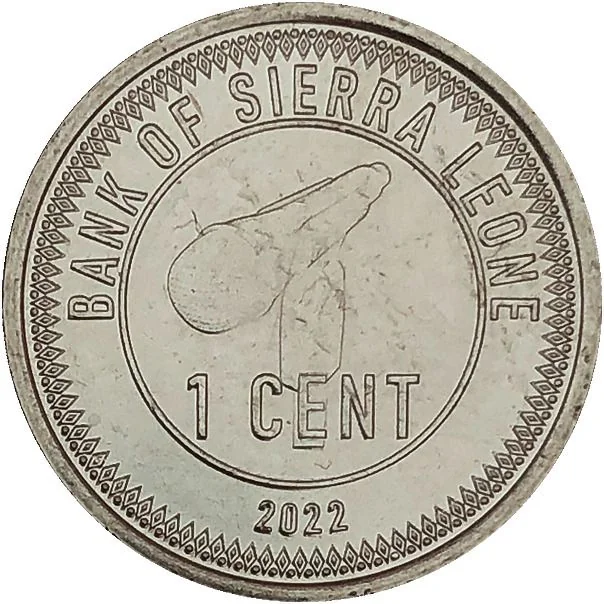
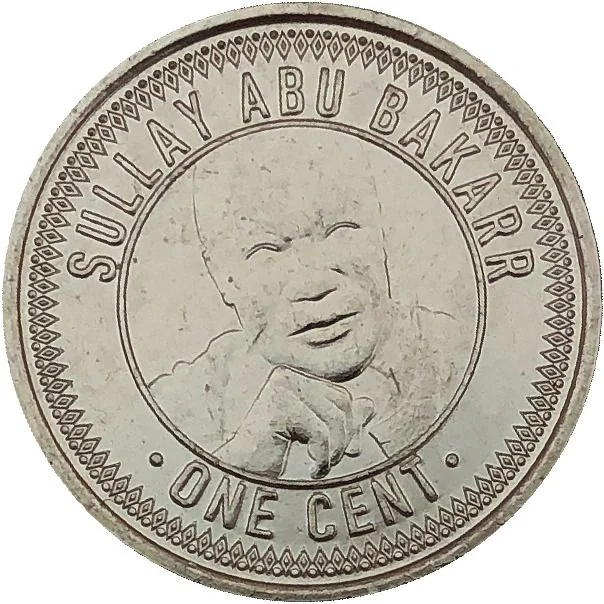
1 cent – Sierra Leone
Add to wishlist
Sierra Leone
Context
Year: 2022
Issuer: Sierra Leone
Issuing organization: Bank of Sierra Leone
Period:
(since 1996)
Currency:
(since 2022)
Material
References
KM: #
Numista: #325641
Value
Exchange value: 0.01 SLE
Obverse
Reverse
Description:
Portrait of Sullay Abu Bakarr.
Inscription:
SULLAY ABU BAKARR
· ONE CENT ·
· ONE CENT ·
Script: Latin
Edge
Plain
Mintings
| Year | Mint Mark | Mintage | Quality | Collection |
|---|---|---|---|---|
| 2022 | — | — |
Historical background
In 2022, Sierra Leone's currency, the Leone (SLL), faced significant and persistent depreciation pressures, continuing a long-term trend exacerbated by global and domestic shocks. The primary driver was a severe imbalance in foreign exchange supply and demand. The country, heavily reliant on imports for food, fuel, and manufactured goods, saw its import bill surge due to the global inflationary wave following the Russia-Ukraine war. Meanwhile, foreign exchange earnings from key exports like iron ore and diamonds remained volatile and insufficient to bridge the gap, leading to a widening trade deficit and depleted foreign reserves.
Domestically, high inflation—which peaked at over 30% in mid-2022—severely eroded the Leone's purchasing power and public confidence. Loose monetary policy and substantial government financing from the Bank of Sierra Leone contributed to excess liquidity in the system, further pressuring the exchange rate. This created a difficult cycle: depreciation fueled inflation (by making imports more expensive), and high inflation accelerated the demand for stable foreign currencies like the US dollar as a store of value, thus fueling further depreciation.
The government and central bank responded with a mix of interventions, including direct sales of forex to commercial banks and tightening monetary policy by raising the interest rate. In July 2022, a major policy shift occurred with the redenomination of the Leone (removing three zeros to create the "New Leone"), aimed at simplifying transactions and restoring confidence, though its immediate impact on underlying economic fundamentals was limited. Overall, 2022 was a year of profound currency weakness for Sierra Leone, characterized by external vulnerabilities, domestic fiscal pressures, and ongoing challenges in achieving macroeconomic stability.
Domestically, high inflation—which peaked at over 30% in mid-2022—severely eroded the Leone's purchasing power and public confidence. Loose monetary policy and substantial government financing from the Bank of Sierra Leone contributed to excess liquidity in the system, further pressuring the exchange rate. This created a difficult cycle: depreciation fueled inflation (by making imports more expensive), and high inflation accelerated the demand for stable foreign currencies like the US dollar as a store of value, thus fueling further depreciation.
The government and central bank responded with a mix of interventions, including direct sales of forex to commercial banks and tightening monetary policy by raising the interest rate. In July 2022, a major policy shift occurred with the redenomination of the Leone (removing three zeros to create the "New Leone"), aimed at simplifying transactions and restoring confidence, though its immediate impact on underlying economic fundamentals was limited. Overall, 2022 was a year of profound currency weakness for Sierra Leone, characterized by external vulnerabilities, domestic fiscal pressures, and ongoing challenges in achieving macroeconomic stability.
🌱 Common