

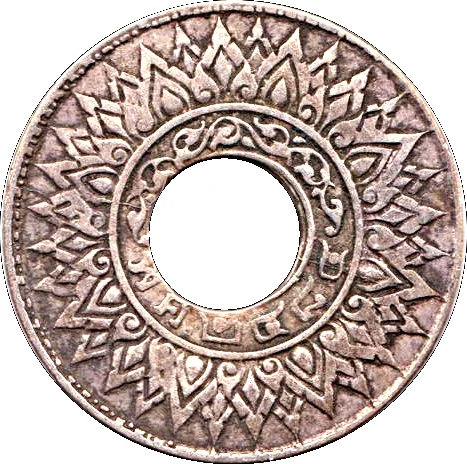
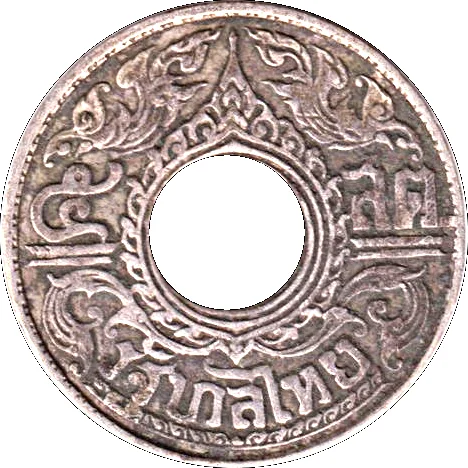
5 satangs – Thailand
Add to wishlist
Thailand
Context
Year: 1941
Thai Year:: 2484
Issuer: Thailand
Ruler: Ananda Mahidol
Currency:
(since 1897)
Demonetized: Yes
Material
Diameter: 16.6 mm
Weight: 1.5 g
Silver Weight:: 0.98 g
Shape: Round with a round hole
Composition: 65% Silver
Magnetic: No
Technique: Milled
Alignment: Coin alignment
flip
References
Y: #
Numista: #13752
Value
Exchange value: 0.05 THB
Bullion value: $2.44
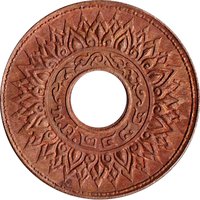
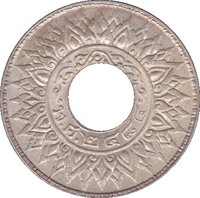
Obverse
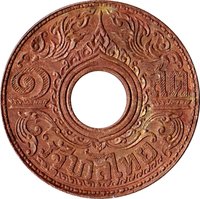
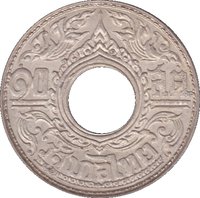
Reverse
Edge
Mintings
| Year | Mint Mark | Mintage | Quality | Collection |
|---|---|---|---|---|
| 1941 | — | — |
Historical background
In 1941, Thailand’s currency situation was directly shaped by the pressures of World War II and regional geopolitics. The country was under the authoritarian, nationalist government of Field Marshal Plaek Phibunsongkhram, which had just concluded a brief war with French Indochina in early 1941. To finance its military expansion and modernization, the government had increasingly relied on deficit spending, leading to a growing money supply and inflationary pressures. The official currency, the baht (or tical), remained pegged to gold and sterling, but this peg was becoming increasingly difficult to maintain as global trade disruptions strained the economy and foreign reserves.
The situation was further complicated by Japan's escalating dominance in Southeast Asia. Following the Franco-Thai War, and with Japanese mediation, Thailand gained territories from French Indochina, but this came at the cost of deepening economic and political dependence on Tokyo. In December 1941, Japanese forces invaded Thailand, leading to a swift armistice and a de facto alliance. Consequently, Thailand was integrated into Japan's "Greater East Asia Co-Prosperity Sphere," which drastically redirected its economic and monetary policy. The Japanese military began issuing their own "Japanese invasion currency" for use in occupied territories, though the baht remained in circulation, now effectively under a dual-system influenced by Japanese demands.
This period marked the beginning of significant wartime inflation for Thailand. The Japanese government made large-scale purchases of Thai rice and raw materials, paying with increasingly worthless yen credits, which the Bank of Thailand was compelled to accept. This flooded the economy with liquidity without corresponding goods, as resources were diverted to the Japanese war effort. By the end of 1941, the foundations for severe economic distortion were set, with the baht's stability artificially propped up by political decree rather than genuine reserves, setting the stage for the rampant inflation and economic hardship that would characterize the remainder of the war.
The situation was further complicated by Japan's escalating dominance in Southeast Asia. Following the Franco-Thai War, and with Japanese mediation, Thailand gained territories from French Indochina, but this came at the cost of deepening economic and political dependence on Tokyo. In December 1941, Japanese forces invaded Thailand, leading to a swift armistice and a de facto alliance. Consequently, Thailand was integrated into Japan's "Greater East Asia Co-Prosperity Sphere," which drastically redirected its economic and monetary policy. The Japanese military began issuing their own "Japanese invasion currency" for use in occupied territories, though the baht remained in circulation, now effectively under a dual-system influenced by Japanese demands.
This period marked the beginning of significant wartime inflation for Thailand. The Japanese government made large-scale purchases of Thai rice and raw materials, paying with increasingly worthless yen credits, which the Bank of Thailand was compelled to accept. This flooded the economy with liquidity without corresponding goods, as resources were diverted to the Japanese war effort. By the end of 1941, the foundations for severe economic distortion were set, with the baht's stability artificially propped up by political decree rather than genuine reserves, setting the stage for the rampant inflation and economic hardship that would characterize the remainder of the war.
🌟 Limited