

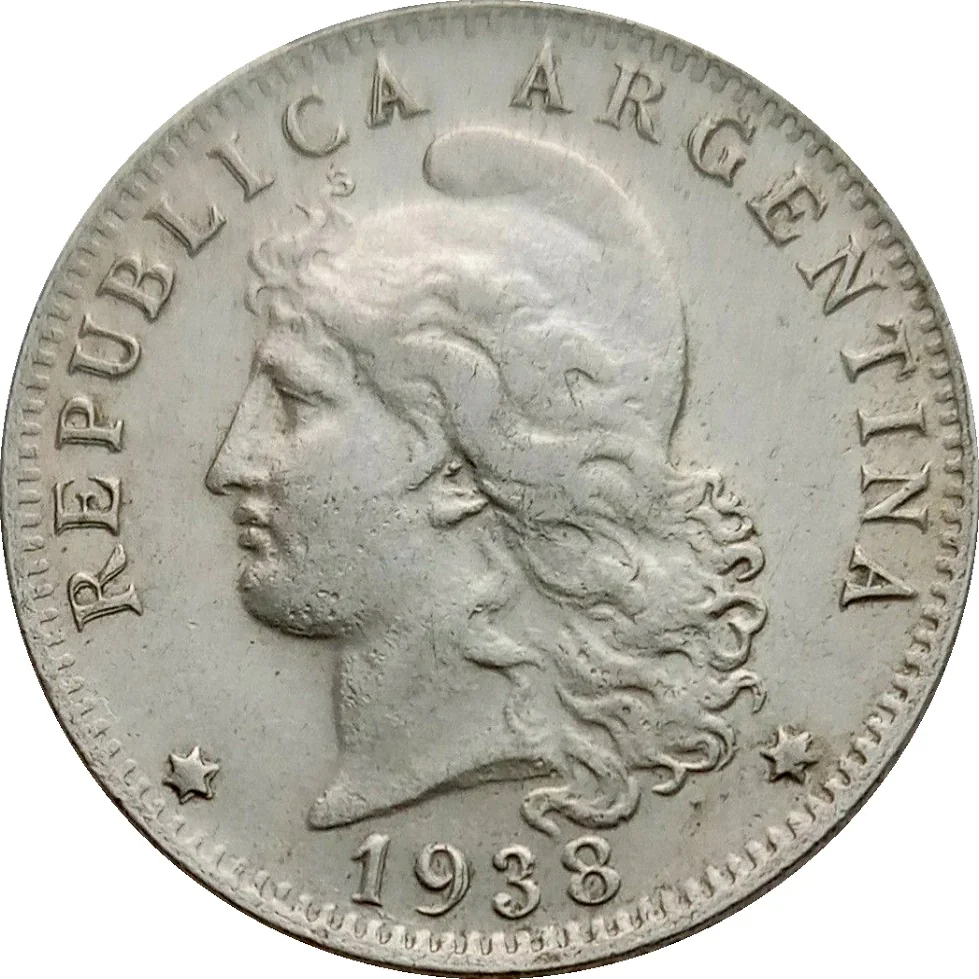
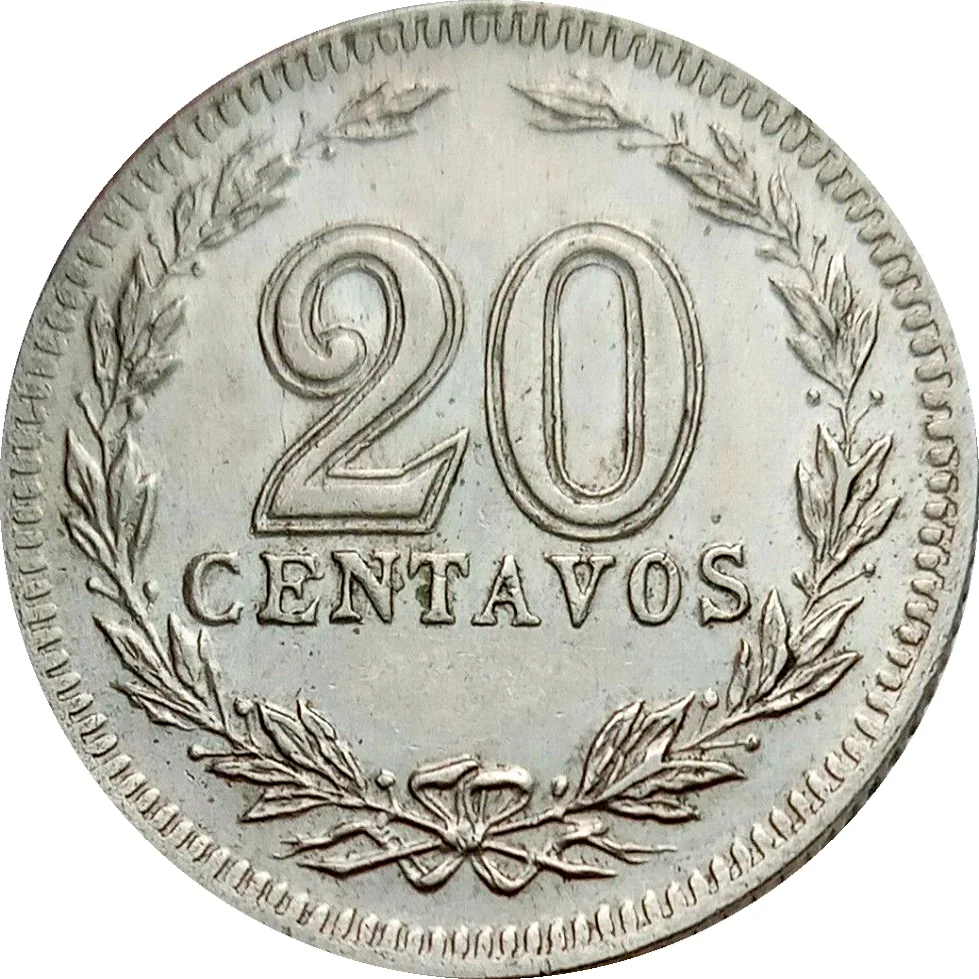
20 centavos – Argentina
Add to wishlist
Argentina
Context
Years: 1896–1942
Issuer: Argentina
Period:
(since 1861)
Currency:
(1881—1969)
Demonetization: 1 January 1943
Total mintage: 116,528,970
Material
References
KM: #
Numista: #3252
Value
Exchange value: 0.20 ARM
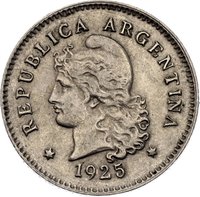
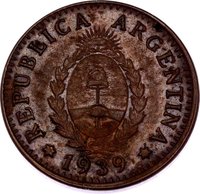
Obverse
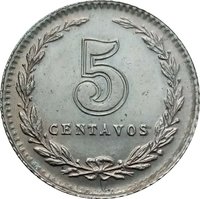
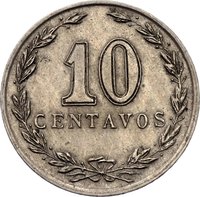
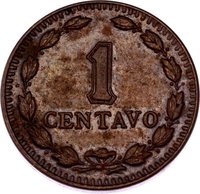
Reverse
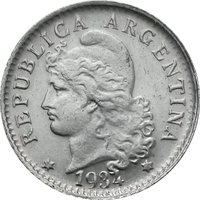
Edge
Reeded
Mints
| Name | Mark |
|---|---|
| Buenos Aires | — |
Mintings
| Year | Mint Mark | Mintage | Quality | Collection |
|---|---|---|---|---|
| 1896 | — | 2,029,616 | ||
| 1897 | — | 5,262,782 | ||
| 1898 | — | 1,263,963 | ||
| 1899 | — | 840,108 | ||
| 1905 | — | 4,454,610 | ||
| 1906 | — | 4,331,360 | ||
| 1907 | — | 3,729,577 | ||
| 1908 | — | 719,128 | ||
| 1909 | — | 1,328,888 | ||
| 1910 | — | 1,845,444 | ||
| 1911 | — | 1,109,630 | ||
| 1912 | — | 2,401,962 | ||
| 1913 | — | 1,579,446 | ||
| 1914 | — | 526,770 | ||
| 1915 | — | 1,921,400 | ||
| 1916 | — | 984,634 | ||
| 1918 | — | 1,637,745 | ||
| 1919 | — | 2,279,906 | ||
| 1920 | — | 7,571,819 | ||
| 1921 | — | 5,286,461 | ||
| 1922 | — | 2,324,168 | ||
| 1923 | — | 4,415,711 | ||
| 1924 | — | 3,675,515 | ||
| 1925 | — | 3,798,934 | ||
| 1926 | — | 3,250,000 | ||
| 1927 | — | 2,880,000 | ||
| 1928 | — | 2,885,988 | ||
| 1929 | — | 8,361,445 | ||
| 1930 | — | 8,281,400 | ||
| 1931 | — | 341,873 | ||
| 1935 | — | 1,126,787 | ||
| 1936 | — | 855,101 | ||
| 1937 | — | 3,314,120 | ||
| 1938 | — | 6,448,556 | ||
| 1939 | — | 3,555,017 | ||
| 1940 | — | 4,465,224 | ||
| 1941 | — | 600,011 | ||
| 1942 | — | 4,843,871 |
Historical background
In 1896, Argentina was in the final years of the Ley de Conversión (Conversion Law) of 1891, which had established a new monetary regime following the devastating Baring Crisis of 1890. The law created a currency board (the Caja de Conversión) that pegged the Argentine peso to gold at a fixed rate, making it fully convertible. This was a deliberate move to restore international financial credibility and attract the foreign capital deemed essential for the nation's rapid expansion. However, the system was inherently deflationary and rigid, as the money supply was directly tied to the country's gold reserves, limiting the government's ability to respond to economic fluctuations.
The economy in 1896 was experiencing a strong recovery, driven by booming agricultural exports, particularly beef and wheat. This export surge generated the trade surpluses needed to accumulate gold reserves, thereby supporting the currency peg. Yet, the benefits were uneven. The gold standard and fiscal austerity required by the system placed a heavy burden on the domestic economy, especially the interior provinces and the working class. While financiers and large landowners connected to the export sector prospered, many Argentines faced tight credit, stagnant wages, and the social tensions that would later fuel the rise of political movements like the Radical Civic Union.
Thus, the currency situation in 1896 was one of superficial stability masking underlying strains. The gold peg had successfully ended the hyperinflation of the early 1890s and reintegrated Argentina into global markets, but it created a brittle financial structure. The system's dependence on continuous export growth and capital inflows made the economy vulnerable to external shocks, a weakness that would be brutally exposed following World War I and during the Great Depression, ultimately leading to the abandonment of the gold standard.
The economy in 1896 was experiencing a strong recovery, driven by booming agricultural exports, particularly beef and wheat. This export surge generated the trade surpluses needed to accumulate gold reserves, thereby supporting the currency peg. Yet, the benefits were uneven. The gold standard and fiscal austerity required by the system placed a heavy burden on the domestic economy, especially the interior provinces and the working class. While financiers and large landowners connected to the export sector prospered, many Argentines faced tight credit, stagnant wages, and the social tensions that would later fuel the rise of political movements like the Radical Civic Union.
Thus, the currency situation in 1896 was one of superficial stability masking underlying strains. The gold peg had successfully ended the hyperinflation of the early 1890s and reintegrated Argentina into global markets, but it created a brittle financial structure. The system's dependence on continuous export growth and capital inflows made the economy vulnerable to external shocks, a weakness that would be brutally exposed following World War I and during the Great Depression, ultimately leading to the abandonment of the gold standard.
Series: 1896 Argentina circulation coins
🌱 Very Common