

10 centavos – Argentina
Add to wishlist
Argentina
Context
Years: 1942–1950
Issuer: Argentina
Period:
(since 1861)
Currency:
(1881—1969)
Demonetization: 1 January 1951
Total mintage: 265,838,005
Material
References
KM: #
Numista: #3248
Value
Exchange value: 0.10 ARM
Obverse
Description:
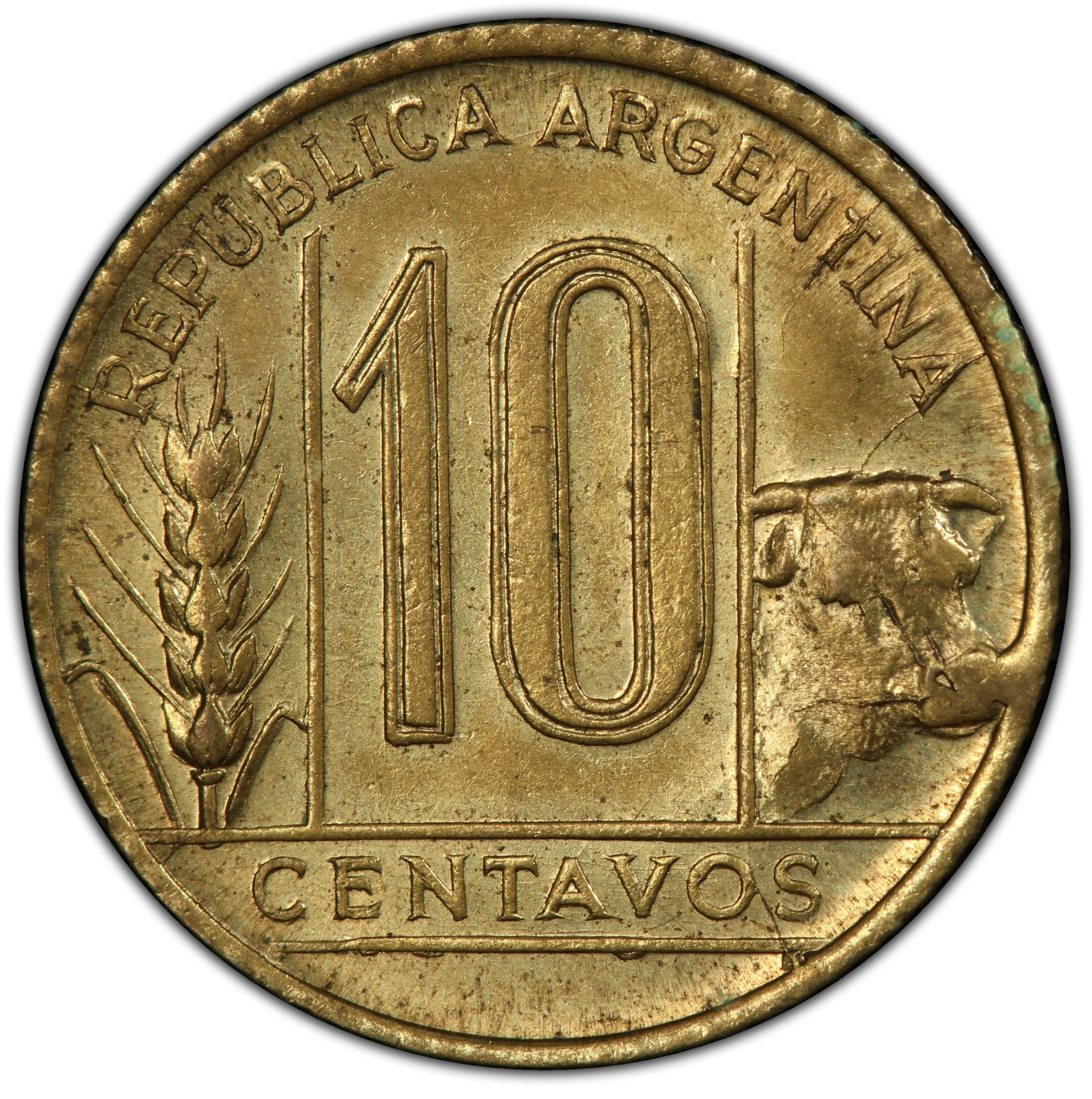
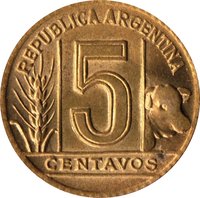
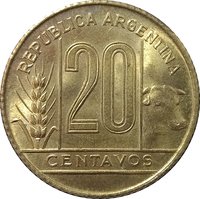
Wheatear and bull's head flank the value.
Inscription:
REPÚBLICA ARGENTINA
10
CENTAVOS
10
CENTAVOS
Translation:
Argentine Republic
10
Cents
10
Cents
Script: Latin
Language: Spanish
Engraver: Lucien Georges Bazor
Reverse
Description:
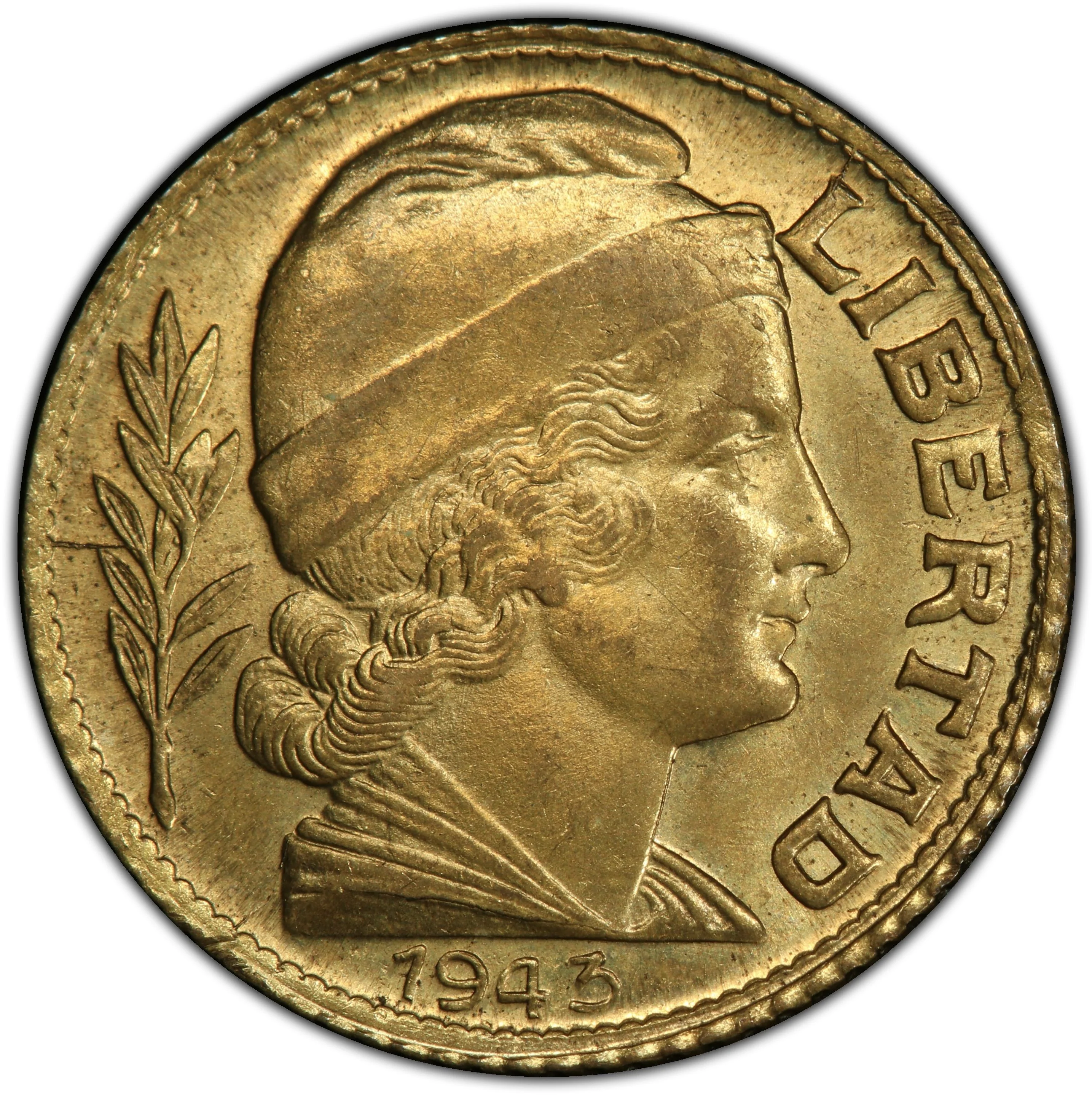
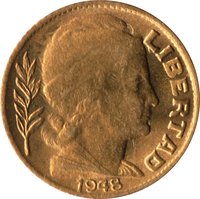
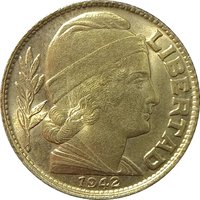
Liberty effigy with Phrygian cap, flanked by a branch and "LIBERTAD", with date in exergue.
Inscription:
LIBERTAD
1943
1943
Translation:
LIBERTY
1943
1943
Script: Latin
Language: Spanish
Engraver: Lucien Georges Bazor
Edge
Reeded
Mints
| Name | Mark |
|---|---|
| Buenos Aires | — |
Mintings
| Year | Mint Mark | Mintage | Quality | Collection |
|---|---|---|---|---|
| 1942 | — | 15,541,000 | ||
| 1943 | — | 13,916,000 | ||
| 1944 | — | 16,411,000 | ||
| 1945 | — | 12,500,000 | ||
| 1946 | — | 15,790,005 | ||
| 1947 | — | 36,430,000 | ||
| 1948 | — | 54,685,000 | ||
| 1949 | — | 57,740,000 | ||
| 1950 | — | 42,825,000 |
Historical background
In 1942, Argentina's currency situation was defined by strict exchange controls and a managed peso, operating within the context of global wartime disruption and domestic economic policy. The country had abandoned the gold standard in 1929, and by the early 1940s, the Central Bank of Argentina (BCRA), established in 1935, exercised firm control over the foreign exchange market. A fixed, overvalued official exchange rate for the peso was maintained, but a significant black market for US dollars and other hard currencies flourished, creating a wide gap between the official and parallel rates. This system was fundamentally shaped by Argentina's status as a major agricultural exporter, with the government channeling wartime commodity profits from beef and grains to support industrialization and manage foreign debt.
The economic context of World War II was paramount. While initially neutral, Argentina experienced a boom in exports to Allied nations, generating substantial foreign exchange reserves, particularly in British pounds sterling. However, these sterling balances were largely "blocked" or inconvertible due to British wartime exchange controls, limiting Argentina's access to dollar-denominated markets. This forced a shift toward bilateral trade agreements and import substitution industrialization (ISI), as obtaining necessary machinery and inputs from the United States became difficult. The government, under President Ramón Castillo, used exchange controls to prioritize essential imports for industry while restricting consumer goods, further entrenching a state-directed economic model.
Consequently, the currency regime of 1942 was one of apparent stability on the surface, underpinned by strong export earnings, but it was inherently distorted and fragile. The pervasive black market reflected the peso's overvaluation and the scarcity of freely convertible currency. These controls and imbalances, designed to conserve foreign reserves and direct economic development, laid the groundwork for the persistent fiscal and monetary challenges that would characterize Argentina's economy in the postwar era. The system prioritized state economic management and industrial growth over currency convertibility, setting a precedent for decades of managed exchange rates and periodic crises.
The economic context of World War II was paramount. While initially neutral, Argentina experienced a boom in exports to Allied nations, generating substantial foreign exchange reserves, particularly in British pounds sterling. However, these sterling balances were largely "blocked" or inconvertible due to British wartime exchange controls, limiting Argentina's access to dollar-denominated markets. This forced a shift toward bilateral trade agreements and import substitution industrialization (ISI), as obtaining necessary machinery and inputs from the United States became difficult. The government, under President Ramón Castillo, used exchange controls to prioritize essential imports for industry while restricting consumer goods, further entrenching a state-directed economic model.
Consequently, the currency regime of 1942 was one of apparent stability on the surface, underpinned by strong export earnings, but it was inherently distorted and fragile. The pervasive black market reflected the peso's overvaluation and the scarcity of freely convertible currency. These controls and imbalances, designed to conserve foreign reserves and direct economic development, laid the groundwork for the persistent fiscal and monetary challenges that would characterize Argentina's economy in the postwar era. The system prioritized state economic management and industrial growth over currency convertibility, setting a precedent for decades of managed exchange rates and periodic crises.
Series: 1942 Argentina circulation coins
🌱 Very Common