

1 sol – Peru
Add to wishlist
Peru
Material
Diameter: 25.48 mm
Weight: 7.32 g
Thickness: 1.65 mm
Shape: Round
Composition: Nickel brass
Magnetic: No
Technique: Milled
Alignment: Coin alignment
flip
References
KM: #
Numista: #324407
Value
Exchange value: 1 PEN
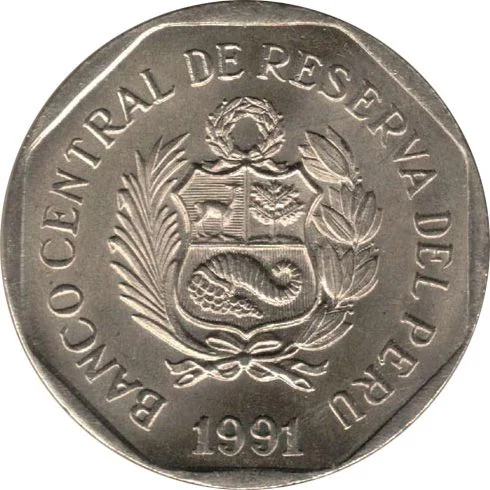
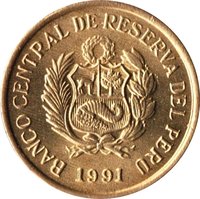
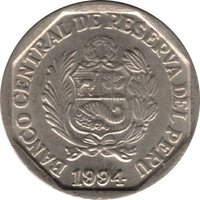
Obverse
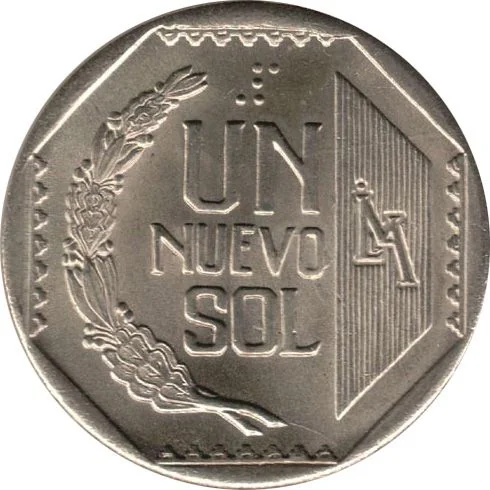
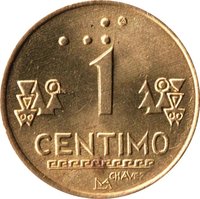
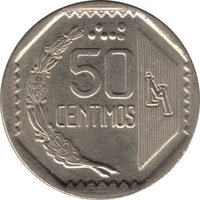
Reverse
Edge
Reeded
Categories
| Symbols> Coat of Arms |
| Symbol> Cornucopia |
Mints
| Name | Mark |
|---|---|
| Lima | LIMA |
Mintings
Historical background
In 1991, Peru was in the throes of a profound economic and social crisis, characterized by hyperinflation, deep recession, and the devastating impact of the Shining Path insurgency. The currency situation was catastrophic: annual inflation had reached a staggering 7,650% in 1990, rendering the national currency, the inti, virtually worthless. A decade of expansionary fiscal policies, price controls, and external debt shocks had led to severe currency devaluation and a massive loss of public confidence in the financial system. The economy was dollarized in practice, with many transactions conducted in U.S. dollars to preserve value, while the government struggled with a severe shortage of foreign reserves.
President Alberto Fujimori, who had taken office in July 1990, responded with a drastic stabilization program. In August 1990, his administration implemented the initial "Fujishock," eliminating subsidies and freeing prices, which set the stage for a more comprehensive reform. The pivotal monetary change came in 1991 with the introduction of a new currency, the nuevo sol (new sol), through the Monetary Reform Law (Decree Law 23-191). This new unit, equivalent to one million intis, was designed to restore sanity to the pricing system and signal a definitive break from the inflationary past.
The currency reform was a cornerstone of a broader package that included aggressive fiscal austerity, trade liberalization, and the start of a sweeping privatization program. While the immediate social costs were high, the measures successfully halted hyperinflation, which fell to 139% in 1991 and continued to drop sharply in subsequent years. The introduction of the stable nuevo sol was thus a critical first step in re-establishing monetary credibility, ending the era of hyperinflation, and laying the foundation for the market-oriented transformation of the Peruvian economy in the 1990s.
President Alberto Fujimori, who had taken office in July 1990, responded with a drastic stabilization program. In August 1990, his administration implemented the initial "Fujishock," eliminating subsidies and freeing prices, which set the stage for a more comprehensive reform. The pivotal monetary change came in 1991 with the introduction of a new currency, the nuevo sol (new sol), through the Monetary Reform Law (Decree Law 23-191). This new unit, equivalent to one million intis, was designed to restore sanity to the pricing system and signal a definitive break from the inflationary past.
The currency reform was a cornerstone of a broader package that included aggressive fiscal austerity, trade liberalization, and the start of a sweeping privatization program. While the immediate social costs were high, the measures successfully halted hyperinflation, which fell to 139% in 1991 and continued to drop sharply in subsequent years. The introduction of the stable nuevo sol was thus a critical first step in re-establishing monetary credibility, ending the era of hyperinflation, and laying the foundation for the market-oriented transformation of the Peruvian economy in the 1990s.
Series: 1991 Peru circulation coins
🌱 Very Common