

10 francs cfa – Western African States
Add to wishlist
Context
Years: 1959–1964
Issuer: Western African States
Issuing organization: Central Bank of Western African States
Currency:
(since 1958)
Total mintage: 20,000,000
Material
References
KM: #
Numista: #1374
Value
Exchange value: 10 XOF
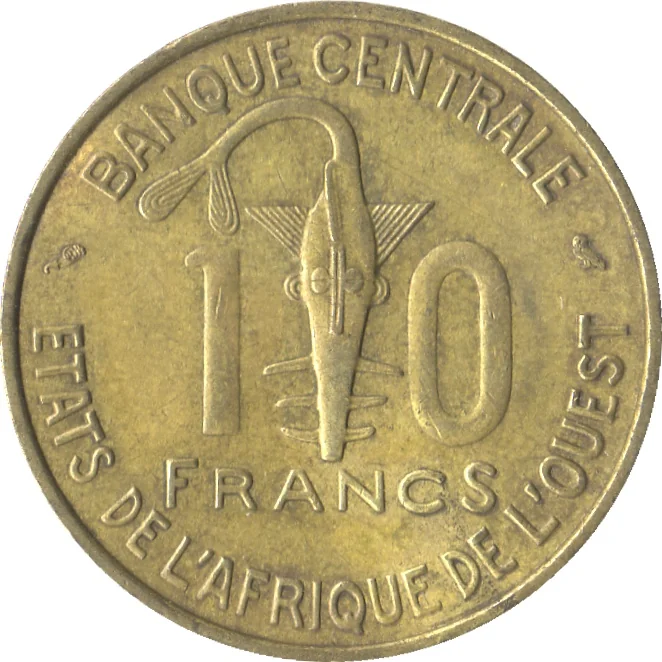
Obverse
Description:
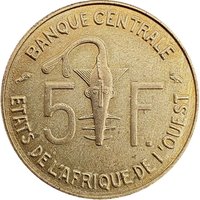
BCEAO emblem and value
Inscription:
10 FRANCS
BANQUE CENTRALE ETATS DE L'AFRIQUE DE L'OUEST
BANQUE CENTRALE ETATS DE L'AFRIQUE DE L'OUEST
Translation:
10 FRANCS
CENTRAL BANK OF THE WEST AFRICAN STATES
CENTRAL BANK OF THE WEST AFRICAN STATES
Script: Latin
Language: French
Engraver: Gabriel-Bernard Lucien Georges Bazor
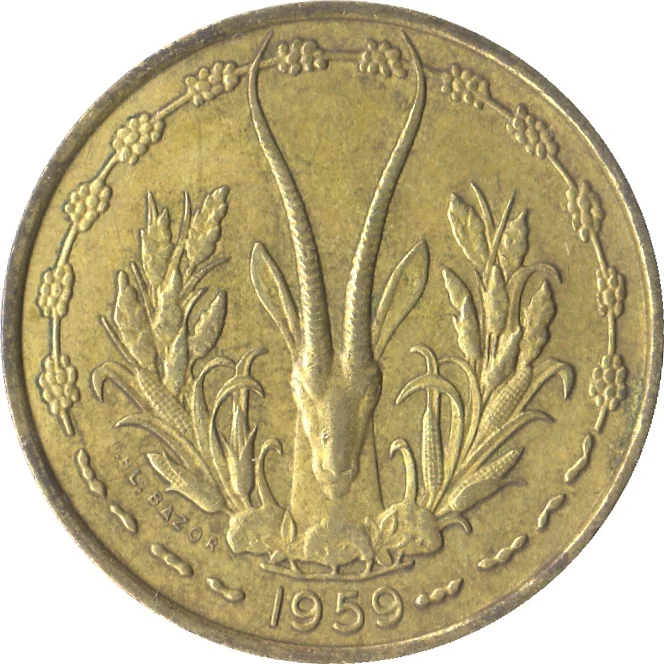
Reverse
Description:
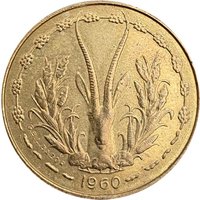
Swift antelope
Inscription:
G.B.L.BAZOR
1959
1959
Script: Latin
Engraver: Gabriel-Bernard Lucien Georges Bazor
Edge
Plain
Mints
| Name | Mark |
|---|---|
| Monnaie de Paris | — |
Mintings
| Year | Mint Mark | Mintage | Quality | Collection |
|---|---|---|---|---|
| 1959 | — | 10,000,000 | ||
| 1964 | — | 10,000,000 |
Historical background
In 1959, the currency situation in French West Africa was defined by the imminent transition from colonial monetary systems to new, independent frameworks. The region was still under the CFA franc system, established by France in 1945 as the "Colonies Françaises d'Afrique" franc. This currency was fully convertible and pegged to the French franc, with its issuance guaranteed by the French Treasury through the operations of two central banks: one for West Africa (BCEAO) and one for Equatorial Africa. This arrangement provided monetary stability and facilitated trade with France, but it also symbolized continued economic dependence and limited sovereign monetary policy for the territories.
The year was one of pivotal preparation, as the political landscape was rapidly shifting toward independence, which most territories would achieve in 1960. Key negotiations were underway between French authorities and the political leaders of the soon-to-be nations to determine the post-colonial monetary order. The critical outcome of these talks was the decision to maintain a cooperative currency union. In 1959, agreements were finalized to reform the existing institutions, transforming the BCEAO into a joint central bank for multiple independent states, thereby creating the foundational structure for the West African CFA franc (Franc de la Communauté Financière Africaine) that would officially launch in 1962.
Meanwhile, in the British West African territories, a different system was in place, centered on the West African Pound, issued by the West African Currency Board. This board-operated currency was also pegged to sterling and served Nigeria, Ghana, Sierra Leone, and The Gambia. However, by 1959, this colonial model was already being dismantled; Ghana had led the way by establishing its own central bank and national currency, the Ghanaian pound, in 1958. Nigeria and Sierra Leone were on similar paths, planning their own central banks and sovereign currencies, which they would introduce shortly after independence. Thus, 1959 stands as a final, transitional year where colonial monetary structures were being actively renegotiated and redesigned to serve new sovereign nations.
The year was one of pivotal preparation, as the political landscape was rapidly shifting toward independence, which most territories would achieve in 1960. Key negotiations were underway between French authorities and the political leaders of the soon-to-be nations to determine the post-colonial monetary order. The critical outcome of these talks was the decision to maintain a cooperative currency union. In 1959, agreements were finalized to reform the existing institutions, transforming the BCEAO into a joint central bank for multiple independent states, thereby creating the foundational structure for the West African CFA franc (Franc de la Communauté Financière Africaine) that would officially launch in 1962.
Meanwhile, in the British West African territories, a different system was in place, centered on the West African Pound, issued by the West African Currency Board. This board-operated currency was also pegged to sterling and served Nigeria, Ghana, Sierra Leone, and The Gambia. However, by 1959, this colonial model was already being dismantled; Ghana had led the way by establishing its own central bank and national currency, the Ghanaian pound, in 1958. Nigeria and Sierra Leone were on similar paths, planning their own central banks and sovereign currencies, which they would introduce shortly after independence. Thus, 1959 stands as a final, transitional year where colonial monetary structures were being actively renegotiated and redesigned to serve new sovereign nations.
🌱 Very Common