



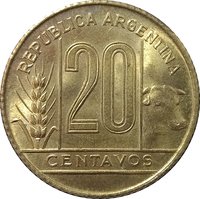
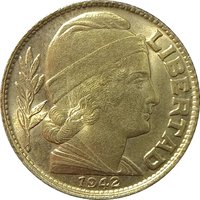
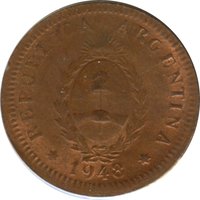
Obverse
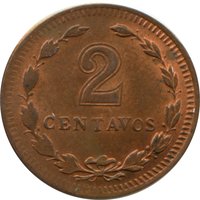
Reverse
Edge
Plain
Categories
| Symbol> Sun |
| Symbols> Coat of Arms |
| Symbol> Phrygian cap |
Mintings
| Year | Mint Mark | Mintage | Quality | Collection |
|---|---|---|---|---|
| 1945 | — | 420,000 | ||
| 1946 | — | 4,450,000 | ||
| 1947 | — | 5,630,000 | ||
| 1948 | — | 4,419,545 |
Historical background
Argentina's currency situation in 1945 was a direct legacy of the economic policies pursued during the presidency of Juan Domingo Perón, who served as Minister of Labor and Vice President before assuming the presidency that year. The state, heavily interventionist, prioritized rapid industrialization and wealth redistribution to bolster the urban working class, his key political base. This was financed through expansive fiscal policies, the creation of state-owned enterprises, and the systematic transfer of resources from the highly profitable agricultural export sector (beef and grains) via a multiple exchange rate system and the Instituto Argentino para la Promoción del Intercambio (IAPI). This institute bought commodities from farmers at low, state-set domestic prices and sold them on the world market at higher prices, capturing the difference to fund social programs and industrial subsidies.
This system created severe distortions. The overvalued official exchange rate for essential imports and debt service penalized agricultural exporters, discouraging production and reducing the flow of crucial US dollar earnings. Meanwhile, a complex web of preferential rates for different transactions fostered corruption and a thriving black market for US dollars (the "blue" market), where the peso's value was significantly lower. While industrial growth and wage increases were initially dramatic, they were built on unsustainable foundations: declining export revenue, rising fiscal deficits, and mounting money supply growth, which planted the seeds for persistent inflation.
Consequently, by the end of 1945, Argentina faced a growing duality in its currency reality. Officially, the peso was pegged and stable, but this masked mounting internal and external imbalances. The loss of foreign exchange reserves, combined with price controls that led to shortages, and the widening gap between the official and black-market dollar rates, signaled an economy under mounting strain. The stage was set for the chronic cycles of inflation, devaluation, and currency crisis that would define the Argentine economy for decades to come, as the artificial support for the peso became increasingly difficult to maintain.
This system created severe distortions. The overvalued official exchange rate for essential imports and debt service penalized agricultural exporters, discouraging production and reducing the flow of crucial US dollar earnings. Meanwhile, a complex web of preferential rates for different transactions fostered corruption and a thriving black market for US dollars (the "blue" market), where the peso's value was significantly lower. While industrial growth and wage increases were initially dramatic, they were built on unsustainable foundations: declining export revenue, rising fiscal deficits, and mounting money supply growth, which planted the seeds for persistent inflation.
Consequently, by the end of 1945, Argentina faced a growing duality in its currency reality. Officially, the peso was pegged and stable, but this masked mounting internal and external imbalances. The loss of foreign exchange reserves, combined with price controls that led to shortages, and the widening gap between the official and black-market dollar rates, signaled an economy under mounting strain. The stage was set for the chronic cycles of inflation, devaluation, and currency crisis that would define the Argentine economy for decades to come, as the artificial support for the peso became increasingly difficult to maintain.
🌱 Common