

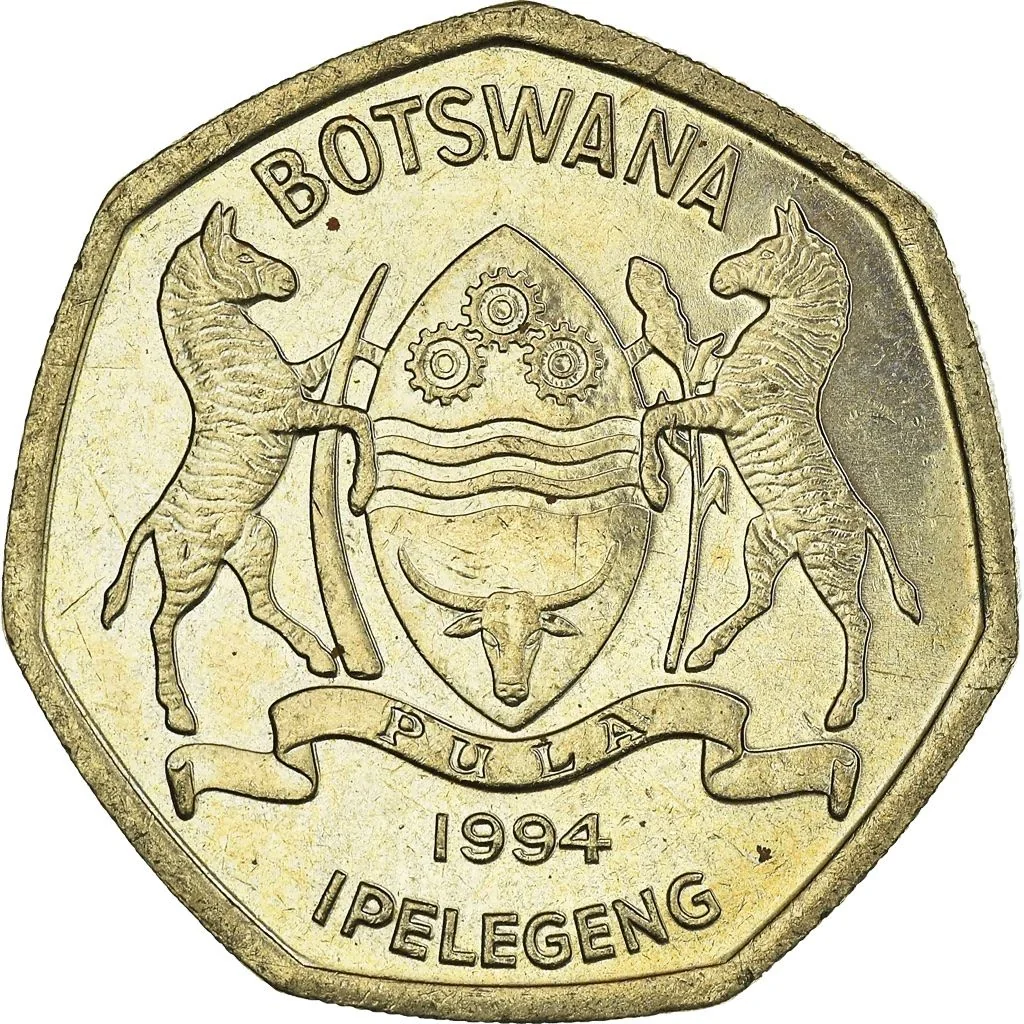
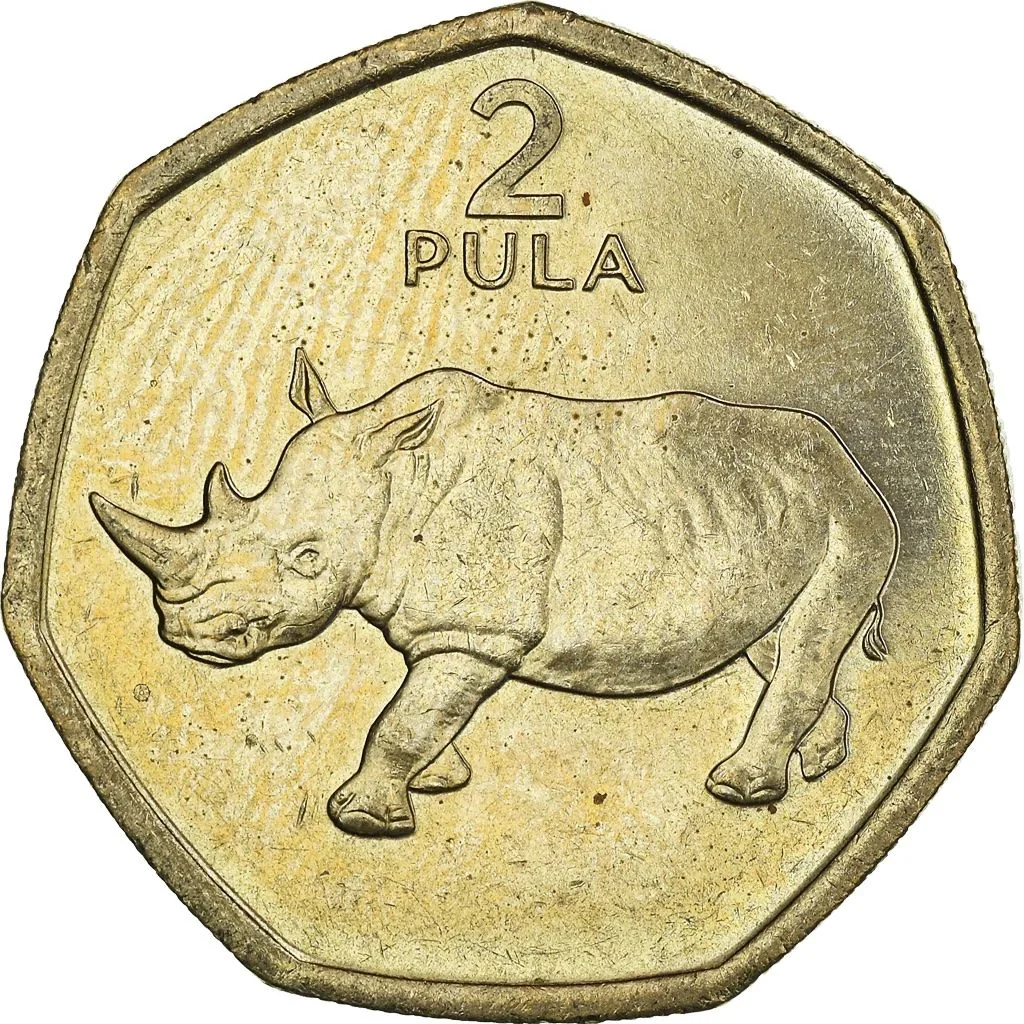
2 pula – Botswana
Add to wishlist
Botswana
Context
Material
Diameter: 26.4 mm
Weight: 6.03 g
Thickness: 2.3 mm
Shape: Heptagonal
Composition: Nickel brass
Magnetic: No
Technique: Milled
Alignment: Medal alignment
flip
References
KM: #
Numista: #3233
Value
Exchange value: 2 BWP
Obverse
Reverse
Description:
White rhinoceros (Ceratotherium simum), the largest rhino species, also known as the square-lipped rhinoceros.
Inscription:
2 PULA
Script: Latin
Edge
Milled
Categories
| Animal> Horse |
| Symbols> Coat of Arms |
Mintings
| Year | Mint Mark | Mintage | Quality | Collection |
|---|---|---|---|---|
| 1994 | — | — |
Historical background
In 1994, Botswana's currency situation was defined by stability and prudent management, anchored by the Botswana pula (BWP). The pula, introduced in 1976 to replace the South African rand, was pegged to a basket of currencies, primarily the South African rand and the International Monetary Fund's Special Drawing Rights (SDRs). This basket peg, as opposed to a single-currency peg, was a strategic tool managed by the Bank of Botswana to mitigate economic shocks and control inflation, which stood at a relatively moderate rate of around 10% that year. This stability was a direct result of the country's consistent fiscal discipline and its substantial diamond-driven foreign exchange reserves.
The broader economic context was one of robust growth, with Botswana having transitioned from one of the poorest nations at independence in 1966 to a middle-income economy. The government's conservative fiscal policies and the success of the diamond mining sector, managed through a 50/50 joint venture with De Beers (Debswana), provided a strong revenue base. This allowed for the accumulation of foreign reserves, which bolstered confidence in the pula and provided a buffer against external volatility, particularly from the economic turbulence in neighbouring South Africa.
However, the currency regime was not without its pressures. Botswana's economy remained closely linked to South Africa's through the Southern African Customs Union (SACU). Consequently, fluctuations in the value of the rand significantly influenced the pula's effective exchange rate and competitiveness. In 1994, this relationship was particularly salient as South Africa underwent its historic democratic transition, which introduced economic uncertainties. Nevertheless, the Botswana authorities successfully maintained the pula's stability, using the basket peg to carefully balance the competing needs of export competitiveness, import price stability, and overall macroeconomic control, setting a foundation for continued economic resilience.
The broader economic context was one of robust growth, with Botswana having transitioned from one of the poorest nations at independence in 1966 to a middle-income economy. The government's conservative fiscal policies and the success of the diamond mining sector, managed through a 50/50 joint venture with De Beers (Debswana), provided a strong revenue base. This allowed for the accumulation of foreign reserves, which bolstered confidence in the pula and provided a buffer against external volatility, particularly from the economic turbulence in neighbouring South Africa.
However, the currency regime was not without its pressures. Botswana's economy remained closely linked to South Africa's through the Southern African Customs Union (SACU). Consequently, fluctuations in the value of the rand significantly influenced the pula's effective exchange rate and competitiveness. In 1994, this relationship was particularly salient as South Africa underwent its historic democratic transition, which introduced economic uncertainties. Nevertheless, the Botswana authorities successfully maintained the pula's stability, using the basket peg to carefully balance the competing needs of export competitiveness, import price stability, and overall macroeconomic control, setting a foundation for continued economic resilience.
🌱 Common