

½ sovereign – British colonies
Add to wishlist
Australia
Context
Years: 1855–1856
Country: Australia
Issuer: British colonies
Ruler: Victoria
Currency:
(1788—1966)
Total mintage: 499,000
Material
References
KM: #
Numista: #32313
Value
Bullion value: $560.41
Obverse
Description:
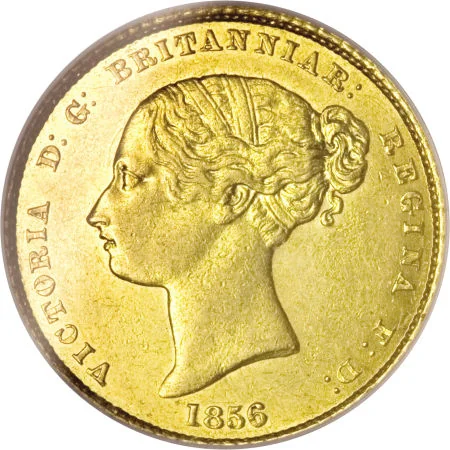
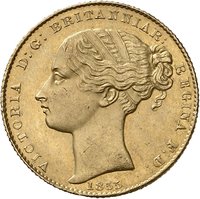
Young Victoria left, 1856; around, VICTORIA D:G: BRITANNIAR: REGINA F:D:
Inscription:
VICTORIA D:G: BRITANNIAR: REGINA F:D:
1856
1856
Script: Latin
Engraver: Joseph Shepherd Wyon
Reverse
Description:
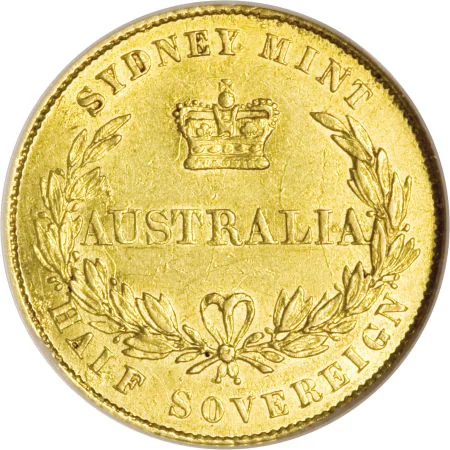
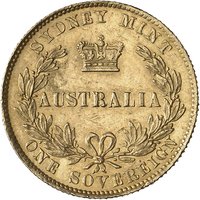
AUSTRALIA within a laurel wreath, crowned. Above: SYDNEY MINT. Below: HALF SOVEREIGN.
Inscription:
SYDNEY MINT
AUSTRALIA
HALF SOVEREIGN
AUSTRALIA
HALF SOVEREIGN
Script: Latin
Engraver: Leonard Charles Wyon
Edge
Milled
Mints
| Name | Mark |
|---|---|
| Royal Mint | — |
Mintings
| Year | Mint Mark | Mintage | Quality | Collection |
|---|---|---|---|---|
| 1855 | — | 21,000 | ||
| 1856 | — | 478,000 |
Historical background
In 1855, the currency situation across the British Empire's colonies was fragmented and complex, largely operating on a de facto gold standard but with significant local variations. The imperial preference was for sterling, yet the practical scarcity of British coin, especially gold sovereigns and silver, meant that a multitude of foreign coins, local tokens, and paper issues circulated. Spanish and Mexican silver dollars remained the dominant trade coin in many regions, particularly the West Indies, West Africa, and Hong Kong, valued by weight and fineness. Colonial governments often gave these foreign coins legal tender status at a fixed sterling rating to facilitate commerce, creating a system of "sterling exchange standards" where local currencies were pegged to, but not physically composed of, British coin.
This system led to chronic problems. The official sterling rating of silver dollars frequently diverged from their intrinsic bullion value, causing "good" full-weight coins to be exported for profit while worn or clipped coins remained in local circulation—a classic example of Gresham's Law. Furthermore, the economic needs of disparate colonies differed greatly; plantation economies issuing paper currency to finance crop cycles (like in the West Indies) faced different challenges from strategic naval bases (like Bermuda) or bustling trade entrepôts (like Singapore). This often resulted in inflationary pressures, exchange rate instability, and frequent complaints from merchants to the Colonial Office in London.
The period was one of transition, with the British government increasingly attempting to impose monetary order. The mid-1850s saw the issuance of specific British colonial coinage, such as the silver "British North America" tokens for Canada, and the push for unified decimal systems in places like Hong Kong. However, a truly uniform imperial currency policy remained elusive. The fundamental tension persisted: London sought centralized control and sterling parity, while individual colonies required flexible mediums of exchange to sustain their local economies and international trade, often with dollars from the Americas and Spanish pieces of eight. This left 1855 as a year caught between the old, chaotic world of competitive commodity money and the emerging order of formal colonial currency boards.
This system led to chronic problems. The official sterling rating of silver dollars frequently diverged from their intrinsic bullion value, causing "good" full-weight coins to be exported for profit while worn or clipped coins remained in local circulation—a classic example of Gresham's Law. Furthermore, the economic needs of disparate colonies differed greatly; plantation economies issuing paper currency to finance crop cycles (like in the West Indies) faced different challenges from strategic naval bases (like Bermuda) or bustling trade entrepôts (like Singapore). This often resulted in inflationary pressures, exchange rate instability, and frequent complaints from merchants to the Colonial Office in London.
The period was one of transition, with the British government increasingly attempting to impose monetary order. The mid-1850s saw the issuance of specific British colonial coinage, such as the silver "British North America" tokens for Canada, and the push for unified decimal systems in places like Hong Kong. However, a truly uniform imperial currency policy remained elusive. The fundamental tension persisted: London sought centralized control and sterling parity, while individual colonies required flexible mediums of exchange to sustain their local economies and international trade, often with dollars from the Americas and Spanish pieces of eight. This left 1855 as a year caught between the old, chaotic world of competitive commodity money and the emerging order of formal colonial currency boards.
💎 Extremely Rare