

5 Shillings – British colonies
Australia
Context
Year: 1813
Country: Australia 
Issuer: British colonies
Ruler: George III
Currency:
(1788—1900)
Demonetization: 1829
Material
Diameter: 39 mm
Weight: 21.04 g
Silver weight: 19.00 g
Shape: Round with a round hole
Composition: 90.3% Silver
Magnetic: No
Technique: Milled
Alignment: Coin alignment
flip
References
KM: #Click to copy to clipboard2.1
Numista: #19811
Value
Bullion value: $55.20
Obverse
Description:
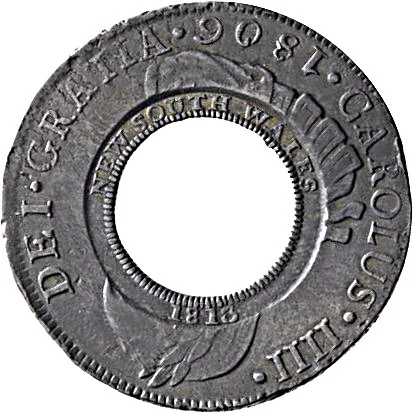
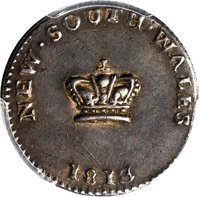
A ring-shaped silver coin made from an 1806 Lima 8 reales piece by removing its center and counterstamping "NEW SOUTH WALES 1813" around the hole. The outer rim retains the original inscription: CAROLUS . IIII . DEI . GRATIA . 1806.
Inscription:
DEI GRATIA
1806
CAROLUS IIII
NEW SOUTH WALES
1813
1806
CAROLUS IIII
NEW SOUTH WALES
1813
Translation:
BY THE GRACE OF GOD
1806
CHARLES IV
NEW SOUTH WALES
1813
1806
CHARLES IV
NEW SOUTH WALES
1813
Script: Latin
Reverse
Description:
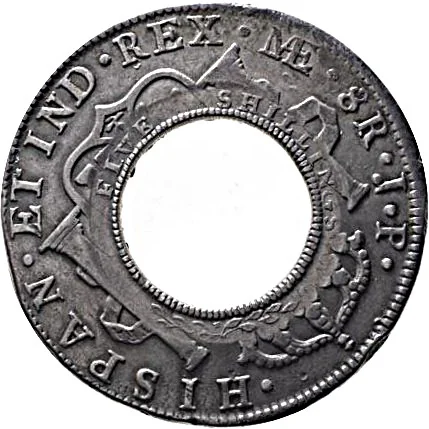
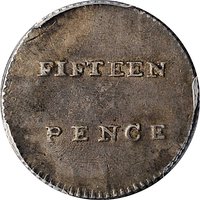
Around the central hole: FIVE SHILLINGS and a leaf spray with the engraver's initial H. The host coin's rim reads: (Lima monogram) 8R . J . P. HISPAN . ET IND . REX .; it features a crowned shield between pillars, mostly removed by the hole and counterstamp.
Inscription:
HISPAN ET IND REX ME 8R J P
FIVE SHILLINGS
FIVE SHILLINGS
Script: Latin
Edge
Circle & rectangle pattern
Mintings
| Year | Mint Mark | Mintage | Quality | Collection |
|---|---|---|---|---|
| 1813 | — | — |
Historical background
In 1813, the currency situation across Britain's global colonies was characterized by chronic scarcity and a complex patchwork of local solutions. The core problem was a persistent shortage of official British coinage, as the mother country prohibited the export of sterling silver and gold coin to prevent its own domestic shortage. This left colonial economies, which were heavily geared toward exporting raw materials and importing manufactured goods, with a severe deficit of reliable, universally accepted money for daily transactions and internal trade. The result was a monetary landscape where a variety of substitutes—foreign coins, paper bills, and even commodity money—circulated with varying degrees of acceptance and stability.
The specific realities differed by region. In the Caribbean sugar colonies, the dominant currency was often the Spanish silver dollar (piece of eight), valued by its weight and fineness, alongside locally issued plantation tokens and promissory notes. In Canada and the maritime provinces, a mixture of Spanish dollars, British Army bills (issued to pay troops during the War of 1812), and notes from fledgling banks filled the void. Meanwhile, in the penal colony of New South Wales, the economy relied heavily on rum as a de facto currency and on promissory notes drawn on the British Treasury, known as "Sterling Bills," due to an almost complete absence of coin.
This fragmented system created significant challenges. Exchange rates between different forms of money were fluctuating and localized, hindering inter-colonial trade. The reliance on paper notes and bills of credit also carried the constant risk of depreciation or default, especially when issued by private entities or colonial governments with shaky finances. Ultimately, the currency situation of 1813 highlighted a fundamental tension: the colonies were integrated into the British imperial economic system but were left to manage their day-to-day exchange with inadequate and improvised monetary tools, a reality that would spur moves toward more formalized banking and currency reforms in the decades to come.
The specific realities differed by region. In the Caribbean sugar colonies, the dominant currency was often the Spanish silver dollar (piece of eight), valued by its weight and fineness, alongside locally issued plantation tokens and promissory notes. In Canada and the maritime provinces, a mixture of Spanish dollars, British Army bills (issued to pay troops during the War of 1812), and notes from fledgling banks filled the void. Meanwhile, in the penal colony of New South Wales, the economy relied heavily on rum as a de facto currency and on promissory notes drawn on the British Treasury, known as "Sterling Bills," due to an almost complete absence of coin.
This fragmented system created significant challenges. Exchange rates between different forms of money were fluctuating and localized, hindering inter-colonial trade. The reliance on paper notes and bills of credit also carried the constant risk of depreciation or default, especially when issued by private entities or colonial governments with shaky finances. Ultimately, the currency situation of 1813 highlighted a fundamental tension: the colonies were integrated into the British imperial economic system but were left to manage their day-to-day exchange with inadequate and improvised monetary tools, a reality that would spur moves toward more formalized banking and currency reforms in the decades to come.
💎 Extremely Rare