

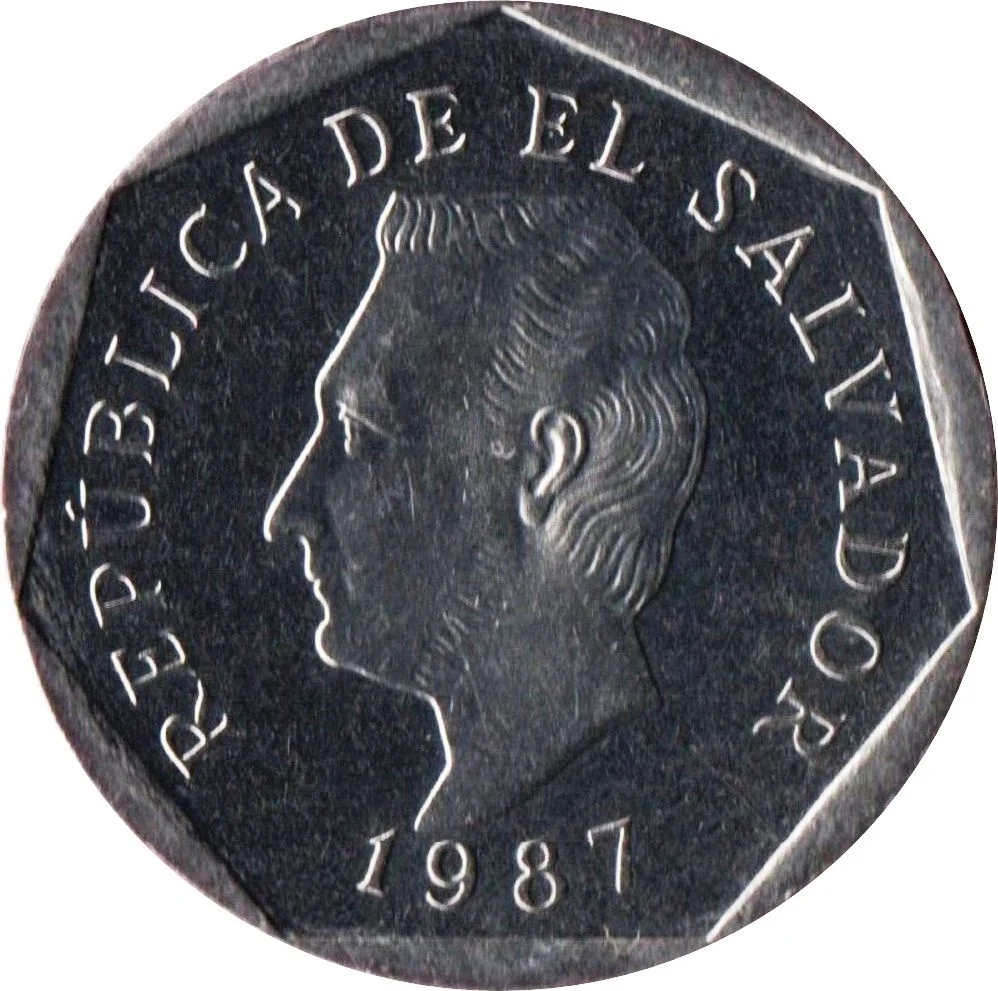
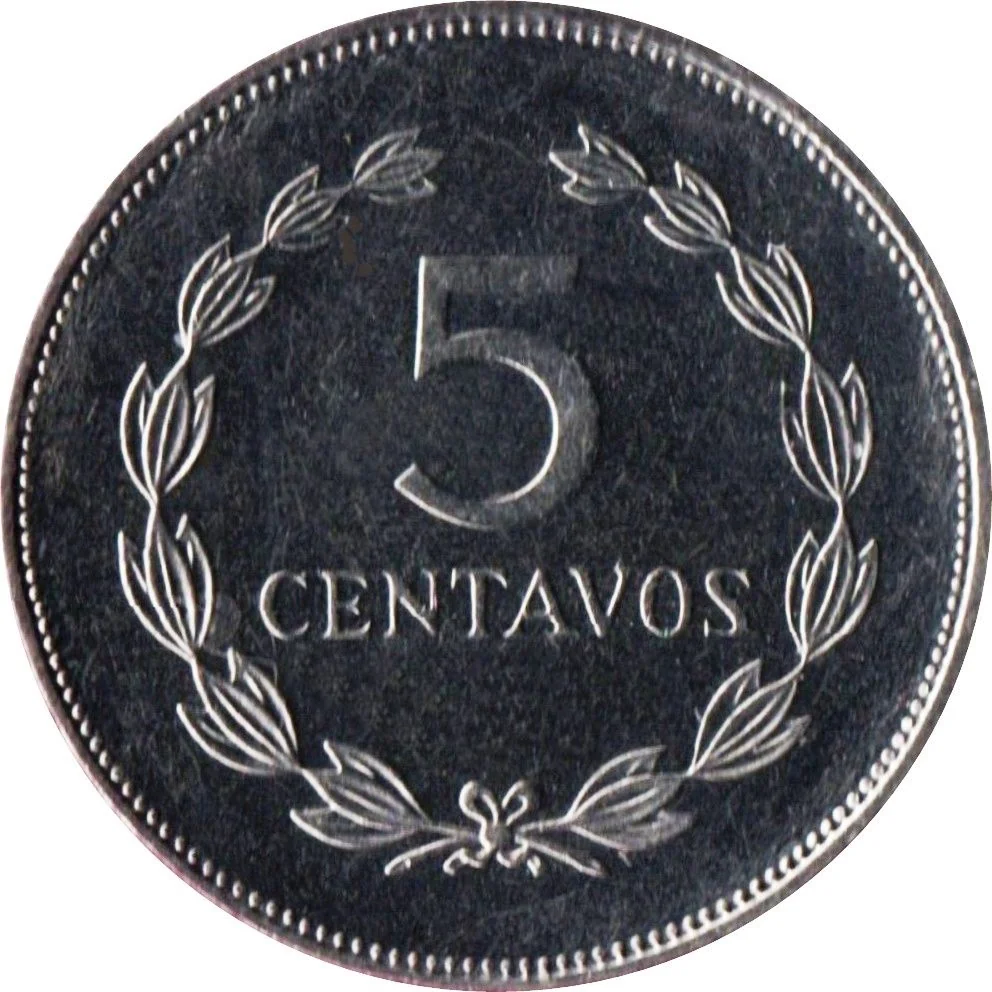
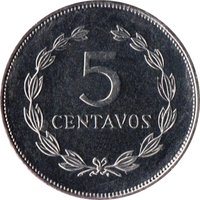
5 Centavos – El Salvador
El Salvador
Context
Years: 1987–1999
Issuer: El Salvador 
Issuing organization: Central Reserve Bank of El Salvador
Period:
(since 1841)
Currency:
(since 1892)
Demonetization: 1 January 2001
Total mintage: 30,000,000
Material
Diameter: 17 mm
Weight: 2 g
Shape: Round
Composition: Stainless steel
Technique: Milled
Alignment: Medal alignment
flip
References
KM: #Click to copy to clipboard154
Numista: #10236
Value
Exchange value: 0.05 SVC
Obverse
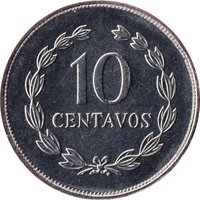
Reverse
Edge
Plain
Categories
| Person> Politician |
| Symbol> Wreath |
Mints
| Name | Mark |
|---|---|
| VDM Metals / Vereinigte Deutsche Metallwerke | — |
Mintings
| Year | Mint Mark | Mintage | Quality | Collection |
|---|---|---|---|---|
| 1987 | — | 30,000,000 | ||
| 1987 | — | — | Proof | |
| 1999 | — | — |
Historical background
In 1987, El Salvador's currency situation was defined by the rigid control of the colón, which was pegged to the US dollar at a fixed exchange rate of 2.5 colones to 1 dollar. This peg had been established in 1934 and was maintained by the Central Reserve Bank of El Salvador (BCR). While this policy provided a long-term sense of stability and predictability for foreign trade and investment, it was increasingly artificial and disconnected from the country's underlying economic realities. The fixed rate did not reflect the severe economic pressures stemming from a protracted civil war, declining agricultural exports, and rampant inflation.
The Salvadoran economy was under immense strain from nearly a decade of civil conflict, which diverted resources to military spending, disrupted production, and damaged infrastructure. Furthermore, the country was heavily dependent on coffee exports, and the collapse of international coffee prices in the mid-1980s severely reduced vital foreign exchange earnings. Despite these shocks, the government maintained the fixed parity through strict exchange controls and the use of limited foreign reserves. This created a growing disparity between the official rate and the black-market rate, where the colón traded at a significant discount, indicating a severe overvaluation of the currency at the official level.
Consequently, by 1987, the currency regime was unsustainable. The fixed peg, while symbolically stable, masked deep economic distortions. It eroded export competitiveness, encouraged capital flight, and created chronic balance of payments difficulties. The government's reliance on printing money to finance deficits further fueled inflation, which averaged around 25% annually in the mid-1980s, silently eroding the colón's domestic purchasing power despite its fixed external value. This untenable situation set the stage for the major economic liberalization and currency reforms that would follow in the early 1990s, including a dramatic devaluation and the eventual adoption of dollarization.
The Salvadoran economy was under immense strain from nearly a decade of civil conflict, which diverted resources to military spending, disrupted production, and damaged infrastructure. Furthermore, the country was heavily dependent on coffee exports, and the collapse of international coffee prices in the mid-1980s severely reduced vital foreign exchange earnings. Despite these shocks, the government maintained the fixed parity through strict exchange controls and the use of limited foreign reserves. This created a growing disparity between the official rate and the black-market rate, where the colón traded at a significant discount, indicating a severe overvaluation of the currency at the official level.
Consequently, by 1987, the currency regime was unsustainable. The fixed peg, while symbolically stable, masked deep economic distortions. It eroded export competitiveness, encouraged capital flight, and created chronic balance of payments difficulties. The government's reliance on printing money to finance deficits further fueled inflation, which averaged around 25% annually in the mid-1980s, silently eroding the colón's domestic purchasing power despite its fixed external value. This untenable situation set the stage for the major economic liberalization and currency reforms that would follow in the early 1990s, including a dramatic devaluation and the eventual adoption of dollarization.
🌱 Common