

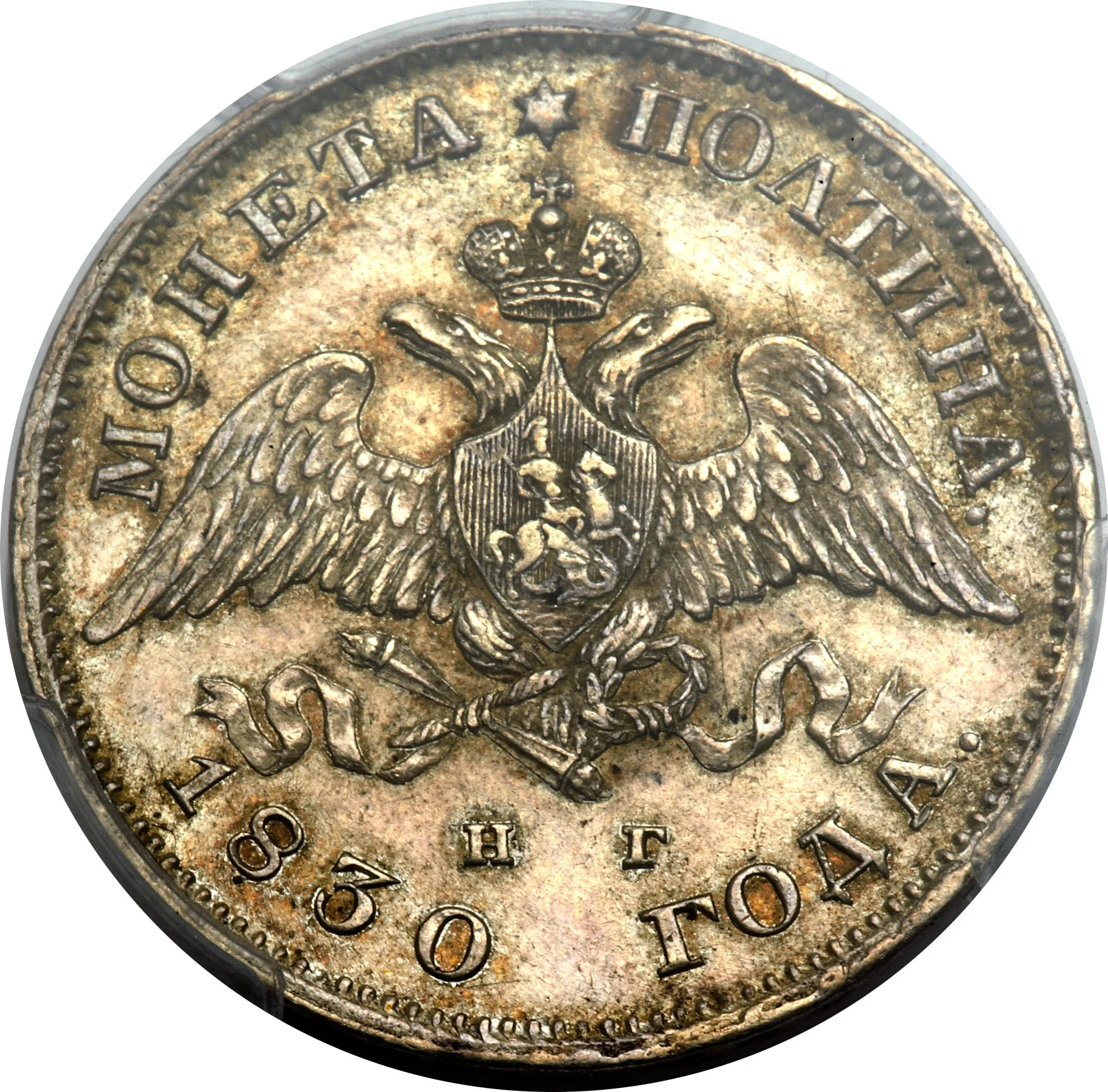
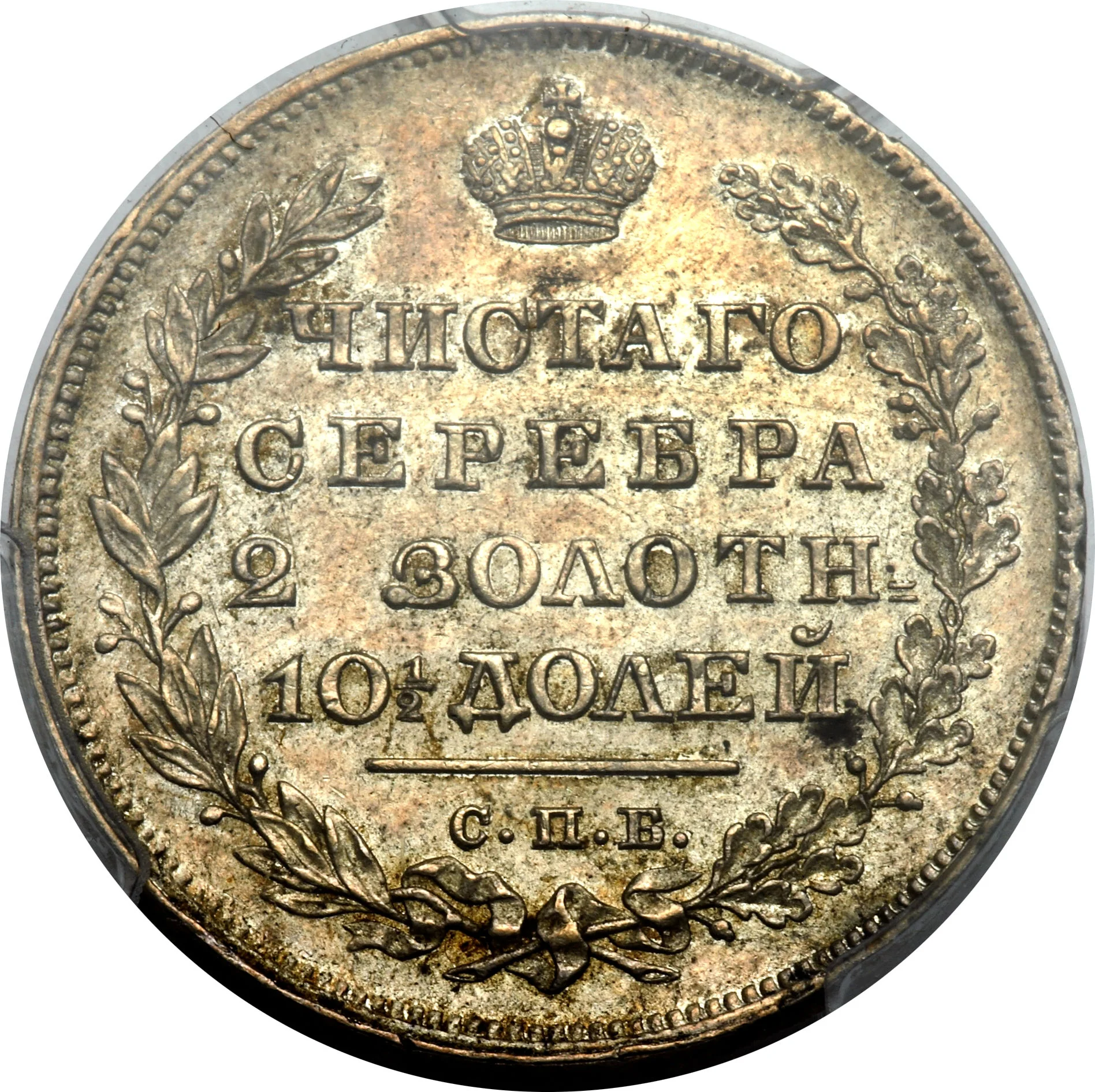
1 Poltina – Russian Empire
Russia
Context
Years: 1826–1831
Country: Russia 
Issuer: Russian Empire
Ruler: Nicholas I
Currency:
(1700—1917)
Demonetized: Yes
Total mintage: 1,748,011
Material
References
Numista: #32212
Value
Bullion value: $26.11
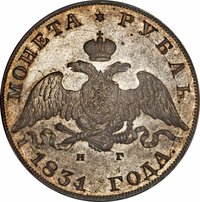
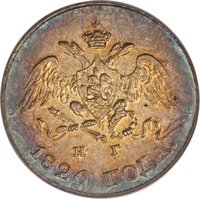
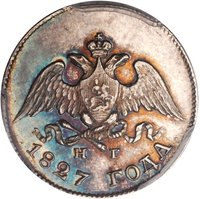
Obverse
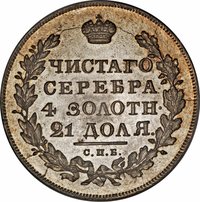
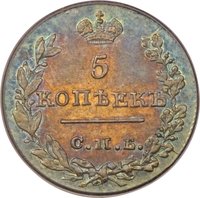
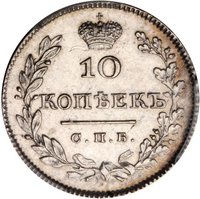
Reverse
Edge
Smooth with inscription
Mintings
| Year | Mint Mark | Mintage | Quality | Collection |
|---|---|---|---|---|
| 1826 | СПБ | — | BU | |
| 1827 | СПБ | 164,000 | BU | |
| 1828 | СПБ | 274,003 | BU | |
| 1829 | СПБ | 880,001 | BU | |
| 1830 | СПБ | 290,007 | BU | |
| 1831 | СПБ | 140,000 | BU |
Historical background
By 1826, the currency situation in the Russian Empire was defined by a state of profound instability and depreciation, a legacy of the Napoleonic Wars. To finance the massive war effort, the state had dramatically increased the issuance of paper assignats (assignatsii), unbacked by silver, leading to severe inflation. The result was a dual-system where the silver ruble and the paper assignat ruble circulated simultaneously at a fluctuating and unfavorable exchange rate, causing confusion in commerce and a loss of public confidence in the paper currency.
Recognizing the crisis, Tsar Nicholas I, who ascended the throne in late 1825, inherited a pressing monetary reform agenda. His government, led by Minister of Finance Egor Kankrin, was actively investigating solutions. The primary goal was to stabilize the currency and restore its value, with a strong preference for a return to a silver standard to ensure solidity and international credibility. However, the immediate priority in 1826 was consolidation and careful planning, as a hasty reform risked further destabilizing the fragile economy.
Thus, in 1826, the Empire was in a transitional phase, grappling with the practical burdens of a devalued paper currency while its financial officials meticulously prepared for a fundamental overhaul. The situation hampered both domestic economic activity and foreign trade, as the unreliable ruble complicated transactions. The groundwork laid in this period would culminate in the successful Kankrin reform of 1839-1843, which finally abolished the assignats and introduced a new silver-based paper currency, but in 1826, that stability remained a key objective yet to be achieved.
Recognizing the crisis, Tsar Nicholas I, who ascended the throne in late 1825, inherited a pressing monetary reform agenda. His government, led by Minister of Finance Egor Kankrin, was actively investigating solutions. The primary goal was to stabilize the currency and restore its value, with a strong preference for a return to a silver standard to ensure solidity and international credibility. However, the immediate priority in 1826 was consolidation and careful planning, as a hasty reform risked further destabilizing the fragile economy.
Thus, in 1826, the Empire was in a transitional phase, grappling with the practical burdens of a devalued paper currency while its financial officials meticulously prepared for a fundamental overhaul. The situation hampered both domestic economic activity and foreign trade, as the unreliable ruble complicated transactions. The groundwork laid in this period would culminate in the successful Kankrin reform of 1839-1843, which finally abolished the assignats and introduced a new silver-based paper currency, but in 1826, that stability remained a key objective yet to be achieved.
💎 Very Rare