

25 Cents – Bermuda
United Kingdom
Context
Years: 1999–2020
Country: United Kingdom 
Issuer: Bermuda 
Ruler: Elizabeth II
Currency:
(since 1970)
Total mintage: 9,762,500
Material
Diameter: 24.29 mm
Weight: 6.01 g
Thickness: 1.8 mm
Shape: Round
Composition: Copper-nickel
Technique: Milled
Alignment: Medal alignment
flip
References
KM: #Click to copy to clipboard110
Numista: #3217
Value
Exchange value: 0.25 BMD
Inflation-adjusted value: 0.56 BMD
Obverse
Description:
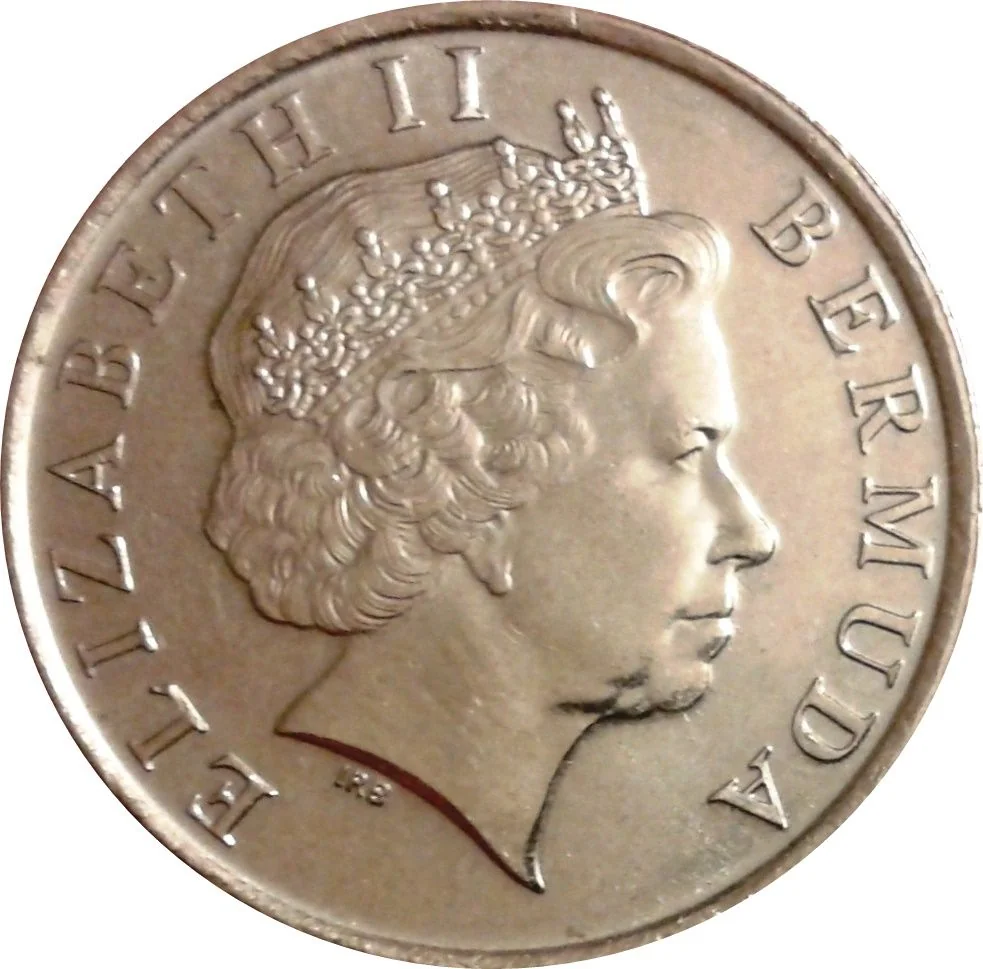
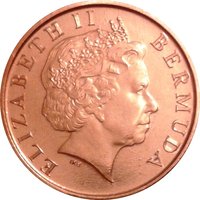
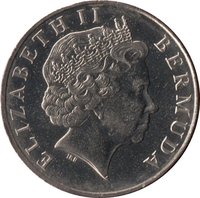
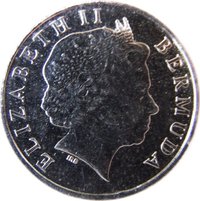
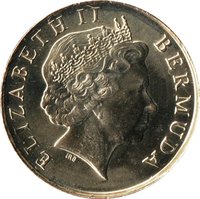
Crowned portrait of Queen Elizabeth II in profile.
Inscription:
ELIZABETH II BERMUDA
IRB
IRB
Translation:
Elizabeth II Bermuda
Four
Four
Script: Latin
Engraver: Ian Rank-Broadley
Reverse
Description:
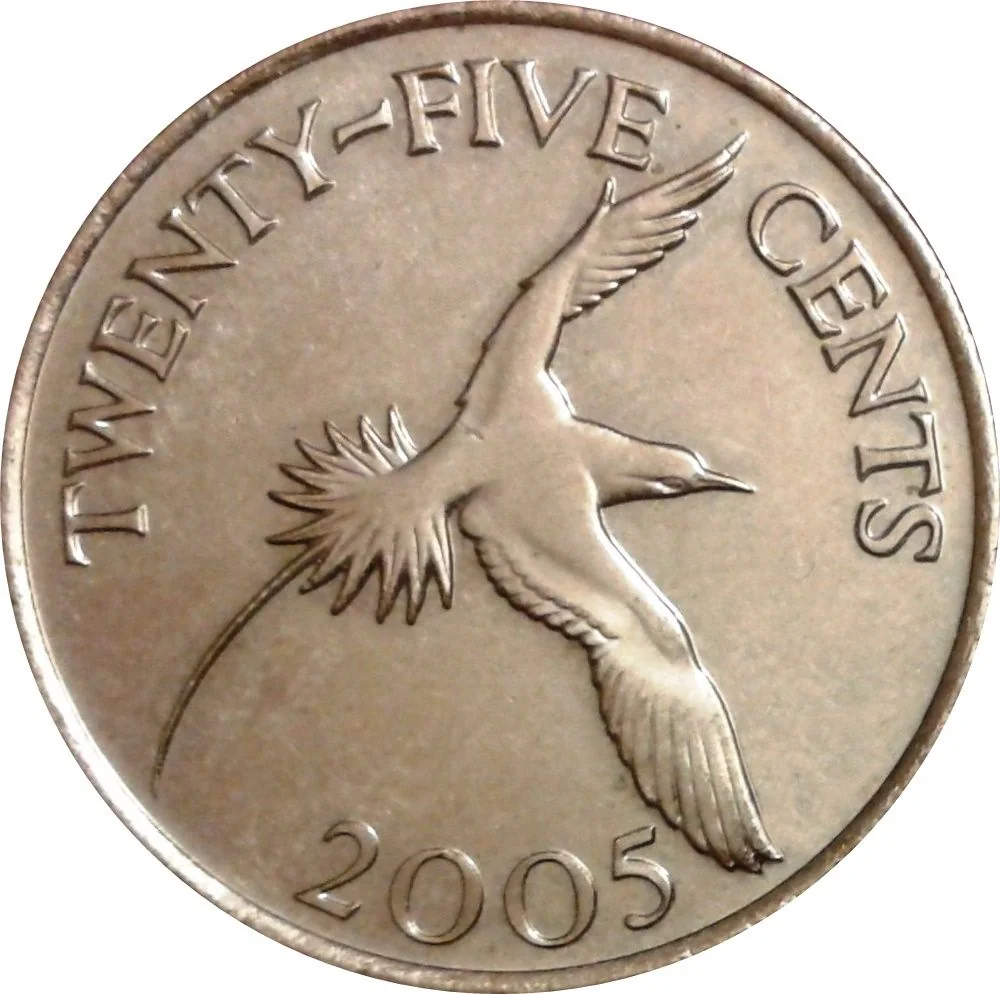
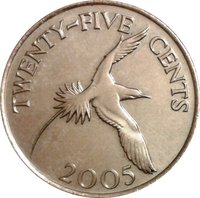
The Bermuda Longtail is a White-tailed Tropicbird (*Phaethon lepturus*).
Inscription:
TWENTY-FIVE CENTS
2005
2005
Script: Latin
Engraver: Michael Rizzello
Edge
Reeded
Mints
| Name | Mark |
|---|---|
| Royal Mint | — |
Mintings
| Year | Mint Mark | Mintage | Quality | Collection |
|---|---|---|---|---|
| 1999 | — | 800,000 | ||
| 1999 | — | 2,500 | Proof | |
| 2000 | — | 800,000 | ||
| 2001 | — | 800,000 | ||
| 2002 | — | 800,000 | ||
| 2003 | — | 800,000 | ||
| 2004 | — | 800,000 | ||
| 2005 | — | 1,440,000 | ||
| 2006 | — | 320,000 | ||
| 2007 | — | — | ||
| 2008 | — | 1,200,000 | ||
| 2009 | — | 2,000,000 | ||
| 2017 | — | — | ||
| 2020 | — | — |
Historical background
In 1999, Bermuda's currency situation was characterized by a stable and unique arrangement, with the Bermudian dollar (BMD) pegged at par to the United States dollar (USD). This one-to-one peg, established in 1972, was a cornerstone of the territory's economic policy, providing predictability for its key pillars of tourism and international business. Both currencies circulated interchangeably on the island, with US dollars accepted virtually everywhere, though change was often given in Bermudian dollars. This system facilitated seamless transactions for American visitors and the many international companies based there, reinforcing Bermuda's position as a global financial hub.
The territory's monetary authority, the Bermuda Monetary Authority (BMA), operated as a currency board, ensuring full foreign reserve backing for all Bermudian dollars in circulation. This strict discipline mandated that the issuance of local currency was directly tied to the holdings of US dollar reserves, which instilled high confidence in the fixed exchange rate. Consequently, there were no concerns about devaluation or exchange rate volatility, which was crucial for an import-dependent economy with no central bank of its own to set independent monetary policy.
The period leading up to 1999 saw no significant changes or crises regarding this peg; it was a time of monetary stability. The primary focus for financial authorities was less on the currency peg itself—which was unquestioned—and more on continuing to develop Bermuda's regulatory framework for its burgeoning insurance and reinsurance sectors. The stability afforded by the currency peg provided a secure foundation for this economic diversification, allowing Bermuda to solidify its reputation as a well-regulated and financially stable jurisdiction as it approached the new millennium.
The territory's monetary authority, the Bermuda Monetary Authority (BMA), operated as a currency board, ensuring full foreign reserve backing for all Bermudian dollars in circulation. This strict discipline mandated that the issuance of local currency was directly tied to the holdings of US dollar reserves, which instilled high confidence in the fixed exchange rate. Consequently, there were no concerns about devaluation or exchange rate volatility, which was crucial for an import-dependent economy with no central bank of its own to set independent monetary policy.
The period leading up to 1999 saw no significant changes or crises regarding this peg; it was a time of monetary stability. The primary focus for financial authorities was less on the currency peg itself—which was unquestioned—and more on continuing to develop Bermuda's regulatory framework for its burgeoning insurance and reinsurance sectors. The stability afforded by the currency peg provided a secure foundation for this economic diversification, allowing Bermuda to solidify its reputation as a well-regulated and financially stable jurisdiction as it approached the new millennium.
Series: 1999 Bermuda circulation coins
🌱 Very Common