Logo Title

6 Văn – Empire of Vietnam

Vietnam
Context
Years: 1884–1885
Country: Vietnam Country flag
Ruler: Hàm Nghi
Currency:
(1868—1945)
Demonetized: Yes
Material
Diameter: 23 mm
Weight: 2.51 g
Shape: Round
Composition: Brass
Magnetic: No
Technique: Cast
Alignment: Medal alignment
Obverse
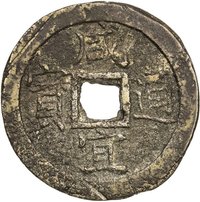
OBVERSE ↑
flip
Reverse
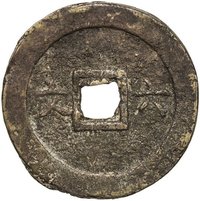
REVERSE ↑
References
Numista: #321309

Obverse

Description:
Four Chinese characters read vertically, right to left.
Inscription:


寶 通

 宜
Translation:
Eternal Treasure
Circulating
Fitting

Reverse

Description:
Blank (uniface).

Edge

Plain

Mintings

YearMint MarkMintageQualityCollection

Historical background

In 1884, the currency situation in the Empire of Vietnam was one of profound transition and fragmentation, directly reflecting its eroding sovereignty. The empire, under the nominal rule of Emperor Hàm Nghi, was caught in the throes of the colonial scramble for Indochina. The previous year, the Treaty of Huế had established a French protectorate over Annam and Tonkin, dismantling Vietnam's independent monetary authority. Consequently, multiple currency systems circulated simultaneously: the traditional Vietnamese cash coins (văn or sapèque) with their square holes, Mexican silver dollars (a dominant trade currency in East Asia), and newly introduced French colonial piastres. This created a chaotic and inefficient multi-tiered system where exchange rates fluctuated locally.

The traditional zinc and copper-alloy cash coins, strung together in strings of 600 coins (quan), remained the basis for everyday transactions and tax payments for the majority of the population. However, their value was unstable and their production was increasingly influenced by French authorities seeking to control the money supply. Meanwhile, large-scale trade and government finances were increasingly conducted in silver, particularly the Mexican dollar and its French-imprinted equivalent, the Indochinese piastre, which the French administration was actively promoting to facilitate colonial economic integration.

Thus, 1884 represents a pivotal moment where Vietnam's centuries-old imperial monetary system was being systematically dismantled and replaced. The coexistence of these currencies underscored the dual reality of the period: the lingering structures of the independent Vietnamese state existed alongside the encroaching financial infrastructure of French Indochina. This monetary fragmentation would soon be formally resolved with the establishment of the Bank of Indochina in 1887 and the imposition of a unified, French-controlled piastre system across the union of Indochina, fully subsuming Vietnam's fiscal autonomy.
Legendary