

200 lire – San Marino
Add to wishlist
Circulating commemorative coins
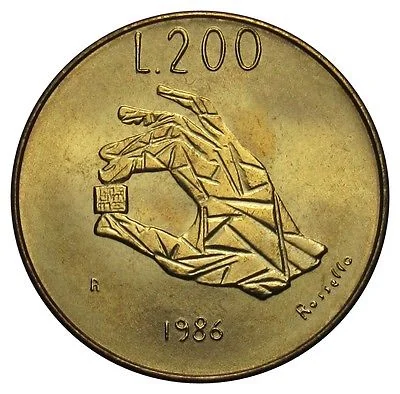
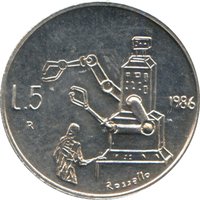
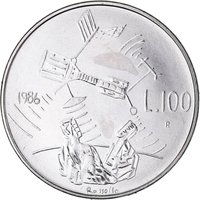
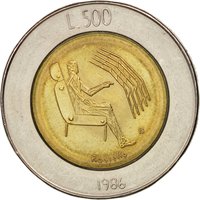
Commemoration: Hand with Transistor
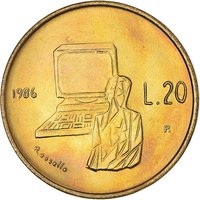
Series: Technological Revolution
San Marino
Context
Year: 1986
Issuer: San Marino
Period:
(since 301)
Currency:
(1864—2001)
Demonetization: 1 March 2002
Total mintage: 100,000
Material
Diameter: 24 mm
Weight: 5 g
Shape: Round
Composition: Aluminium bronze
Magnetic: No
Technique: Milled
Alignment: Coin alignment
flip
References
KM: #
Numista: #13686
Value
Exchange value: 200 SML
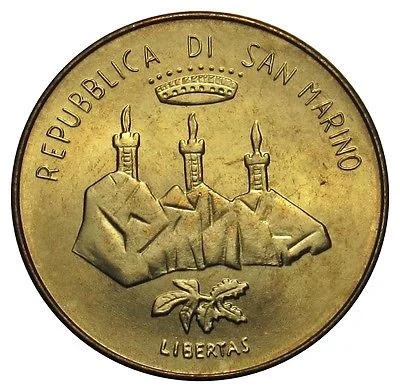
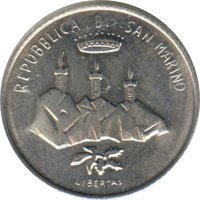
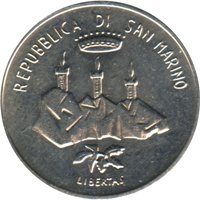
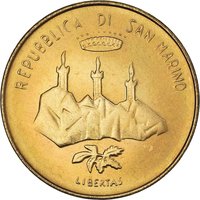
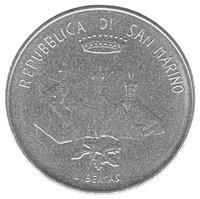
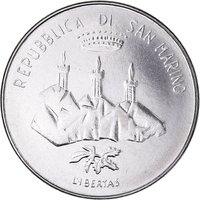
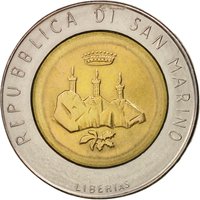
Obverse
Inscription:
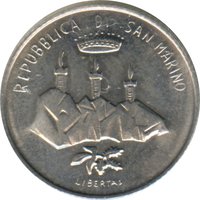
REPUBBLICA DI SAN MARINO
LIBERTAS
LIBERTAS
Translation:
Liberty Republic of San Marino
Script: Latin
Engraver: Mario Rossello
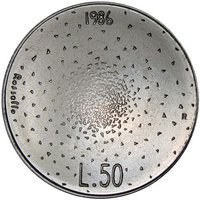
Reverse
Edge
Reeded
Mints
| Name | Mark |
|---|---|
| Rome | R |
Mintings
| Year | Mint Mark | Mintage | Quality | Collection |
|---|---|---|---|---|
| 1986 | R | 100,000 |
Historical background
In 1986, San Marino's currency situation was intrinsically tied to that of Italy, governed by a series of bilateral agreements. The Republic used the Italian Lira as its official legal tender, a relationship formalized after World War II. This arrangement was practical and necessary; San Marino, completely surrounded by Italy, conducted the vast majority of its economic and financial transactions with its much larger neighbor. While the Sammarinese government minted its own distinct coins (the Sammarinese Lira), these were issued in limited quantities, pegged at par with the Italian Lira, and circulated alongside Italian currency, primarily serving as commemorative or collectors' items rather than as a driver of independent monetary policy.
Economically, this meant San Marino had effectively ceded control over its monetary sovereignty to the Banca d'Italia. The republic could not independently influence interest rates, control money supply, or act as a lender of last resort. Its financial stability was directly contingent on Italy's economic performance and the strength of the Lira. During the mid-1980s, this was a period of relative stability for the Italian Lira within the European Monetary System (EMS), which provided a predictable framework for San Marino's trade and price levels, albeit one that would face significant stress later in the decade.
Furthermore, 1986 fell within a period where San Marino was beginning to more actively leverage its monetary agreements to develop its niche financial sector. The republic issued its own postage stamps and commemorative coins for international collectors, a significant source of state revenue. Critically, it also negotiated the right to issue limited amounts of gold and silver scudi (valued separately from the lira) for numismatics. These activities, alongside the maintenance of a low-tax environment and banking secrecy laws, were foundational to building an economy less dependent on Italy, even while its day-to-day currency remained the Italian Lira.
Economically, this meant San Marino had effectively ceded control over its monetary sovereignty to the Banca d'Italia. The republic could not independently influence interest rates, control money supply, or act as a lender of last resort. Its financial stability was directly contingent on Italy's economic performance and the strength of the Lira. During the mid-1980s, this was a period of relative stability for the Italian Lira within the European Monetary System (EMS), which provided a predictable framework for San Marino's trade and price levels, albeit one that would face significant stress later in the decade.
Furthermore, 1986 fell within a period where San Marino was beginning to more actively leverage its monetary agreements to develop its niche financial sector. The republic issued its own postage stamps and commemorative coins for international collectors, a significant source of state revenue. Critically, it also negotiated the right to issue limited amounts of gold and silver scudi (valued separately from the lira) for numismatics. These activities, alongside the maintenance of a low-tax environment and banking secrecy laws, were foundational to building an economy less dependent on Italy, even while its day-to-day currency remained the Italian Lira.
Series: Technological Revolution
🌱 Fairly Common