

1 Cash – Rebellion in Zhejiang
China
Context
Years: 1858–1864
Country: China 
Issuer: Rebellion in Zhejiang
Currency:
(1858—1864)
Demonetized: Yes
Material
Diameter: 25 mm
Weight: 4.39 g
Shape: Round with a square hole
Composition: Brass
Magnetic: No
Technique: Cast
Alignment: Medal alignment

flip
References
Numista: #318329
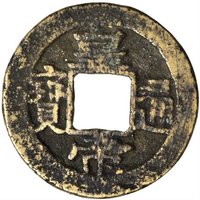
Obverse
Description:
Four Chinese characters read vertically, right to left.
Inscription:
黃
寶 通
帝
寶 通
帝
Translation:
Yellow Emperor's Precious Currency.
Scripts: Chinese (traditional, regular script)
Language: Classical Chinese
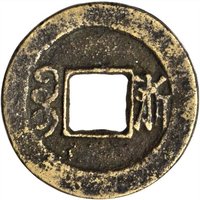
Reverse
Description:
A single Chinese character in multiple places.
Inscription:
聖
Translation:
Holy
Scripts: Chinese (traditional, regular script)
Language: Classical Chinese
Edge
Plain
Mintings
| Year | Mint Mark | Mintage | Quality | Collection |
|---|---|---|---|---|
| — | — | — |
Historical background
The 1858 rebellion in Zhejiang, primarily the ongoing struggle between Qing forces and the Taiping Heavenly Kingdom, unfolded within a context of severe monetary crisis that crippled the local economy and fueled social unrest. The core issue was the collapse of the state-sanctioned bimetallic system of silver taels and copper cash. A massive influx of debased, privately minted copper coinage, alongside a scarcity of silver caused by the Opium War indemnities and trade imbalances, led to wildly fluctuating exchange rates. This monetary chaos disrupted all market transactions, tax payments, and wages, impoverishing peasants, artisans, and merchants alike, and creating a fertile ground for rebellion.
The Taiping rebels themselves introduced their own currency in occupied areas, but their situation in Zhejiang was complex and often destabilizing. While they issued copper and silver coins bearing Taiping iconography to assert sovereignty and fund their military, their control was frequently unstable. The coexistence of debased Qing coinage, legitimate Qing currency, sporadic Taiping issues, and older Spanish silver dollars created a bewildering and unreliable monetary environment. Furthermore, the Taiping's frequent reliance on expropriation and requisition to sustain their armies often undermined any stability their own currency might have provided, perpetuating the very economic hardship that had contributed to the rebellion.
Ultimately, the currency situation was both a cause and a symptom of the disintegration of Qing state authority. The government's inability to maintain a stable monetary standard was a profound failure of one of its most basic sovereign functions. For the populace, the daily experience of worthless coinage and unpredictable prices was a tangible manifestation of a collapsing order. Thus, the rebellion in Zhejiang was not only a military and political conflict but also a severe economic crisis, where the struggle for control of money was inextricably linked to the struggle for control of the province itself.
The Taiping rebels themselves introduced their own currency in occupied areas, but their situation in Zhejiang was complex and often destabilizing. While they issued copper and silver coins bearing Taiping iconography to assert sovereignty and fund their military, their control was frequently unstable. The coexistence of debased Qing coinage, legitimate Qing currency, sporadic Taiping issues, and older Spanish silver dollars created a bewildering and unreliable monetary environment. Furthermore, the Taiping's frequent reliance on expropriation and requisition to sustain their armies often undermined any stability their own currency might have provided, perpetuating the very economic hardship that had contributed to the rebellion.
Ultimately, the currency situation was both a cause and a symptom of the disintegration of Qing state authority. The government's inability to maintain a stable monetary standard was a profound failure of one of its most basic sovereign functions. For the populace, the daily experience of worthless coinage and unpredictable prices was a tangible manifestation of a collapsing order. Thus, the rebellion in Zhejiang was not only a military and political conflict but also a severe economic crisis, where the struggle for control of money was inextricably linked to the struggle for control of the province itself.

✨ Legendary