

500 kroner – Denmark
Add to wishlist
Non-circulating coins
Commemoration: 50th Jubilee of Her Majesty the Queen on14 January 2022
Denmark
Context
Year: 2022
Issuer: Denmark
Issuing organization: National Bank of Denmark
Ruler: Margrethe II
Currency:
(since 1873)
Material
Diameter: 38 mm
Weight: 31.1 g
Silver Weight:: 31.07 g
Shape: Round
Composition: 99.9% Silver
Standard: Silver ounce
Magnetic: No
Technique: Milled
Alignment: Medal alignment
flip
References
KM: #
Numista: #318244
Value
Exchange value: 500 DKK
Bullion value: $77.64
Inflation-adjusted value: 565.38 DKK
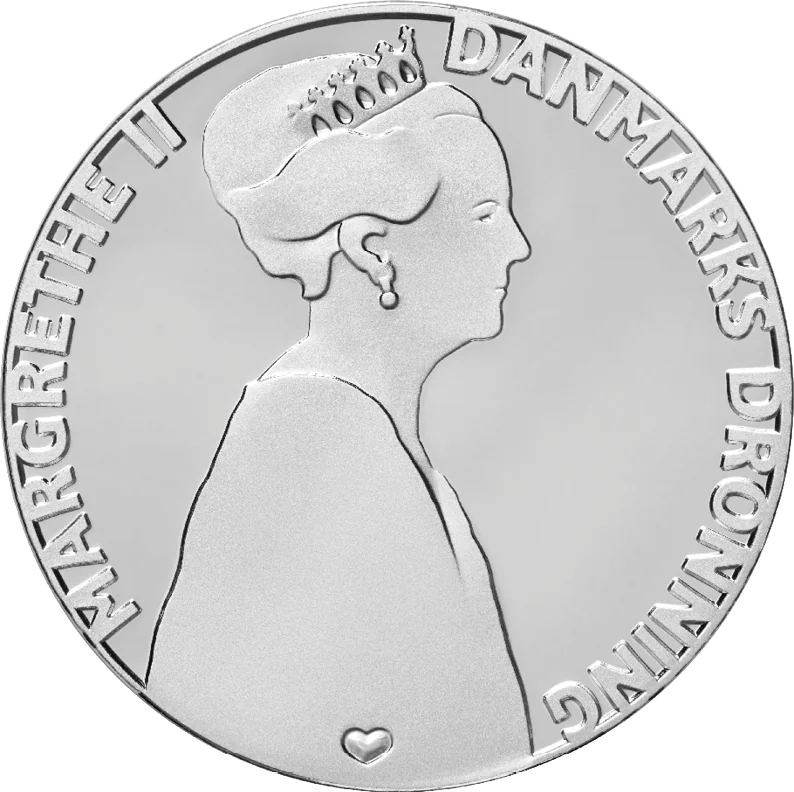
Obverse
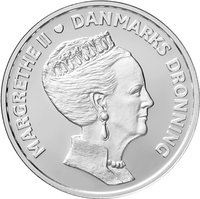
Description:
Queen in profile facing right. Text encircles rim.
Inscription:
MARGRETHE II DANMARKS DRONNING ♥︎
Translation:
MARGRETHE II QUEEN OF DENMARK ♥︎
Script: Latin
Language: Danish
Designer: Kathrine Moseholm
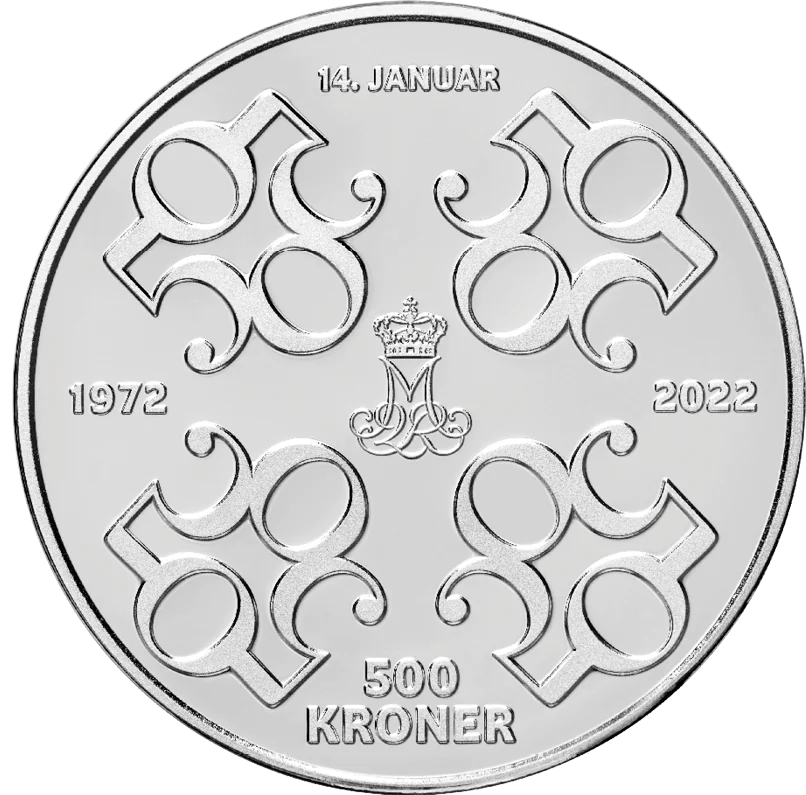
Reverse
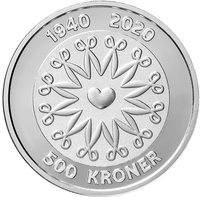
Description:
Pattern of 50.
Inscription:
14. JANUAR
1972 2022
500
KRONER
1972 2022
500
KRONER
Script: Latin
Designer: Jeanette Skov Jensen
Edge
Plain
Mints
| Name | Mark |
|---|---|
| Mint of Finland | — |
Mintings
| Year | Mint Mark | Mintage | Quality | Collection |
|---|---|---|---|---|
| 2022 | ♥︎ | — | Proof |
Historical background
In 2022, Denmark's currency situation was defined by its long-standing and stable peg of the Danish krone (DKK) to the euro through the European Exchange Rate Mechanism II (ERM II). This policy, managed by Danmarks Nationalbank, aims to maintain a stable exchange rate, with the central rate set at 746.038 kroner per 100 euros, allowing a narrow fluctuation band of ±2.25%. Throughout the year, the krone faced upward pressure due to significant global inflationary trends and interest rate hikes by major central banks, including the European Central Bank (ECB) and the US Federal Reserve. To defend the peg and keep the krone from appreciating too strongly—which could hurt exports—Danmarks Nationalbank conducted substantial interventions in the foreign exchange market, primarily by selling kroner and buying foreign currency.
This active monetary policy required Danmarks Nationalbank to frequently adjust its key interest rates, often mirroring but slightly exceeding moves by the ECB to maintain the necessary interest rate differential that makes holding euros marginally more attractive than kroner. Consequently, 2022 saw a series of rate increases, with the benchmark deposit rate rising from -0.75% at the end of 2021 to 0.65% by the fourth quarter of 2022. These moves were defensive actions to curb capital inflows seeking higher returns in Denmark, rather than a primary tool to combat domestic inflation, though they contributed to tightening financial conditions.
Overall, the Danish krone remained remarkably stable against the euro throughout the year, a testament to the credibility of the fixed exchange rate policy upheld for decades. While the external environment of high inflation and rising global rates presented operational challenges and led to a considerable expansion of foreign currency reserves, the core framework proved resilient. The situation underscored Denmark's unique position within the European Union: closely aligned with Eurozone monetary policy while retaining its own currency and the ability to conduct independent interventions to ensure stability.
This active monetary policy required Danmarks Nationalbank to frequently adjust its key interest rates, often mirroring but slightly exceeding moves by the ECB to maintain the necessary interest rate differential that makes holding euros marginally more attractive than kroner. Consequently, 2022 saw a series of rate increases, with the benchmark deposit rate rising from -0.75% at the end of 2021 to 0.65% by the fourth quarter of 2022. These moves were defensive actions to curb capital inflows seeking higher returns in Denmark, rather than a primary tool to combat domestic inflation, though they contributed to tightening financial conditions.
Overall, the Danish krone remained remarkably stable against the euro throughout the year, a testament to the credibility of the fixed exchange rate policy upheld for decades. While the external environment of high inflation and rising global rates presented operational challenges and led to a considerable expansion of foreign currency reserves, the core framework proved resilient. The situation underscored Denmark's unique position within the European Union: closely aligned with Eurozone monetary policy while retaining its own currency and the ability to conduct independent interventions to ensure stability.
💎 Very Rare