

500 kroner (Queen Margrethe II) – Denmark
Add to wishlist
Non-circulating coins
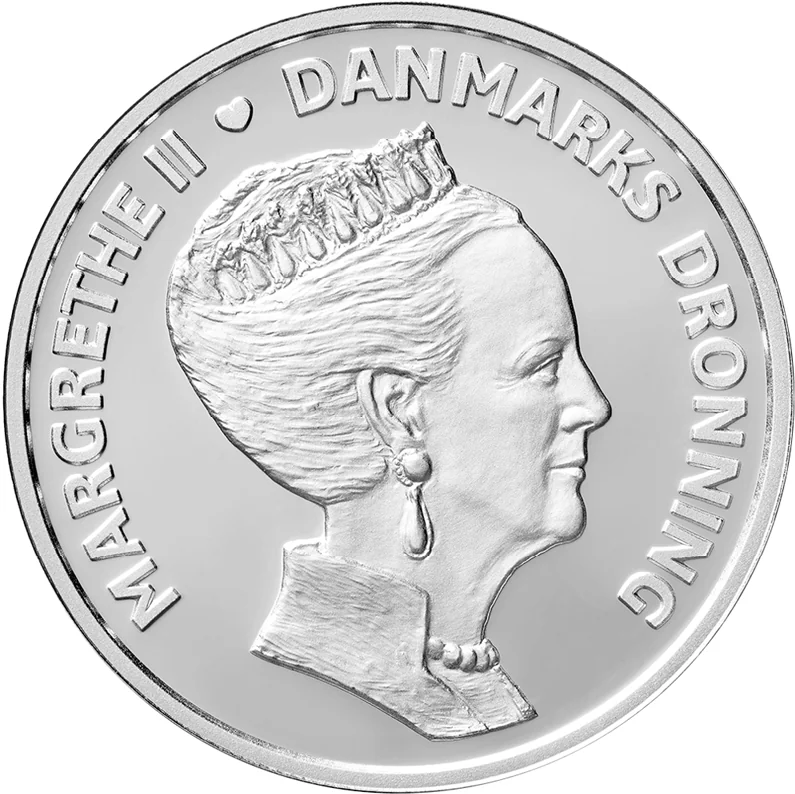
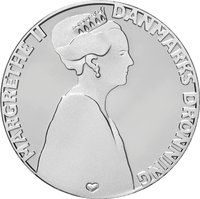
Commemoration: Queen Margrethe II's 80th birthday
Denmark
Context
Material
Diameter: 38 mm
Weight: 31.1 g
Silver Weight:: 31.07 g
Shape: Round
Composition: 99.9% Silver
Standard: Silver ounce
Magnetic: No
Technique: Milled
Alignment: Medal alignment
flip
References
KM: #
Numista: #207285
Value
Exchange value: 500 DKK
Bullion value: $76.73
Inflation-adjusted value: 578.26 DKK
Obverse
Reverse
Description:
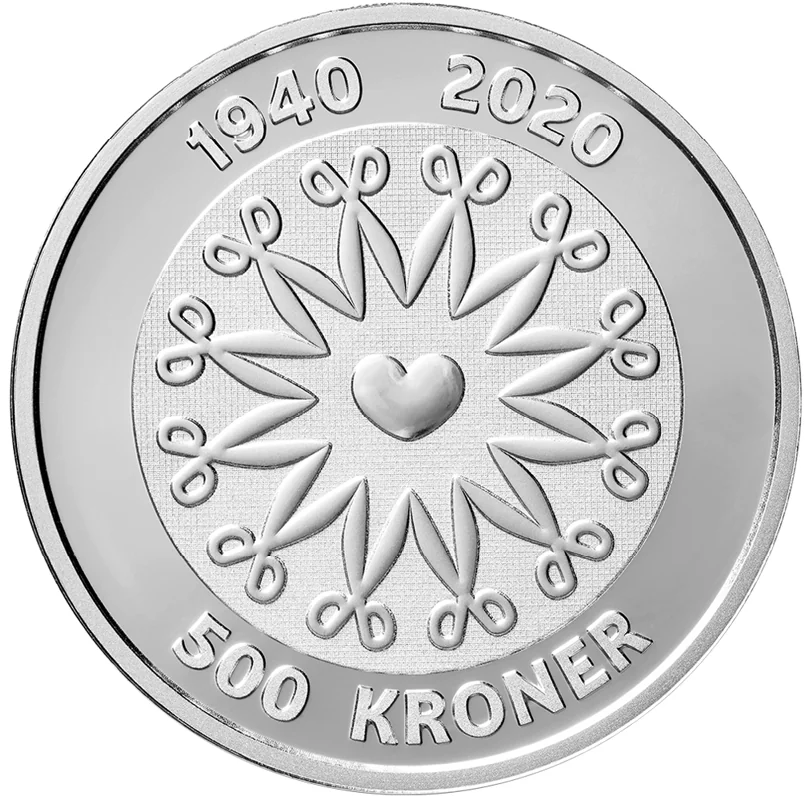
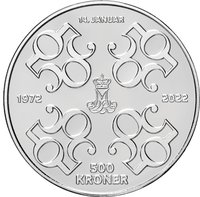
A heart encircled by 12 scissor pairs forms an 'M' for Margrethe. The heart symbolizes the people's love, the circle Denmark's strength and unity, reflecting the Queen's motto and artistry.
Inscription:
1940 2020
500 KRONER
500 KRONER
Script: Latin
Edge
Plain
Categories
| Event> Birth anniversary |
| Person> Monarch |
Mints
| Name | Mark |
|---|---|
| Mint of Finland | — |
Mintings
| Year | Mint Mark | Mintage | Quality | Collection |
|---|---|---|---|---|
| 2020 | — | — |
Historical background
In 2020, Denmark's currency situation was defined by its long-standing and stable peg of the Danish krone (DKK) to the euro through the European Exchange Rate Mechanism II (ERM II). This policy, managed by Danmarks Nationalbank, aimed to maintain a stable exchange rate, with the central rate set at 746.038 kroner per 100 euros, allowing for a narrow fluctuation band of ±2.25%. This framework provided economic certainty for Denmark, a European Union member with an opt-out from the euro, and was a cornerstone of its monetary policy.
The year was dominated by the economic shock of the COVID-19 pandemic, which triggered significant safe-haven flows into traditional reserve currencies. This created substantial upward pressure on the krone, as investors sought stable assets. To defend the peg and prevent the krone from appreciating too strongly—which could hurt exports—Danmarks Nationalbank intervened heavily in the foreign exchange market throughout 2020 by selling kroner and buying foreign currency. This action was accompanied by a series of interest rate cuts, bringing the key certificate of deposit rate to a historic low of -0.60% by year's end, making it less attractive to hold kroner.
Despite the global turmoil, the peg proved resilient. The central bank's decisive interventions and negative interest rate policy successfully maintained the krone within its target band, albeit often at the stronger end of the spectrum. Consequently, 2020 underscored the effectiveness of Denmark's currency regime in a crisis, demonstrating the national bank's commitment and capacity to uphold the fixed exchange rate, which remained a fundamental anchor for the Danish economy throughout the pandemic's uncertainty.
The year was dominated by the economic shock of the COVID-19 pandemic, which triggered significant safe-haven flows into traditional reserve currencies. This created substantial upward pressure on the krone, as investors sought stable assets. To defend the peg and prevent the krone from appreciating too strongly—which could hurt exports—Danmarks Nationalbank intervened heavily in the foreign exchange market throughout 2020 by selling kroner and buying foreign currency. This action was accompanied by a series of interest rate cuts, bringing the key certificate of deposit rate to a historic low of -0.60% by year's end, making it less attractive to hold kroner.
Despite the global turmoil, the peg proved resilient. The central bank's decisive interventions and negative interest rate policy successfully maintained the krone within its target band, albeit often at the stronger end of the spectrum. Consequently, 2020 underscored the effectiveness of Denmark's currency regime in a crisis, demonstrating the national bank's commitment and capacity to uphold the fixed exchange rate, which remained a fundamental anchor for the Danish economy throughout the pandemic's uncertainty.
💎 Very Rare