

1 Cash – Guangdong Triad Society
China
Context
Years: 1857–1858
Country: China 
Issuer: Guangdong Triad Society
Currency:
(1851—1858)
Demonetized: Yes
Material
Diameter: 25 mm
Shape: Round with a square hole
Composition: Brass
Magnetic: No
Technique: Cast
Alignment: Medal alignment

flip
References
Numista: #318187
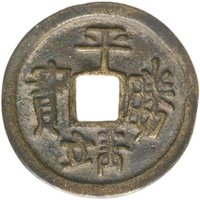
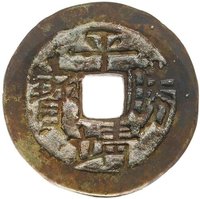
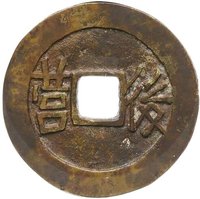
Obverse
Description:
Four Chinese characters read vertically, right to left.
Inscription:
平
寶 勝
靖
寶 勝
靖
Translation:
Ping Sheng Bao
Jing
Jing
Scripts: Chinese (traditional, regular script)
Language: Chinese
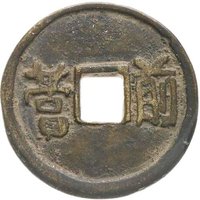
Reverse
Description:
Two Chinese characters read right to left.
Inscription:
营左
Translation:
Camp Left
Scripts: Chinese (traditional, regular script)
Language: Classical Chinese
Edge
Plain
Mintings
| Year | Mint Mark | Mintage | Quality | Collection |
|---|---|---|---|---|
| — | — | — |
Historical background
In 1857, the currency situation within Guangdong's Triad societies (collectively part of the Hung Mun or Heaven and Earth Society) was defined by profound instability and opportunistic adaptation. The broader provincial economy was in disarray following the Second Opium War (1856-1860), with British forces occupying Guangzhou. Official Qing dynasty coinage—silver taels and copper-alloy cash coins—suffered from severe debasement, counterfeiting, and inconsistent supply, undermining public trust in the monetary system. This chaos was exacerbated by the widespread circulation of foreign silver dollars (like Spanish Carolus and Mexican pesos), which were often chopped or stamped by local merchants to verify purity, creating a fragmented and complex currency environment.
For the secret societies, which were deeply involved in anti-Qing rebellion, protection rackets, and controlling the opium trade, this monetary fragmentation presented both a challenge and an opportunity. They required reliable means to fund their operations, pay members, and procure supplies. It is documented that some Triad lodges issued their own promissory notes and private scrip for use within their networks, a practice that bolstered internal cohesion and financial independence from Qing authorities. More significantly, their involvement in illicit trades meant they commonly transacted in bulk silver sycee and foreign silver dollars, the most trusted and liquid stores of value amidst the depreciating official currency.
Thus, the Triads' currency practices in 1857 were less about creating a unified monetary system and more about pragmatic navigation of a collapsing one. They operated as both shadow bankers and insurgents, leveraging the chaos to build parallel economic structures. Their financial resilience relied on hard currency from illegal commerce and localized credit instruments, which directly supported their ultimate political aim: to fund a rebellion capable of overthrowing the Qing dynasty in the region.
For the secret societies, which were deeply involved in anti-Qing rebellion, protection rackets, and controlling the opium trade, this monetary fragmentation presented both a challenge and an opportunity. They required reliable means to fund their operations, pay members, and procure supplies. It is documented that some Triad lodges issued their own promissory notes and private scrip for use within their networks, a practice that bolstered internal cohesion and financial independence from Qing authorities. More significantly, their involvement in illicit trades meant they commonly transacted in bulk silver sycee and foreign silver dollars, the most trusted and liquid stores of value amidst the depreciating official currency.
Thus, the Triads' currency practices in 1857 were less about creating a unified monetary system and more about pragmatic navigation of a collapsing one. They operated as both shadow bankers and insurgents, leveraging the chaos to build parallel economic structures. Their financial resilience relied on hard currency from illegal commerce and localized credit instruments, which directly supported their ultimate political aim: to fund a rebellion capable of overthrowing the Qing dynasty in the region.

✨ Legendary