

1 Cash – Taiping Heavenly Kingdom
China
Context
Years: 1861–1864
Country: China 
Issuer: Taiping Heavenly Kingdom
Ruler: Hong Xiuquan
Currency:
(1853—1864)
Demonetized: Yes
Material
Diameter: 25 mm
Shape: Round with a square hole
Composition: Brass
Magnetic: No
Technique: Cast
Alignment: Medal alignment
flip
References
Numista: #318081
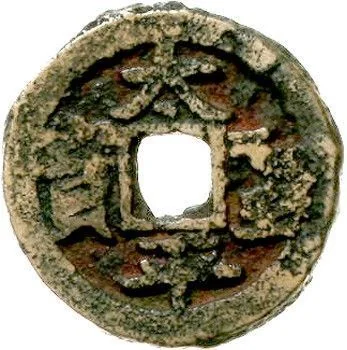
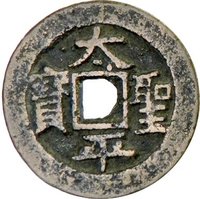
Obverse
Description:
Four Chinese characters read vertically, right to left.
Inscription:
太
寶 聖
平
寶 聖
平
Translation:
Great Treasure of the Sage and Pacified [Reign]
Scripts: Chinese (traditional, regular script)
Language: Classical Chinese
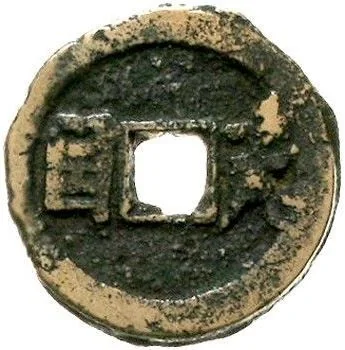
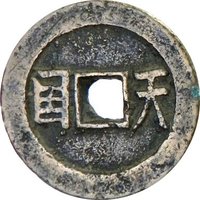
Reverse
Description:
Two Chinese characters read right to left.
Inscription:
國天
Translation:
Heaven-Supported Nation
Scripts: Chinese (traditional, regular script)
Language: Classical Chinese
Edge
Plain
Mintings
| Year | Mint Mark | Mintage | Quality | Collection |
|---|---|---|---|---|
| — | — | — |
Historical background
By 1861, the currency system of the Taiping Heavenly Kingdom was in a state of severe crisis, undermining its economic stability and war effort. The rebel state, having established its capital at Nanjing in 1853, initially issued its own currency to assert sovereignty and fund its campaign against the Qing Dynasty. These coins, made of bronze, silver, and even gold, bore unique inscriptions promoting Taiping theology, replacing traditional Qing reign titles with phrases like "Holy Treasure" (Sheng Bao). Paper notes were also introduced, a radical step in mid-19th century China.
However, by the critical year of 1861, the system was collapsing under military and logistical pressure. The Taiping's controlled territory was shrinking and becoming fragmented as Qing forces, aided by Western-led units like the Ever-Victorious Army, advanced. This disrupted the supply of metals and the centralized minting process, leading to widespread forgery and a drastic decline in the quality and trustworthiness of the currency. Coins became crudely cast and debased, while paper money, never widely accepted, became virtually worthless outside of heavily garrisoned Taiping strongholds.
Consequently, the economy within Taiping areas regressed to a chaotic mix of barter, the use of old Qing coinage, and reliance on sporadic military requisitioning. This monetary failure severely hampered the Taiping's ability to pay troops, purchase supplies, and administer their remaining territories, contributing directly to their weakening resistance. The currency's collapse in 1861 was both a symptom and a cause of the Heavenly Kingdom's impending defeat, reflecting the loss of economic coherence long before its final military fall in 1864.
However, by the critical year of 1861, the system was collapsing under military and logistical pressure. The Taiping's controlled territory was shrinking and becoming fragmented as Qing forces, aided by Western-led units like the Ever-Victorious Army, advanced. This disrupted the supply of metals and the centralized minting process, leading to widespread forgery and a drastic decline in the quality and trustworthiness of the currency. Coins became crudely cast and debased, while paper money, never widely accepted, became virtually worthless outside of heavily garrisoned Taiping strongholds.
Consequently, the economy within Taiping areas regressed to a chaotic mix of barter, the use of old Qing coinage, and reliance on sporadic military requisitioning. This monetary failure severely hampered the Taiping's ability to pay troops, purchase supplies, and administer their remaining territories, contributing directly to their weakening resistance. The currency's collapse in 1861 was both a symptom and a cause of the Heavenly Kingdom's impending defeat, reflecting the loss of economic coherence long before its final military fall in 1864.
✨ Legendary