

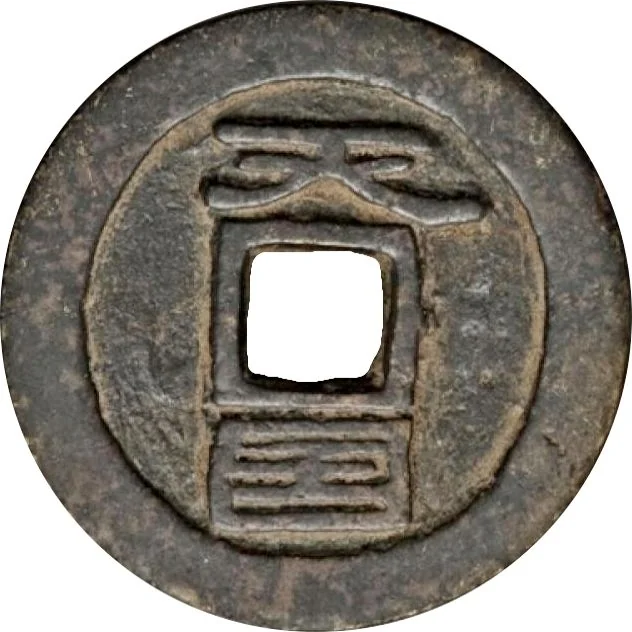
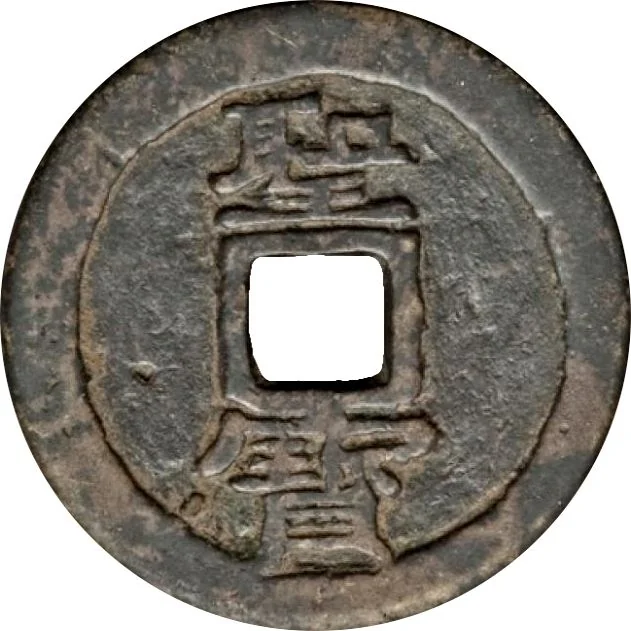
1 cash – Taiping Heavenly Kingdom
Add to wishlist
China
Context
Years: 1853–1855
Country: China
Issuer: Taiping Heavenly Kingdom
Ruler: Hong Xiuquan
Currency:
(1853—1864)
Demonetized: Yes
Material
Diameter: 25 mm
Weight: 4.95 g
Shape: Round with a square hole
Composition: Brass
Magnetic: No
Technique: Cast
Alignment: Medal alignment
flip
References
Numista: #318072
Obverse
Description:
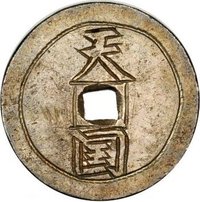
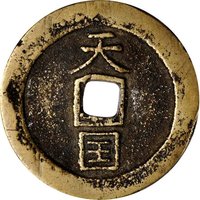
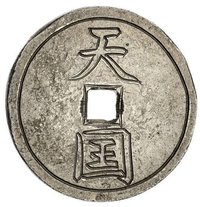
Two Chinese characters read vertically.
Inscription:
天
国
国
Translation:
Heavenly Kingdom
Scripts: Chinese (traditional, regular script)
Language: Chinese
Reverse
Description:
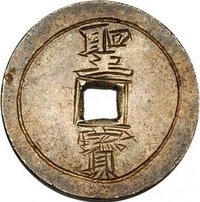
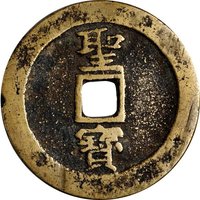
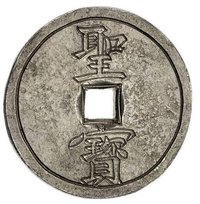
Two Chinese characters read vertically.
Inscription:
聖
寶
寶
Translation:
Sacred Treasure
Scripts: Chinese (traditional, regular script)
Language: Classical Chinese
Edge
Plain
Mintings
| Year | Mint Mark | Mintage | Quality | Collection |
|---|---|---|---|---|
| — | — | — |
Historical background
During the early years of the Taiping Heavenly Kingdom (1851-1864), the rebel state faced acute economic challenges after establishing its capital at Nanjing in 1853. Having seized control of a wealthy region but engaged in constant warfare with the Qing dynasty, the Taiping leadership needed to fund its administration and military while disavowing the imperial financial system. Their solution was to issue a new currency, asserting sovereignty and economic independence. This initiative was led by Hong Xiuquan’s cousin, Hong Rengan, who understood the symbolic and practical power of a state minting its own money.
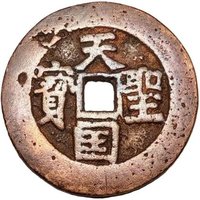
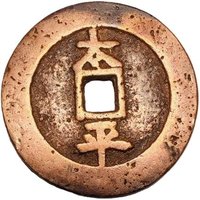
The Taiping coins were crude, minted from brass, iron, lead, and even silver, with quality deteriorating over time due to material shortages and technical limitations. They were inscribed with the characters "Taiping Tianguo" (Heavenly Kingdom of Great Peace) on one side and "Sheng Bao" (Holy Treasure) on the other, replacing the Qing emperor's reign title with Taiping religious and political ideology. While revolutionary in concept, the currency faced severe practical hurdles. Widespread public distrust, lack of a unified monetary system, and the inability to suppress circulating Qing coinage and foreign silver dollars prevented it from achieving stability.
Consequently, the Taiping currency never functioned as a successful, unified medium of exchange. It circulated primarily within garrison cities and for official purposes, failing to displace the established Qing and Spanish silver currencies that continued to dominate commerce even in Taiping-controlled areas. This monetary failure reflected the broader struggles of the Taiping state: though ambitious in ideology, it lacked the administrative cohesion, economic resources, and lasting territorial control necessary to implement a fundamental financial overhaul amidst the chaos of civil war.
The Taiping coins were crude, minted from brass, iron, lead, and even silver, with quality deteriorating over time due to material shortages and technical limitations. They were inscribed with the characters "Taiping Tianguo" (Heavenly Kingdom of Great Peace) on one side and "Sheng Bao" (Holy Treasure) on the other, replacing the Qing emperor's reign title with Taiping religious and political ideology. While revolutionary in concept, the currency faced severe practical hurdles. Widespread public distrust, lack of a unified monetary system, and the inability to suppress circulating Qing coinage and foreign silver dollars prevented it from achieving stability.
Consequently, the Taiping currency never functioned as a successful, unified medium of exchange. It circulated primarily within garrison cities and for official purposes, failing to displace the established Qing and Spanish silver currencies that continued to dominate commerce even in Taiping-controlled areas. This monetary failure reflected the broader struggles of the Taiping state: though ambitious in ideology, it lacked the administrative cohesion, economic resources, and lasting territorial control necessary to implement a fundamental financial overhaul amidst the chaos of civil war.

✨ Legendary