

10 Cash – South Xinjiang
China
Context
Years: 1883–1885
Country: China 
Issuer: South Xinjiang
Ruler: Daoguang
Currency:
(1759—1909)
Demonetized: Yes
Material
Diameter: 25 mm
Shape: Round with a square hole
Composition: Copper
Magnetic: No
Technique: Cast
Alignment: Medal alignment
flip
References
Numista: #317959
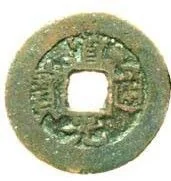
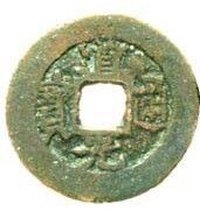
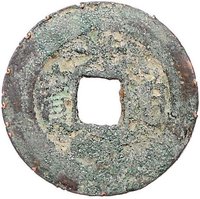
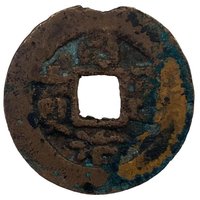
Obverse
Description:
Four Chinese characters read vertically, right to left.
Inscription:
道
寶 通
光
寶 通
光
Translation:
Daoguang
Tongbao
Tongbao
Scripts: Chinese (traditional, regular script)
Language: Chinese
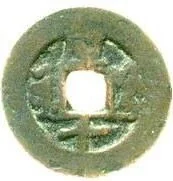
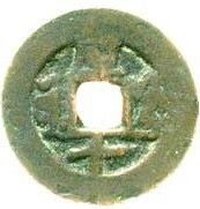
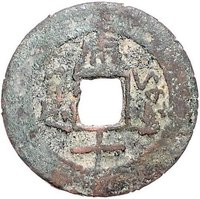
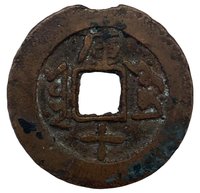
Reverse
Description:
One Chinese character above and below, with Uyghur to the right and Manchu to the left.
Inscription:
庫
ᡴᡠᠴᠠ كوچا
十
ᡴᡠᠴᠠ كوچا
十
Translation:
Treasury
Kucha
Ten
Kucha
Ten
Edge
Plain
Mints
| Name | Mark |
|---|---|
| Kucha Mint | — |
Mintings
| Year | Mint Mark | Mintage | Quality | Collection |
|---|---|---|---|---|
| — | — | — |
Historical background
In 1883, the currency situation in South Xinjiang (the Tarim Basin region) was characterized by profound complexity and instability, a direct legacy of the region's recent turbulent history. Following the reconquest of the region from the Yakub Beg-led Kokandi state by Qing forces in the late 1870s, the monetary system was a fragmented patchwork. Official Qing currency—primarily silver sycees (ingots) and copper cash coins with square holes—co-existed with large quantities of older, locally struck coins from various regimes, including the depreciated "pul" coins from the Kashgaria period. The scarcity of standardized Qing coinage, coupled with the vast distances from central China, meant that the official currency was often in short supply, failing to meet the needs of local trade and taxation.
This scarcity led to widespread use of amorphous silver bullion by weight (measured in tæls and misqals) for larger transactions, a practice prone to fraud and inefficiency. Furthermore, the region's pivotal position on Central Asian trade routes ensured a continuous inflow of foreign currencies, most notably Russian Imperial silver rubles and gold tillas, as well as Indian rupees. These foreign coins, particularly the Russian ruble, were often preferred for their reliable silver content and played a major role in commerce, undermining Qing monetary sovereignty. Local authorities, including Qing ambans and beg officials, struggled to impose order, facing counterfeiting, erratic exchange rates, and the logistical nightmare of transporting heavy copper cash across the desert.
The year 1883 itself marked a critical turning point, as it was the year the Qing formally established Xinjiang Province, with Liu Jintang as its first governor. A primary objective of this new administration was to standardize and centralize the monetary system to solidify Qing control and facilitate economic integration. While full reform would take years, 1883 set the stage for systematic efforts to mint and circulate unified copper and silver coins bearing the reign title of Emperor Guangxu from a new mint in Kashgar, aiming to gradually displace the chaotic mix of old and foreign currencies that defined the post-reconquest economy.
This scarcity led to widespread use of amorphous silver bullion by weight (measured in tæls and misqals) for larger transactions, a practice prone to fraud and inefficiency. Furthermore, the region's pivotal position on Central Asian trade routes ensured a continuous inflow of foreign currencies, most notably Russian Imperial silver rubles and gold tillas, as well as Indian rupees. These foreign coins, particularly the Russian ruble, were often preferred for their reliable silver content and played a major role in commerce, undermining Qing monetary sovereignty. Local authorities, including Qing ambans and beg officials, struggled to impose order, facing counterfeiting, erratic exchange rates, and the logistical nightmare of transporting heavy copper cash across the desert.
The year 1883 itself marked a critical turning point, as it was the year the Qing formally established Xinjiang Province, with Liu Jintang as its first governor. A primary objective of this new administration was to standardize and centralize the monetary system to solidify Qing control and facilitate economic integration. While full reform would take years, 1883 set the stage for systematic efforts to mint and circulate unified copper and silver coins bearing the reign title of Emperor Guangxu from a new mint in Kashgar, aiming to gradually displace the chaotic mix of old and foreign currencies that defined the post-reconquest economy.

✨ Legendary