

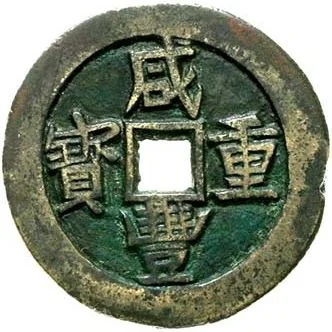
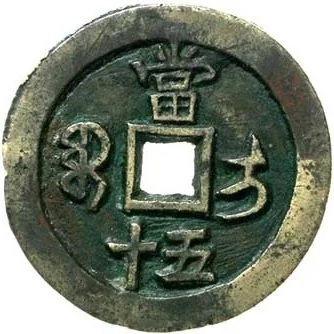
50 Cash – South Xinjiang
China
Context
Years: 1854–1855
Country: China 
Issuer: South Xinjiang
Ruler: Xianfeng
Currency:
(1759—1909)
Demonetized: Yes
Material
Diameter: 46 mm
Weight: 33.01 g
Shape: Round with a square hole
Composition: Copper
Magnetic: No
Technique: Cast
Alignment: Medal alignment
flip
References
Numista: #317877
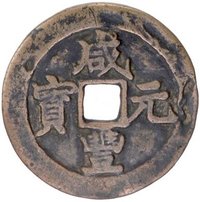
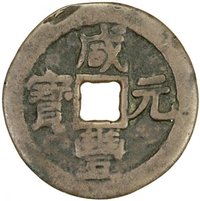
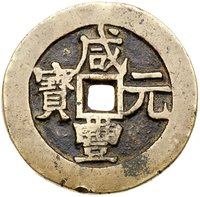
Obverse
Description:
Four Chinese characters read vertically, right to left.
Inscription:
咸
寶 重
豐
寶 重
豐
Translation:
Xianfeng
Treasured Coin
Valuable
Treasured Coin
Valuable
Scripts: Chinese (traditional, regular script)
Language: Chinese
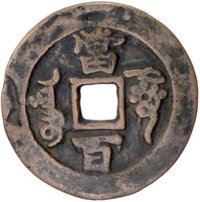
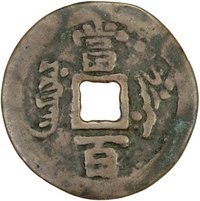
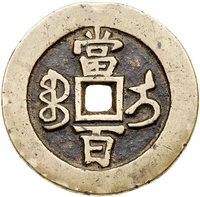
Reverse
Description:
One Chinese character above and below, flanking two vertical Manchu words split by the hole.
Inscription:
當
ᠪᠣᠣ ᡳ
十五
ᠪᠣᠣ ᡳ
十五
Translation:
Dang
Boo i
Juwan juwe
Boo i
Juwan juwe
Edge
Plain
Mintings
| Year | Mint Mark | Mintage | Quality | Collection |
|---|---|---|---|---|
| — | — | — |
Historical background
In 1854, the currency situation in the region known as South Xinjiang (the Tarim Basin, centered on cities like Kashgar and Yarkand) was defined by profound instability and competing systems. The area was not under direct Qing Dynasty control at the time, having been lost in 1826 to the Khoqand Khanate and the rebellions of Jahangir Khoja and his successors. The primary circulating currency was the pul, a small copper coin locally minted by the various Khoqandi-appointed rulers (Hakim Begs) in cities like Kashgar, Yarkand, and Khotan. These coins were often debased, of inconsistent weight and alloy, leading to chronic inflation and a severe lack of trust in the monetary system for daily trade.
Simultaneously, the region operated within a complex web of overlapping monetary spheres. Silver played a crucial role for larger transactions and long-distance trade, primarily in the form of Yambu (silver ingots) from China and Khoqand Tillas (silver coins). The persistence of the Chinese silver tael system, a legacy from earlier Qing rule, remained a benchmark for value. Furthermore, the economic influence of the Khoqand Khanate was cemented through a "currency imperialism," where a tax called the tagh was collected specifically in Khoqand-minted coins, forcing the local economy to engage with and acquire this external currency.
This monetary fragmentation mirrored the political chaos. With no central authority guaranteeing value, exchange rates between pul, silver ingots, and foreign coins fluctuated wildly, hampering commerce and exacerbating local hardship. The situation created a ripe environment for the imminent Qing reconquest, which would begin in earnest under Zuo Zongtang in the mid-1870s. A primary objective of this campaign would be to abolish the Khoqandi coinage and re-impose a standardized Qing currency system, seeking to restore economic and political order through monetary unification.
Simultaneously, the region operated within a complex web of overlapping monetary spheres. Silver played a crucial role for larger transactions and long-distance trade, primarily in the form of Yambu (silver ingots) from China and Khoqand Tillas (silver coins). The persistence of the Chinese silver tael system, a legacy from earlier Qing rule, remained a benchmark for value. Furthermore, the economic influence of the Khoqand Khanate was cemented through a "currency imperialism," where a tax called the tagh was collected specifically in Khoqand-minted coins, forcing the local economy to engage with and acquire this external currency.
This monetary fragmentation mirrored the political chaos. With no central authority guaranteeing value, exchange rates between pul, silver ingots, and foreign coins fluctuated wildly, hampering commerce and exacerbating local hardship. The situation created a ripe environment for the imminent Qing reconquest, which would begin in earnest under Zuo Zongtang in the mid-1870s. A primary objective of this campaign would be to abolish the Khoqandi coinage and re-impose a standardized Qing currency system, seeking to restore economic and political order through monetary unification.

✨ Legendary