

10 Cash – South Xinjiang
China
Context
Years: 1853–1861
Country: China 
Issuer: South Xinjiang
Ruler: Xianfeng
Currency:
(1759—1909)
Demonetized: Yes
Material
Diameter: 26 mm
Shape: Round with a square hole
Composition: Copper
Magnetic: No
Technique: Cast
Alignment: Medal alignment

flip
References
Numista: #317874
Obverse
Description:
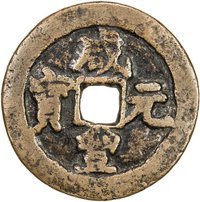
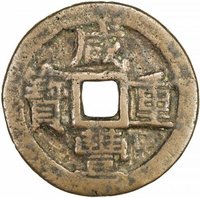
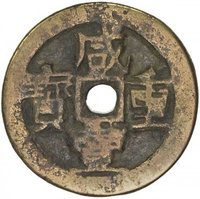
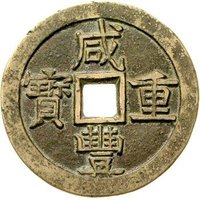
Four Chinese characters read vertically, right to left.
Inscription:
咸
寶 通
豐
寶 通
豐
Translation:
Xianfeng.
Tongbao.
Tongbao.
Scripts: Chinese (traditional, regular script)
Language: Chinese
Reverse
Description:
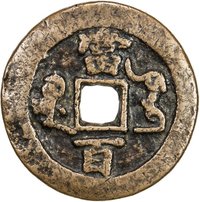
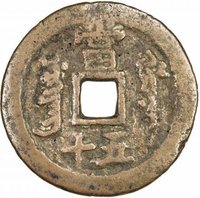
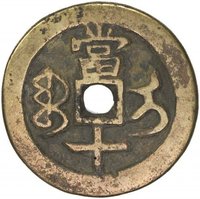
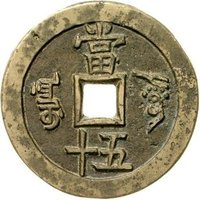
Chinese ideograms above and below, Uyghur to the right, Manchu to the left.
Inscription:
當
ᠶᡝᡵᡴᡳᠶᠠᠩ ياركند
十
ᠶᡝᡵᡴᡳᠶᠠᠩ ياركند
十
Translation:
Yarkand
Ten
Ten
Edge
Plain
Mints
| Name | Mark |
|---|---|
| Yarkand Mint | — |
Mintings
| Year | Mint Mark | Mintage | Quality | Collection |
|---|---|---|---|---|
| — | — | — |
Historical background
In 1853, the currency situation in South Xinjiang (the Tarim Basin region) was characterized by severe instability and fragmentation, a direct consequence of the ongoing turmoil of the Dungan Revolt (1853-1877). The widespread anti-Qing uprisings disrupted the fragile monetary systems that had existed under the administration of the Qing Dynasty. Official Qing coinage, primarily copper cash coins (wen) produced in state mints, faced severe shortages as supply lines from central China were severed and local Qing authority collapsed. This breakdown created a vacuum that led to a crisis of both supply and trust in standardized currency.
The monetary landscape fractured into a patchwork of local and improvised solutions. In various oasis cities like Kashgar, Yarkand, and Khotan, local Muslim rulers and rebel leaders began striking their own crude copper coins, often of inferior alloy and inconsistent weight, to facilitate basic trade and pay troops. These issues competed with remaining stocks of older Qing coins, Chinese silver sycee ingots (valued by weight), and a persistent influx of foreign silver coins, particularly the Mexican silver dollar, which served as a more trusted, high-value medium for larger transactions. The simultaneous circulation of these multiple forms of money, without fixed exchange rates, led to widespread confusion, arbitrage, and economic hardship for the common population.
Ultimately, the currency chaos of 1853 was a symptom of the profound political disintegration in the region. There was no central authority to guarantee value, enforce standards, or manage supply. This environment of monetary anarchy stifered regional commerce, encouraged hoarding, and contributed to inflationary pressures, as the value of locally minted coins plummeted against silver. The situation would remain volatile and fragmented until the eventual Qing reconquest of the region in the late 1870s, which sought to re-impose a unified imperial currency system.
The monetary landscape fractured into a patchwork of local and improvised solutions. In various oasis cities like Kashgar, Yarkand, and Khotan, local Muslim rulers and rebel leaders began striking their own crude copper coins, often of inferior alloy and inconsistent weight, to facilitate basic trade and pay troops. These issues competed with remaining stocks of older Qing coins, Chinese silver sycee ingots (valued by weight), and a persistent influx of foreign silver coins, particularly the Mexican silver dollar, which served as a more trusted, high-value medium for larger transactions. The simultaneous circulation of these multiple forms of money, without fixed exchange rates, led to widespread confusion, arbitrage, and economic hardship for the common population.
Ultimately, the currency chaos of 1853 was a symptom of the profound political disintegration in the region. There was no central authority to guarantee value, enforce standards, or manage supply. This environment of monetary anarchy stifered regional commerce, encouraged hoarding, and contributed to inflationary pressures, as the value of locally minted coins plummeted against silver. The situation would remain volatile and fragmented until the eventual Qing reconquest of the region in the late 1870s, which sought to re-impose a unified imperial currency system.

✨ Legendary