

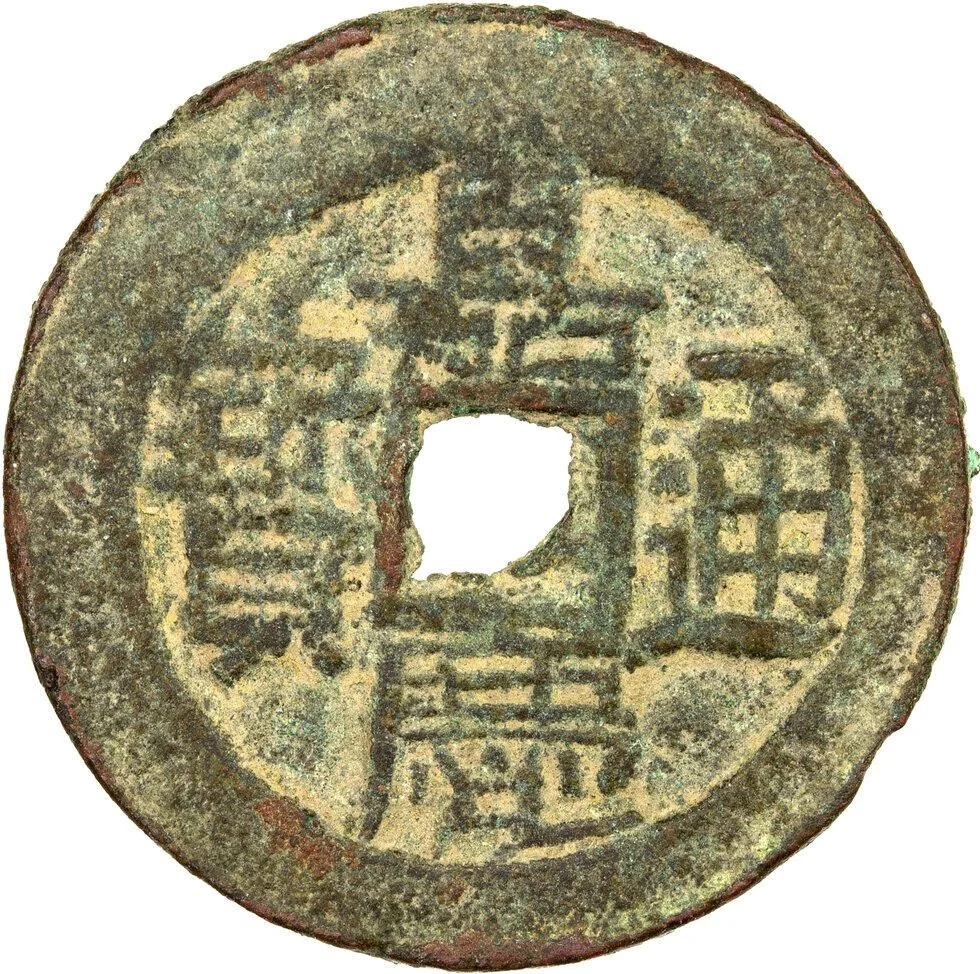
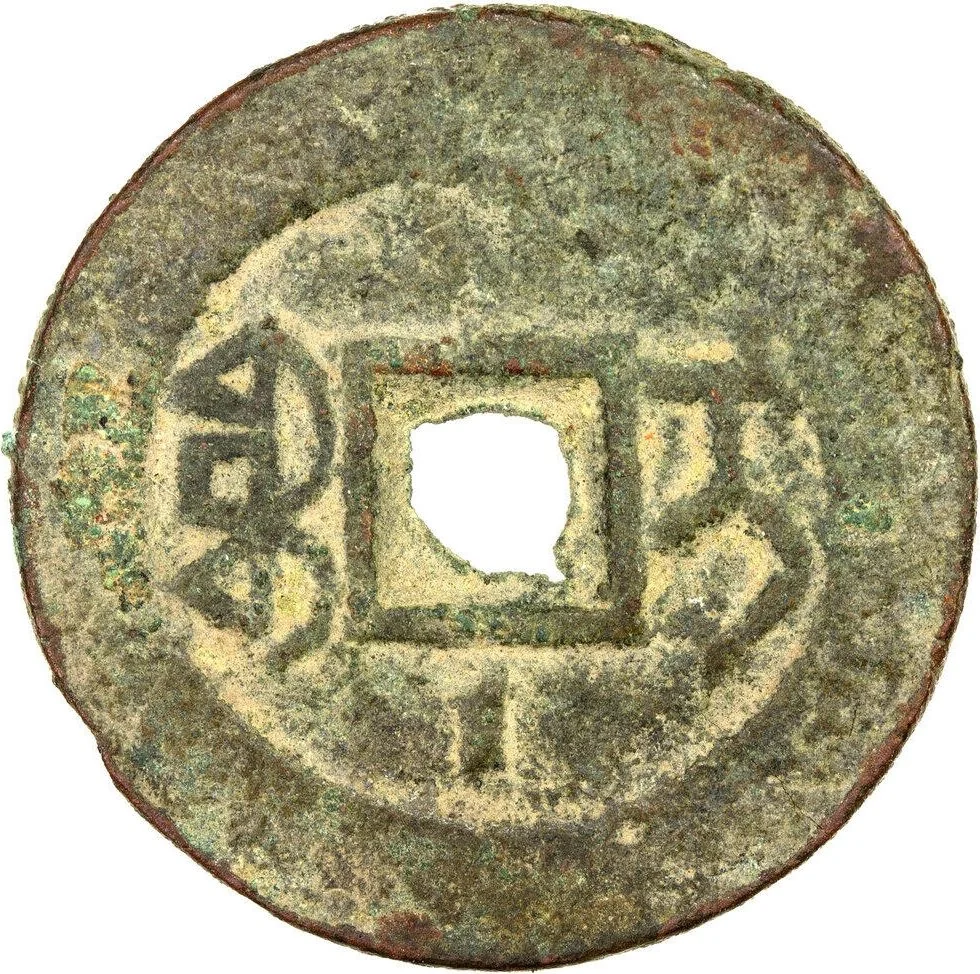
1 cash – South Xinjiang
Add to wishlist
China
Context
Years: 1803–1820
Country: China
Issuer: South Xinjiang
Ruler: Jiaqing
Currency:
(1759—1909)
Demonetized: Yes
Material
Diameter: 25 mm
Weight: 4.96 g
Shape: Round with a square hole
Composition: Copper
Magnetic: No
Technique: Cast
Alignment: Medal alignment
flip
References
Numista: #317825
Obverse
Description:
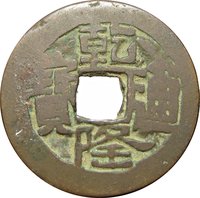
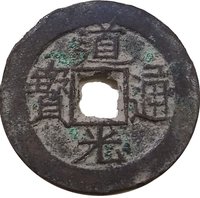
Four Chinese characters read vertically, right to left.
Inscription:
嘉
寶 通
慶
寶 通
慶
Translation:
Jiaqing Treasure Circulating
Scripts: Chinese (traditional, regular script)
Language: Classical Chinese
Reverse
Description:
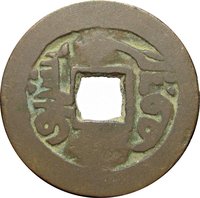
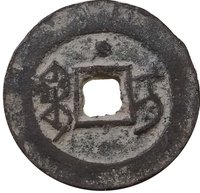
Two Manchu words flank a central hole with a movable marker.
Inscription:
ᠪᠣᠣ ᡳ
Translation:
Boo i
Script: Mongolian / Manchu
Language: Manchu
Edge
Plain
Mintings
| Year | Mint Mark | Mintage | Quality | Collection |
|---|---|---|---|---|
| — | — | — |
Historical background
In 1803, the currency situation in South Xinjiang (the Tarim Basin region) was characterized by a complex and fragmented monetary environment under the consolidating, yet still indirect, control of the Qing Dynasty. Following the conquest of the region in the 1750s, the Qing had integrated it into the provincial system as part of Xinjiang ("New Frontier"), but local economies remained distinct. The official currency was the Xinjiang pūl (or red cash), a locally minted copper coin with a higher copper content and a different exchange rate than the standard cash coins used in China proper. This created a dual system where official Qing military and administrative transactions used the pūl, while much of the local populace, especially in oasis cities like Kashgar, Yarkand, and Khotan, continued to rely on traditional silver yambu bars measured in tæls and misqals for larger transactions.
This monetary fragmentation was exacerbated by the region's position on the Silk Road. A wide variety of foreign silver coins, particularly Persian kran and Bukharan tanga, circulated freely through trade, their value determined by weight and silver purity in local bazaars. Furthermore, the scarcity of Qing-minted coins in such a remote territory led to the persistent use of older Jungar pūl coins from the previous ruling power and even privately issued token coins by local merchants and begs (local administrators). The result was a market where exchange rates were highly localized and unstable, requiring money changers (sarraf) at every major market to facilitate trade between different coinages.
For the Qing authorities, this situation presented administrative and logistical challenges. The inconsistent currency hindered tax collection and the payment of troops stationed in the region, a critical concern given Xinjiang's strategic importance. Efforts were underway to standardize the coinage by increasing the output of the imperial mints in Yarkand and Aksu, but in 1803, this process was incomplete. Therefore, the monetary landscape of South Xinjiang remained a practical reflection of its geopolitical reality: a Qing territory where Central Asian trade networks, local traditions, and imperial fiscal policy converged in a daily economic reality of calculation and conversion.
This monetary fragmentation was exacerbated by the region's position on the Silk Road. A wide variety of foreign silver coins, particularly Persian kran and Bukharan tanga, circulated freely through trade, their value determined by weight and silver purity in local bazaars. Furthermore, the scarcity of Qing-minted coins in such a remote territory led to the persistent use of older Jungar pūl coins from the previous ruling power and even privately issued token coins by local merchants and begs (local administrators). The result was a market where exchange rates were highly localized and unstable, requiring money changers (sarraf) at every major market to facilitate trade between different coinages.
For the Qing authorities, this situation presented administrative and logistical challenges. The inconsistent currency hindered tax collection and the payment of troops stationed in the region, a critical concern given Xinjiang's strategic importance. Efforts were underway to standardize the coinage by increasing the output of the imperial mints in Yarkand and Aksu, but in 1803, this process was incomplete. Therefore, the monetary landscape of South Xinjiang remained a practical reflection of its geopolitical reality: a Qing territory where Central Asian trade networks, local traditions, and imperial fiscal policy converged in a daily economic reality of calculation and conversion.
✨ Legendary