

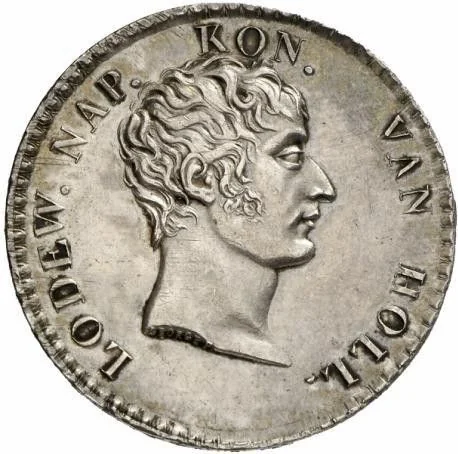
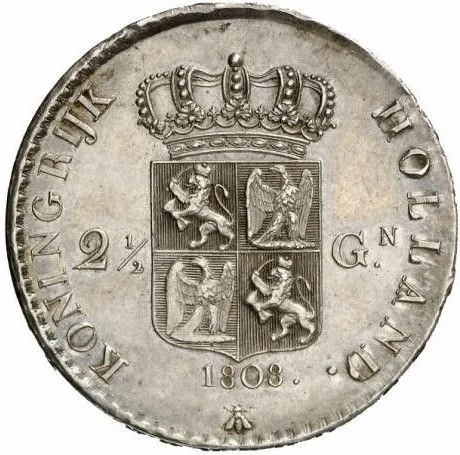
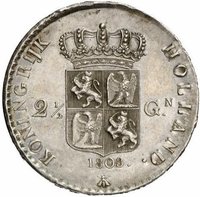
2½ Gulden – Netherlands
Netherlands
Context
Year: 1808
Issuer: Netherlands 
Ruler: Louis Napoléon Bonaparte
Currency:
(1581—1817)
Demonetized: Yes
Material
References
KM: #Click to copy to clipboard32
Numista: #317135
Value
Bullion value: $68.31
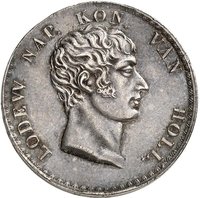
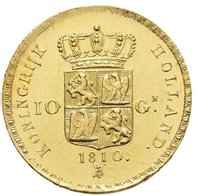
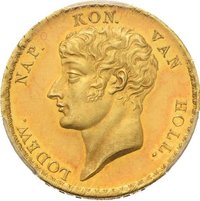
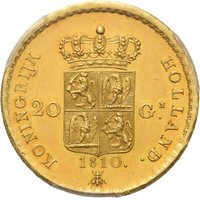
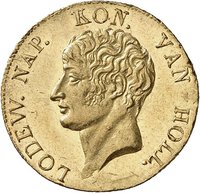
Obverse
Reverse
Edge
Lettered
Legend:
DE NAAM DES HEEREN ZY GELOOFD
Translation:
The name of the Lord be praised.
Language: Dutch
Categories
| Symbol> Crown |
| Symbols> Coat of Arms |
Mints
| Name | Mark |
|---|---|
| Royal Dutch Mint | — |
Mintings
| Year | Mint Mark | Mintage | Quality | Collection |
|---|---|---|---|---|
| 1808 | — | — |
Historical background
In 1808, the Netherlands existed as the Kingdom of Holland, a French client state ruled by Napoleon Bonaparte’s brother, Louis. The currency situation was one of profound instability and transition, deeply entangled with the economic demands of the Continental System. This French-led blockade against Britain severely disrupted Dutch trade, the nation's traditional economic lifeblood, leading to widespread commercial stagnation and a sharp decline in public revenue. The state faced near-bankruptcy, forcing King Louis to resort to unpopular financial measures, including the confiscation of church silver to mint coinage and the issuance of paper money that quickly depreciated.
The monetary system itself was a complex and chaotic patchwork. Historically, the Netherlands had used guilders (guldens), stuivers, and ducats, but the provinces and cities had long issued their own coins, leading to a lack of uniformity. While efforts at standardization had been made in the late 18th century, the French occupation and the creation of the kingdom intensified the push for a centralized, French-aligned system. In practice, however, old Dutch coins, French francs, and even foreign currencies from trade all circulated simultaneously, causing confusion and facilitating fraud, as the intrinsic value of metal often differed from the face value.
Ultimately, the currency woes of 1808 were a direct reflection of political subjugation. Napoleon viewed the kingdom primarily as a financial and military resource, imposing heavy conscription and subsidies. The desperate need to fund these French demands, coupled with the crippled economy, made sound monetary policy impossible. This period accelerated the decline of Amsterdam as a leading financial center and set the stage for the more forceful integration that would follow: Napoleon’s annexation of the Netherlands directly into the French Empire in 1810, which formally replaced the Dutch guilder with the French franc.
The monetary system itself was a complex and chaotic patchwork. Historically, the Netherlands had used guilders (guldens), stuivers, and ducats, but the provinces and cities had long issued their own coins, leading to a lack of uniformity. While efforts at standardization had been made in the late 18th century, the French occupation and the creation of the kingdom intensified the push for a centralized, French-aligned system. In practice, however, old Dutch coins, French francs, and even foreign currencies from trade all circulated simultaneously, causing confusion and facilitating fraud, as the intrinsic value of metal often differed from the face value.
Ultimately, the currency woes of 1808 were a direct reflection of political subjugation. Napoleon viewed the kingdom primarily as a financial and military resource, imposing heavy conscription and subsidies. The desperate need to fund these French demands, coupled with the crippled economy, made sound monetary policy impossible. This period accelerated the decline of Amsterdam as a leading financial center and set the stage for the more forceful integration that would follow: Napoleon’s annexation of the Netherlands directly into the French Empire in 1810, which formally replaced the Dutch guilder with the French franc.
✨ Legendary