



100 Yuan – People's Republic of China
China
Context
Year: 2016
Country: China 
Issuer: People's Republic of China
Period:
(since 1949)
Currency:
(since 1955)
Total mintage: 30,000
Material


References
Numista: #316331
Value
Exchange value: 100 CNY = $14.62
Bullion value: $1335.21
Inflation-adjusted value: 114.65 CNY
Obverse
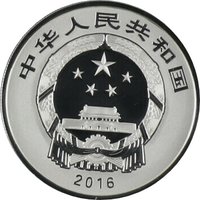
Reverse
Edge
Mintings
| Year | Mint Mark | Mintage | Quality | Collection |
|---|---|---|---|---|
| 2016 | — | 30,000 | Proof |
Historical background
In 2016, the People's Republic of China faced significant challenges in managing its currency, the renminbi (RMB), amidst slowing economic growth and capital outflows. The year began with heightened global market turmoil, triggered by perceptions that Chinese authorities were engineering a competitive devaluation. This followed a surprising August 2015 reform where the People's Bank of China (PBOC) adjusted the RMB's daily fixing mechanism to be more market-driven, leading to a sudden depreciation. Throughout 2016, sustaining the RMB's value against a strong US dollar, while managing a record $1 trillion in capital outflows over the previous 18 months, became a primary policy dilemma for the central bank.
Chinese authorities pursued a dual strategy: gradual depreciation with heavy intervention to prevent a disorderly collapse. The PBOC spent heavily from its foreign exchange reserves, which fell by nearly $320 billion in 2016, to support the currency and counteract speculative selling. Simultaneously, it tightened capital controls to stem outflows, scrutinizing overseas acquisitions by Chinese companies and limiting individual foreign exchange purchases. The RMB's inclusion in the IMF's Special Drawing Rights (SDR) basket in October was a major strategic victory, boosting its international prestige, but also created pressure to maintain stability and avoid the perception of manipulation.
By year's end, the situation had stabilized but at a cost. The RMB depreciated nearly 7% against the dollar for the year, its largest annual drop since 1994. Policymakers successfully averted a financial crisis and restored a measure of control, but the episode underscored the fundamental tension between China's desire for a market-oriented, global currency and its need for macroeconomic control. The experience of 6.99 RMB/USD in December, approaching the psychologically critical 7.0 level, set the stage for continued currency management battles and capital control vigilance in the years that followed.
Chinese authorities pursued a dual strategy: gradual depreciation with heavy intervention to prevent a disorderly collapse. The PBOC spent heavily from its foreign exchange reserves, which fell by nearly $320 billion in 2016, to support the currency and counteract speculative selling. Simultaneously, it tightened capital controls to stem outflows, scrutinizing overseas acquisitions by Chinese companies and limiting individual foreign exchange purchases. The RMB's inclusion in the IMF's Special Drawing Rights (SDR) basket in October was a major strategic victory, boosting its international prestige, but also created pressure to maintain stability and avoid the perception of manipulation.
By year's end, the situation had stabilized but at a cost. The RMB depreciated nearly 7% against the dollar for the year, its largest annual drop since 1994. Policymakers successfully averted a financial crisis and restored a measure of control, but the episode underscored the fundamental tension between China's desire for a market-oriented, global currency and its need for macroeconomic control. The experience of 6.99 RMB/USD in December, approaching the psychologically critical 7.0 level, set the stage for continued currency management battles and capital control vigilance in the years that followed.
Series: Auspicious Culture














✨ Legendary