

10 centavos – Cuba
Add to wishlist
Cuba
Context
Material
Diameter: 21.3 mm
Weight: 4.1 g
Thickness: 1.6 mm
Shape: Round
Composition: Copper-nickel
Technique: Milled
Alignment: Medal alignment
flip
References
KM: #
Numista: #10229
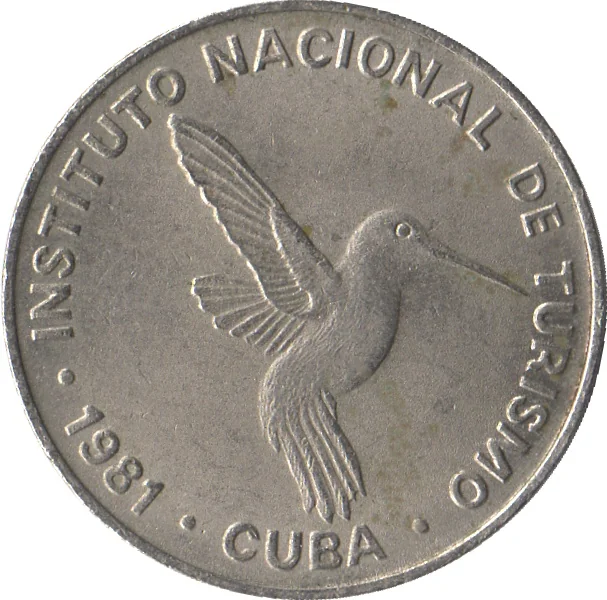
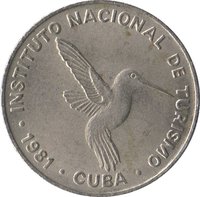
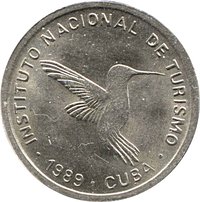
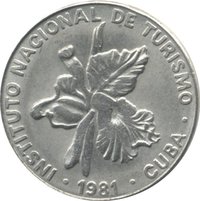
Obverse
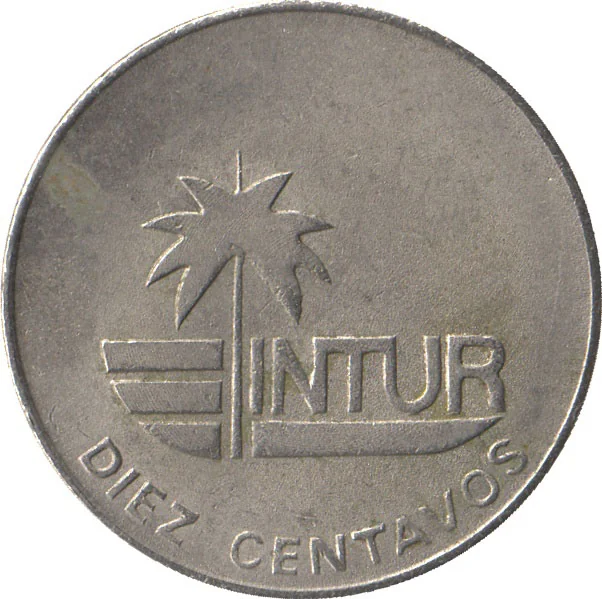
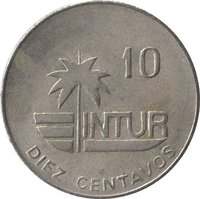
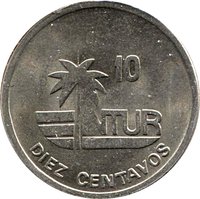
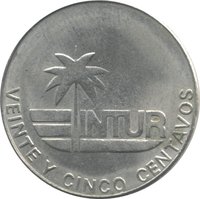
Reverse
Description:
INTUR logo with a real palm tree and face value in words below.
Inscription:
INTUR
DIEZ CENTAVOS
DIEZ CENTAVOS
Script: Latin
Edge
Plain
Mintings
| Year | Mint Mark | Mintage | Quality | Collection |
|---|---|---|---|---|
| 1981 | — | — |
Historical background
In 1981, Cuba's currency situation was defined by the exclusive circulation of the Cuban peso (CUP), a socialist currency insulated from the global market and strictly controlled by the state. Following the break with the United States and alignment with the Soviet Union, Cuba operated a centrally planned economy where the peso's value was administratively set, not determined by trade or convertibility. It was used for all domestic salaries, and for purchasing rationed and non-rationed goods in state-run stores, though the availability of consumer goods was often limited. The economy was heavily subsidized by the Soviet Union through favorable trade agreements, particularly for oil and sugar, which helped maintain the peso's artificial stability despite underlying inefficiencies.
Notably absent in 1981 was the convertible peso or "chavito" (CUC), which would not be introduced until the 1990s during the Special Period. Therefore, there was no legal dual-currency system for everyday citizens. However, a stark divide existed between the domestic peso economy and foreign exchange. Access to hard currency like US dollars was illegal for most Cubans but remained highly coveted, as it was needed for transactions on the black market or for purchases in diplomatic stores, which offered a wider array of goods. This created an informal economic tier where those with access to dollars from abroad or through illicit means could obtain scarce commodities.
The currency reality of 1981 thus reflected Cuba's broader economic and geopolitical position: outwardly stable and unified under the state peso, but internally constrained by the shortcomings of a planned economy. The system functioned within the framework of Soviet support, masking the pressures that would later erupt with the collapse of the Eastern Bloc. The fundamental tensions—between official and black-market values, and between domestic currency and hard currency desires—were already present, foreshadowing the severe monetary crises and reforms that would define the decades to come.
Notably absent in 1981 was the convertible peso or "chavito" (CUC), which would not be introduced until the 1990s during the Special Period. Therefore, there was no legal dual-currency system for everyday citizens. However, a stark divide existed between the domestic peso economy and foreign exchange. Access to hard currency like US dollars was illegal for most Cubans but remained highly coveted, as it was needed for transactions on the black market or for purchases in diplomatic stores, which offered a wider array of goods. This created an informal economic tier where those with access to dollars from abroad or through illicit means could obtain scarce commodities.
The currency reality of 1981 thus reflected Cuba's broader economic and geopolitical position: outwardly stable and unified under the state peso, but internally constrained by the shortcomings of a planned economy. The system functioned within the framework of Soviet support, masking the pressures that would later erupt with the collapse of the Eastern Bloc. The fundamental tensions—between official and black-market values, and between domestic currency and hard currency desires—were already present, foreshadowing the severe monetary crises and reforms that would define the decades to come.
Series: 1981 Cuba circulation coins
🌱 Common