

1 Mohur – Afghanistan
Afghanistan
Context
Year: 1805
Islamic (Hijri) Year: 1219
Issuer: Afghanistan 
Ruler: Shujah Shah
Currency:
(1747—1891)
Demonetized: Yes
Material
Diameter: 18 mm
Weight: 10.92 g
Gold weight: 10.92 g
Shape: Irregular round
Composition: Gold
Magnetic: No
References
Numista: #315501
Value
Bullion value: $1820.70
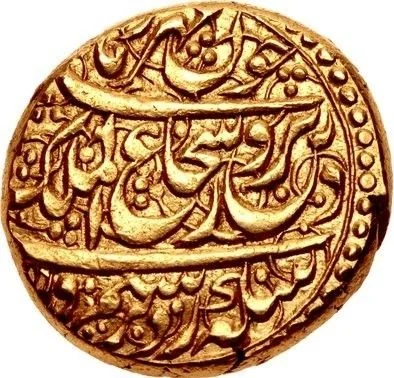
Obverse
Description:
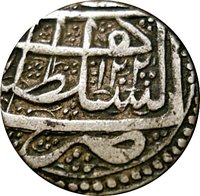
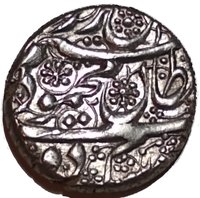
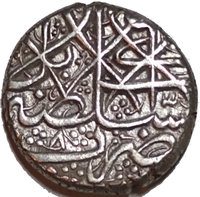
Shah Shuja' al-Mulk quoted in a Persian couplet.
Script: Arabic
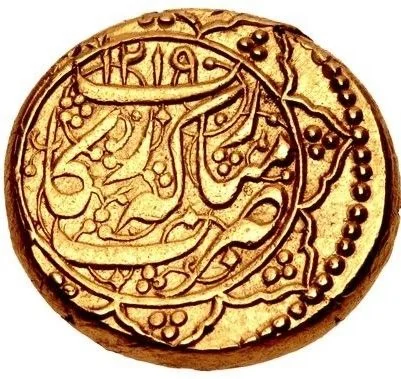
Reverse
Description:
Mint RY Formula
Script: Arabic
Edge
Mintings
| Year | Mint Mark | Mintage | Quality | Collection |
|---|---|---|---|---|
| 1805 | — | — |
Historical background
In 1805, the currency situation in Afghanistan was characterized by fragmentation and instability, reflecting the decentralized and contested political landscape of the Durrani Empire. Following the death of Ahmad Shah Durrani in 1772, the empire had entered a period of decline and civil war among his descendants. By 1805, Shah Mahmud Durrani ruled in Kabul, but his authority was weak and challenged by rivals, including his brother Shah Shujah. This political fragmentation meant there was no unified monetary authority, leading to a circulation of diverse and often debased coins from various regional mints.
The primary currency in circulation was the silver rupee, but its weight, purity, and design varied significantly depending on the mint city—such as Kabul, Kandahar, or Peshawar—and the currently ruling prince. These coins often bore the name of the Mughal Emperor Shah Alam II, a lingering formal acknowledgment of Mughal suzerainty that had become purely ceremonial. Alongside these, Persian, Bukharan, and Indian rupees also circulated through trade, further complicating transactions. The constant warfare and power shifts led rulers to frequently debase coinage (reducing silver content) to finance their military campaigns, causing inflation and eroding public trust in the currency.
This monetary chaos presented a significant obstacle to both internal trade and the vital caravan routes that crossed Afghanistan. Merchants had to navigate fluctuating exchange rates and assess the metal content of coins from different origins, relying heavily on money changers (sarrafs). Ultimately, the currency situation in 1805 was a direct symptom of a fractured state, where economic unity was impossible without political consolidation, a condition that would persist for much of the 19th century.
The primary currency in circulation was the silver rupee, but its weight, purity, and design varied significantly depending on the mint city—such as Kabul, Kandahar, or Peshawar—and the currently ruling prince. These coins often bore the name of the Mughal Emperor Shah Alam II, a lingering formal acknowledgment of Mughal suzerainty that had become purely ceremonial. Alongside these, Persian, Bukharan, and Indian rupees also circulated through trade, further complicating transactions. The constant warfare and power shifts led rulers to frequently debase coinage (reducing silver content) to finance their military campaigns, causing inflation and eroding public trust in the currency.
This monetary chaos presented a significant obstacle to both internal trade and the vital caravan routes that crossed Afghanistan. Merchants had to navigate fluctuating exchange rates and assess the metal content of coins from different origins, relying heavily on money changers (sarrafs). Ultimately, the currency situation in 1805 was a direct symptom of a fractured state, where economic unity was impossible without political consolidation, a condition that would persist for much of the 19th century.
✨ Legendary