

50 centimos – Spain
Add to wishlist
Spain
Context
Year: 1904
Issuer: Spain
Ruler: Alfonso XIII
Currency:
(1868—2001)
Demonetization: 20 February 1939
Total mintage: 1,303,000
Material
References
KM: #
Numista: #3155
Value
Exchange value: 0.50 ESP
Bullion value: $5.34
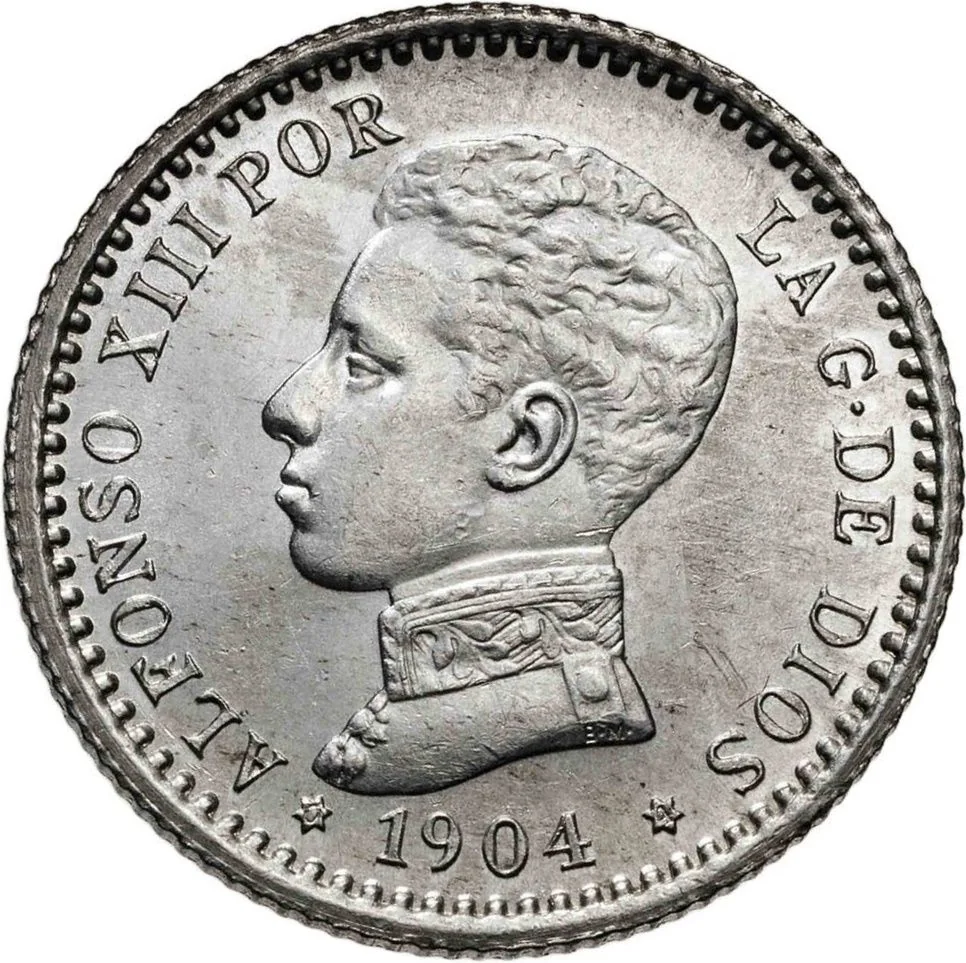
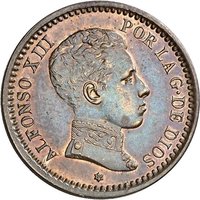
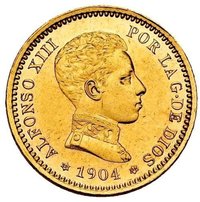
Obverse
Description:
King Alfonso III facing left.
Inscription:
ALFONSO XIII POR LA G· DE DIOS
B· M·
🟌 1904 🟌
B· M·
🟌 1904 🟌
Translation:
By the grace of God, Alfonso XIII
B. M.
🟌 1904 🟌
B. M.
🟌 1904 🟌
Script: Latin
Language: Spanish
Engraver: Bartolomé Maura Montaner
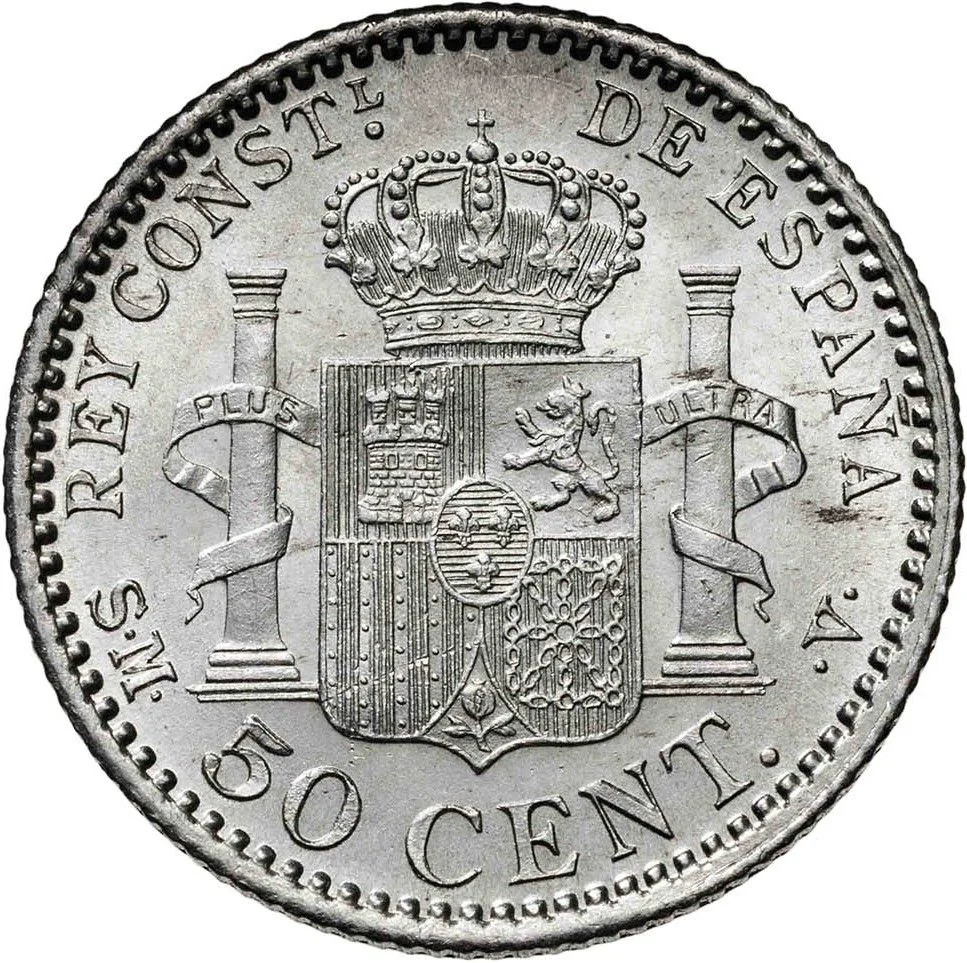
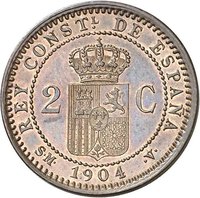
Reverse
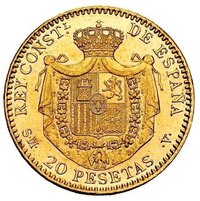
Description:
Spanish coat of arms with the Pillars of Hercules.
Inscription:
REY CONSTL. DE ESPAÑA
PLUS ULTRA
S·M· 50 CENT. ·V·
PLUS ULTRA
S·M· 50 CENT. ·V·
Translation:
KING CONSTITUTIONAL OF SPAIN
FURTHER BEYOND
H.M. 50 CENTS ·V·
FURTHER BEYOND
H.M. 50 CENTS ·V·
Script: Latin
Engraver: Bartolomé Maura Montaner
Edge
Reeded
Categories
| Person> Monarch |
| Symbols> Coat of Arms |
Mints
| Name | Mark |
|---|---|
| Royal Mint of Madrid | (🟌) |
Mintings
| Year | Mint Mark | Mintage | Quality | Collection |
|---|---|---|---|---|
| 1904 | 🟌 | 1,303,000 |
Historical background
In 1904, Spain's currency system was anchored to the bimetallic standard of the Latin Monetary Union, though it was effectively operating on a de facto gold standard. The primary unit was the silver peseta, introduced in 1868 to replace the old real and to align with the French franc. However, a global shortage of silver and the demonetization of the metal by major powers had significantly depressed its value. Consequently, while silver coins remained in circulation for smaller denominations, the value of the peseta was legally defined by and pegged to gold. The country's gold reserves were held to back the currency, aiming to ensure stability and facilitate international trade, particularly with its main economic partners in Europe.
The period was one of relative monetary stability but underlying economic fragility. The Spanish government, under King Alfonso XIII, maintained the gold peg, which helped control inflation and fostered a sense of credibility. However, this stability was somewhat artificial and did not reflect the nation's broader economic condition. Spain was not a major industrial power compared to its northern European counterparts; its economy was still heavily agrarian and burdened by political instability, colonial losses, and significant public debt. The stability of the peseta was therefore managed and defended by the Bank of Spain, which had the sole right of note issue, rather than being driven by robust economic fundamentals.
Looking ahead, the calm of 1904 was precarious. The costs of maintaining the gold standard, combined with heavy government spending (particularly on the military following the 1898 defeat in the Spanish-American War), placed continuous strain on the nation's gold reserves. This tension would eventually contribute to the peseta's difficulties in the following decades, leading to periods of devaluation and the abandonment of the gold standard during World War I. Thus, 1904 represents a point of apparent equilibrium in Spain's monetary history, situated between the financial turmoil of the late 19th century and the challenges of the 20th.
The period was one of relative monetary stability but underlying economic fragility. The Spanish government, under King Alfonso XIII, maintained the gold peg, which helped control inflation and fostered a sense of credibility. However, this stability was somewhat artificial and did not reflect the nation's broader economic condition. Spain was not a major industrial power compared to its northern European counterparts; its economy was still heavily agrarian and burdened by political instability, colonial losses, and significant public debt. The stability of the peseta was therefore managed and defended by the Bank of Spain, which had the sole right of note issue, rather than being driven by robust economic fundamentals.
Looking ahead, the calm of 1904 was precarious. The costs of maintaining the gold standard, combined with heavy government spending (particularly on the military following the 1898 defeat in the Spanish-American War), placed continuous strain on the nation's gold reserves. This tension would eventually contribute to the peseta's difficulties in the following decades, leading to periods of devaluation and the abandonment of the gold standard during World War I. Thus, 1904 represents a point of apparent equilibrium in Spain's monetary history, situated between the financial turmoil of the late 19th century and the challenges of the 20th.
🌱 Very Common