

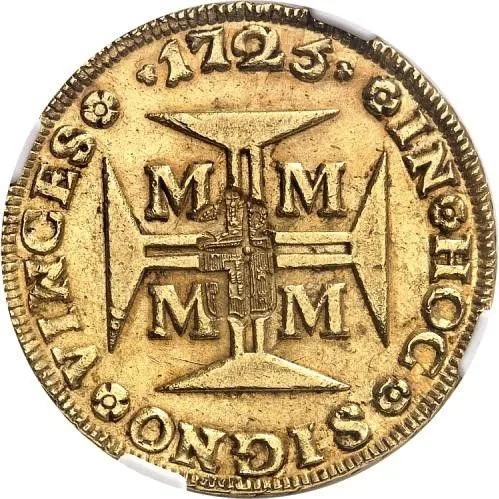
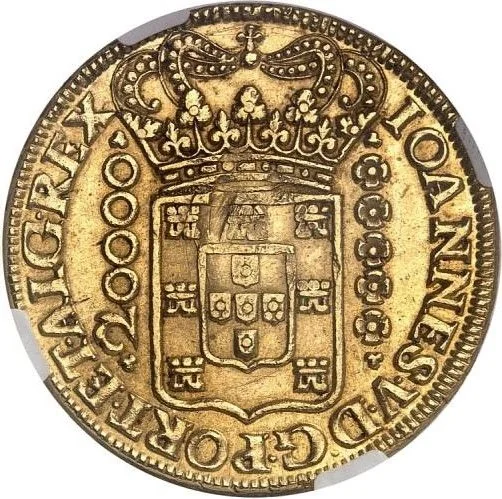
30000 réis – Portugal
Add to wishlist
Portugal
Material
Diameter: 37.8 mm
Weight: 53.78 g
Gold Weight:: 49.30 g
Shape: Round
Composition: 91.67% Gold
Magnetic: No
Techniques: Milled, Countermarked
Alignment: Coin alignment
flip
References
Numista: #315493
Value
Bullion value: $7675.37
Obverse
Description:
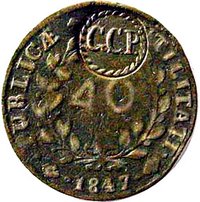
Crowned shield countermark on a João V Minas Gerais dobrão.
Script: Latin
Reverse
Script: Latin
Edge
Rope shaped
Mints
| Name | Mark |
|---|---|
| Imprensa Nacional - Casa da Moeda | — |
Mintings
| Year | Mint Mark | Mintage | Quality | Collection |
|---|---|---|---|---|
| 1847 | — | — |
Historical background
In 1847, Portugal's currency situation was deeply unstable, reflecting the nation's profound political and fiscal turmoil during the Patuleia, or the Little Civil War (1846-47). The country was divided between the Septembrist radicals and the more conservative Cartistas, with foreign military intervention by Britain and Spain underway to end the conflict. This political chaos directly crippled state finances, leading to severe deficits and a reliance on debt issuance and inflationary monetary practices to fund government operations. The Banco de Lisboa, the country's primary note-issuing bank, was effectively under government control and forced to provide large advances to the treasury, undermining the credibility of its banknotes.
The monetary system itself was a complex and fragmented bimetallic system based on the réis, but it suffered from a chronic shortage of specie (gold and silver coin). Much of the precious metal in circulation was old, worn, and often clipped, while a flood of low-quality copper coins exacerbated public distrust. The value of paper banknotes issued by the Banco de Lisboa fluctuated wildly and traded at a significant discount to their face value in metal, a clear sign of inflation and lack of confidence. This created a dual circulation where transactions were often calculated in "gold réis" or "paper réis," with the latter being worth far less.
Ultimately, the currency crisis of 1847 was a symptom of the broader failure of the Portuguese state to establish fiscal discipline and political stability. The resolution of the civil war later that year set the stage for necessary reforms, which would culminate in the 1850s with the creation of the Bank of Portugal (1846) gaining monopoly note-issuing powers and a serious push toward monetary standardization. However, in 1847 itself, the landscape was one of confusion, devaluation, and a monetary system struggling to function amidst civil strife.
The monetary system itself was a complex and fragmented bimetallic system based on the réis, but it suffered from a chronic shortage of specie (gold and silver coin). Much of the precious metal in circulation was old, worn, and often clipped, while a flood of low-quality copper coins exacerbated public distrust. The value of paper banknotes issued by the Banco de Lisboa fluctuated wildly and traded at a significant discount to their face value in metal, a clear sign of inflation and lack of confidence. This created a dual circulation where transactions were often calculated in "gold réis" or "paper réis," with the latter being worth far less.
Ultimately, the currency crisis of 1847 was a symptom of the broader failure of the Portuguese state to establish fiscal discipline and political stability. The resolution of the civil war later that year set the stage for necessary reforms, which would culminate in the 1850s with the creation of the Bank of Portugal (1846) gaining monopoly note-issuing powers and a serious push toward monetary standardization. However, in 1847 itself, the landscape was one of confusion, devaluation, and a monetary system struggling to function amidst civil strife.
✨ Legendary