

½ Penny – Australia
Australia
Context
Years: 1959–1964
Issuer: Australia 
Ruler: Elizabeth II
Currency:
(1788—1966)
Total mintage: 74,835,741
Material
References
KM: #Click to copy to clipboard61
Numista: #3149
Obverse
Description:
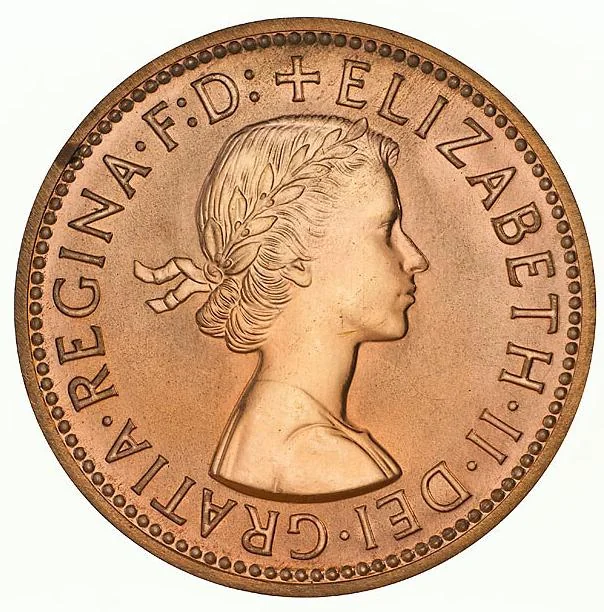
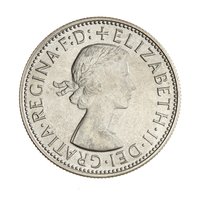
First portrait of Elizabeth II facing right, wearing a laurel, with "F:D:" on legend.
Inscription:
+ELIZABETH·II·DEI·GRATIA·REGINA·F:D:
Translation:
Elizabeth the Second, by the Grace of God, Queen, Defender of the Faith.
Script: Latin
Language: Latin
Designer: Mary Gillick
Reverse
Description:
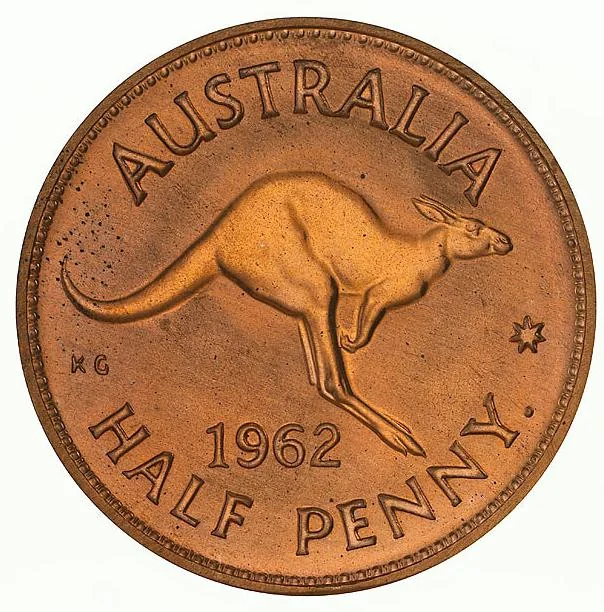
Kangaroo hopping right.
Inscription:
AUSTRALIA
KG
1959
HALF PENNY
KG
1959
HALF PENNY
Script: Latin
Designer: George Kruger Gray
Edge
Plain
Mints
| Name | Mark |
|---|---|
| Royal Mint | — |
| Perth Mint | . |
Mintings
| Year | Mint Mark | Mintage | Quality | Collection |
|---|---|---|---|---|
| 1959 | — | 10,166,000 | ||
| 1959 | — | 1,506 | Proof | |
| 1960 | — | 1,030 | Proof | |
| 1960 | — | 17,812,000 | ||
| 1961 | — | 20,183,000 | ||
| 1961 | — | 1,040 | Proof | |
| 1962 | — | 10,259,000 | ||
| 1962 | — | 1,064 | Proof | |
| 1963 | — | 16,410,000 | ||
| 1963 | — | 1,100 | Proof | |
| 1964 | — | — | ||
| 1964 | — | 1 | Proof |
Historical background
In 1959, Australia's currency system was in a transitional phase, still operating under the framework of the Australian Pound (A£), which was pegged to the British Pound Sterling (GBP) as part of the Sterling Area. This system, established in 1909, meant Australia's monetary policy and reserves were closely tied to Britain's, with the exchange rate fixed at A£1 = GBP1. The currency was issued by the Commonwealth Bank of Australia (the nation's central bank until 1960) and was a tangible symbol of the country's historical economic and political links to the United Kingdom. However, this post-war period saw increasing pressure on this traditional arrangement due to Australia's growing economic diversification and stronger trade ties with the United States and Japan.
Economically, the late 1950s were a time of prosperity and industrial expansion, often called the "long boom." This growth, coupled with a rising population from immigration, increased the demand for money and credit. While the Sterling peg provided stability, it also limited independent monetary policy, particularly in controlling domestic inflation. Notably, 1959 was the year before a significant institutional change: the Reserve Bank Act 1959 was passed, separating the central banking functions from the commercial activities of the Commonwealth Bank. This legislative move, effective from January 1960, was a crucial step toward modernising Australia's financial system in anticipation of future economic challenges.
Looking forward, the situation in 1959 was on the cusp of major change. The debate about decimalisation—replacing the pounds, shillings, and pence system with a decimal currency—was gaining serious momentum, with formal investigations underway. Within just seven years, this would culminate in the introduction of the Australian Dollar in 1966. Furthermore, the fixed Sterling peg, a cornerstone of the 1959 system, would come under severe strain and was eventually abandoned in 1967 after the devaluation of the British Pound. Thus, 1959 represents the final years of an older imperial monetary order, quietly setting the stage for Australia's journey toward a distinct and independent national currency.
Economically, the late 1950s were a time of prosperity and industrial expansion, often called the "long boom." This growth, coupled with a rising population from immigration, increased the demand for money and credit. While the Sterling peg provided stability, it also limited independent monetary policy, particularly in controlling domestic inflation. Notably, 1959 was the year before a significant institutional change: the Reserve Bank Act 1959 was passed, separating the central banking functions from the commercial activities of the Commonwealth Bank. This legislative move, effective from January 1960, was a crucial step toward modernising Australia's financial system in anticipation of future economic challenges.
Looking forward, the situation in 1959 was on the cusp of major change. The debate about decimalisation—replacing the pounds, shillings, and pence system with a decimal currency—was gaining serious momentum, with formal investigations underway. Within just seven years, this would culminate in the introduction of the Australian Dollar in 1966. Furthermore, the fixed Sterling peg, a cornerstone of the 1959 system, would come under severe strain and was eventually abandoned in 1967 after the devaluation of the British Pound. Thus, 1959 represents the final years of an older imperial monetary order, quietly setting the stage for Australia's journey toward a distinct and independent national currency.
🌱 Very Common