

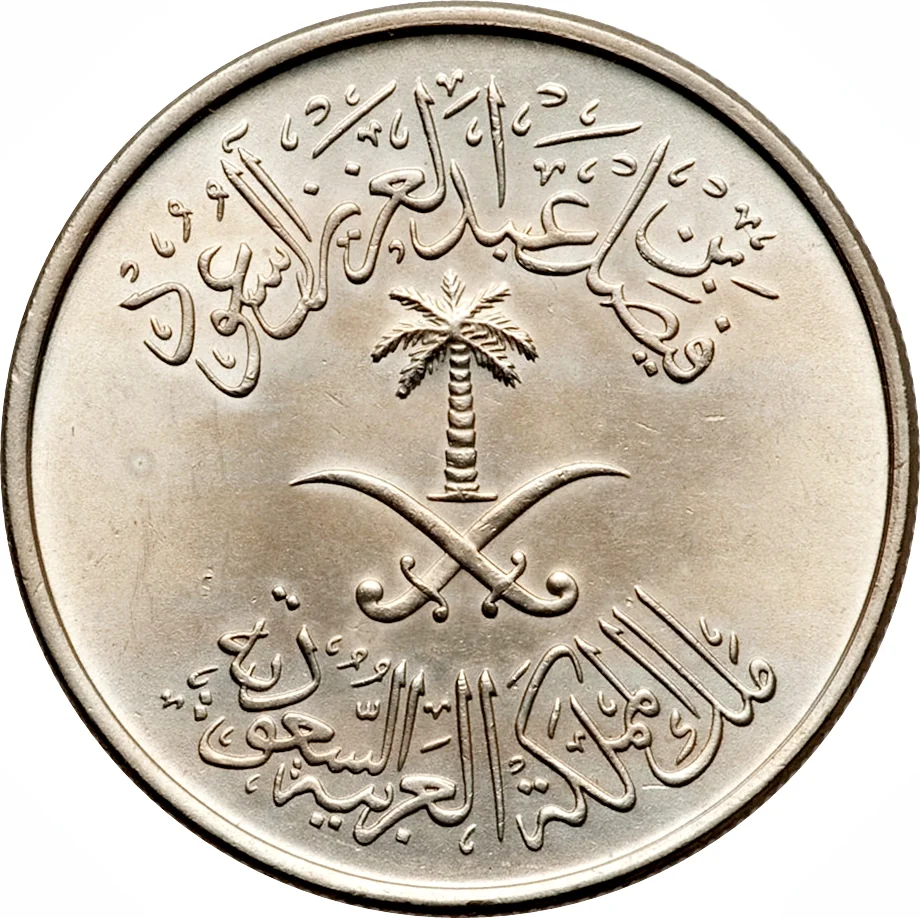
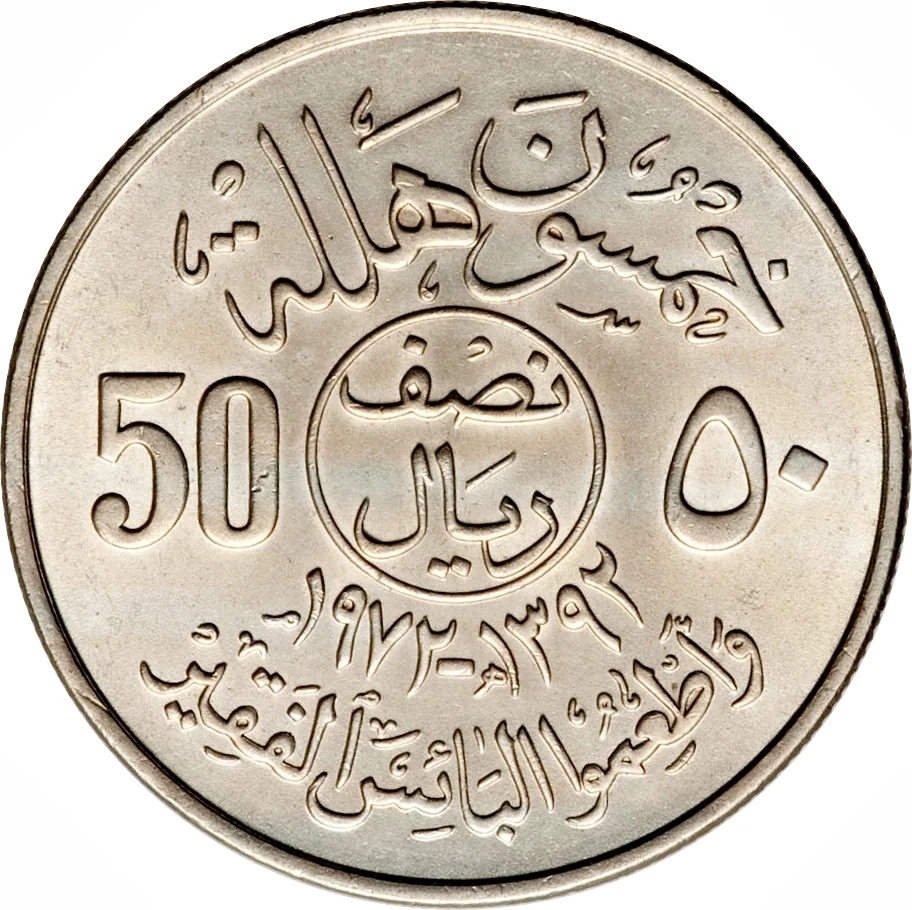
50 Halalas – Saudi Arabia
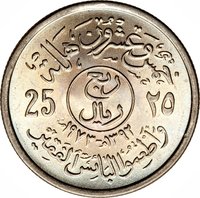
Circulating commemorative coins
Commemoration: F.A.O.
Saudi Arabia
Context
Year: 1972
Islamic (Hijri) Year: 1392
Issuer: Saudi Arabia 
Ruler: Faisal bin Abdulaziz
Currency:
(since 1960)
Total mintage: 500,000
References
KM: #Click to copy to clipboard50
Numista: #3144
Value
Exchange value: 0.50 SAR
Obverse
Reverse
Edge
Reeded
Categories
| Organization> FAO |
| Plant> Tree |
| Symbols> Coat of Arms |
| Object> Cold weapons |
Mints
| Name | Mark |
|---|---|
| Lahore | — |
Mintings
| Year | Mint Mark | Mintage | Quality | Collection |
|---|---|---|---|---|
| 1972 | — | 500,000 |
Historical background
In 1972, Saudi Arabia's currency situation was fundamentally defined by its adherence to the gold standard through the Saudi Gold Sovereign (al-sa’oudi al-thahabi), a unique system established in the late 1920s. Unlike most of the world, which operated under the Bretton Woods system of fixed exchange rates to the US dollar, the Kingdom's official currency, the Saudi Riyal (SAR), was directly pegged to gold. The Saudi Arabian Monetary Agency (SAMA), established in 1952, managed this peg, setting the value of the Riyal based on a specific weight of fine gold. This created a highly stable and credible currency regime, but one that was administratively complex and separate from the dominant global financial architecture.
However, this gold peg existed alongside a critical and growing economic reality: the soaring importance of the US dollar due to oil revenues. Following the 1971 collapse of the Bretton Woods system (the "Nixon Shock"), which severed the dollar's link to gold, Saudi Arabia faced a pivotal decision. Its vast and increasing oil exports were priced and paid for in US dollars, creating a natural economic alignment with the dollar despite its official gold peg. This period was one of transition and evaluation, as SAMA and the government navigated the implications of a floating dollar for their gold-backed currency and their massive dollar holdings.
Consequently, 1972 was the calm before a major monetary shift. The Kingdom maintained its gold peg for another year, but the pressures were mounting. The practicalities of managing oil wealth in dollars, coupled with the desire for exchange rate stability with its primary trading and investment partner, the United States, made the existing system increasingly anachronistic. This set the stage for the decisive move in 1974, when—following the 1973 oil embargo and a massive increase in petrodollar inflows—Saudi Arabia formally abandoned its gold peg and re-pegged the Riyal to the US dollar, a linkage that has remained the cornerstone of its monetary policy ever since.
However, this gold peg existed alongside a critical and growing economic reality: the soaring importance of the US dollar due to oil revenues. Following the 1971 collapse of the Bretton Woods system (the "Nixon Shock"), which severed the dollar's link to gold, Saudi Arabia faced a pivotal decision. Its vast and increasing oil exports were priced and paid for in US dollars, creating a natural economic alignment with the dollar despite its official gold peg. This period was one of transition and evaluation, as SAMA and the government navigated the implications of a floating dollar for their gold-backed currency and their massive dollar holdings.
Consequently, 1972 was the calm before a major monetary shift. The Kingdom maintained its gold peg for another year, but the pressures were mounting. The practicalities of managing oil wealth in dollars, coupled with the desire for exchange rate stability with its primary trading and investment partner, the United States, made the existing system increasingly anachronistic. This set the stage for the decisive move in 1974, when—following the 1973 oil embargo and a massive increase in petrodollar inflows—Saudi Arabia formally abandoned its gold peg and re-pegged the Riyal to the US dollar, a linkage that has remained the cornerstone of its monetary policy ever since.
🌱 Common