

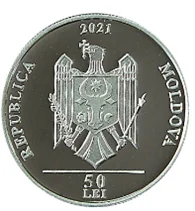
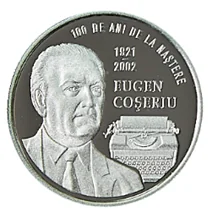
50 lei (Eugen Coșeriu) – Moldova
Add to wishlist
Non-circulating coins
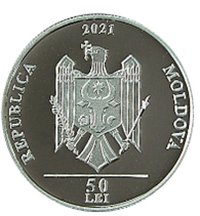
Commemoration: 100 years since the birth of Eugen Coșeriu
Series: Science and Innovation
Moldova
Context
Material
References
KM: #
Numista: #312659
Value
Exchange value: 50 MDL
Bullion value: $41.35
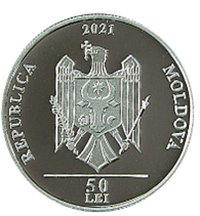
Obverse
Reverse
Description:
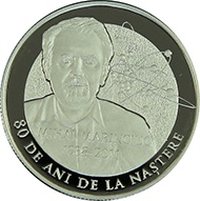
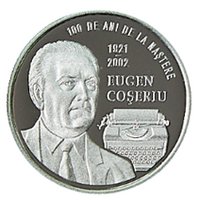
- center: Eugen Coșeriu's bust, a typewriter, the engraved name "EUGEN COȘERIU" and years "1921-2002".
- top circumference: the engraved inscription "100 DE ANI DE LA NAȘTERE".
- top circumference: the engraved inscription "100 DE ANI DE LA NAȘTERE".
Inscription:
100 DE ANI DE LA NAȘTERE
1921-2002
EUGEN
COȘERIU
1921-2002
EUGEN
COȘERIU
Translation:
ONE HUNDRED YEARS SINCE THE BIRTH
1921-2002
EUGEN
COȘERIU
1921-2002
EUGEN
COȘERIU
Script: Latin
Language: Romanian
Edge
Reeded
Mintings
| Year | Mint Mark | Mintage | Quality | Collection |
|---|---|---|---|---|
| 2021 | — | 200 | Proof |
Historical background
In 2021, Moldova's currency situation was characterized by significant volatility and political influence, with the Moldovan Leu (MDL) experiencing notable depreciation pressures. The year began with the Leu trading around 17.2 to the US Dollar, but it weakened to approximately 17.8 by year's end, a decline of over 3%. This trend was driven by a confluence of factors, including heightened political uncertainty following the election of President Maia Sandu and her pro-European Party of Action and Solidarity (PAS), which led to early parliamentary elections in July. Investors and the public were wary of the political transition and its implications for economic policy, leading to cautious behavior and demand for foreign currency.
The economic backdrop further strained the currency. Moldova remained heavily dependent on energy imports and remittances, with inflation rising sharply due to global energy price increases and domestic agricultural challenges, including a severe drought. The National Bank of Moldova (NBM) faced the difficult task of balancing inflation control with supporting economic recovery from the COVID-19 pandemic. While the NBM intervened periodically in the foreign exchange market to smooth out excessive fluctuations, it generally maintained a flexible exchange rate regime, allowing the Leu to adjust to market forces while building up foreign reserves, which saw a modest increase during the year.
Ultimately, the currency's trajectory in 2021 reflected a nation at a geopolitical and economic crossroads. The decisive parliamentary victory for the PAS party in July signaled a firm pro-EU integration path, which promised long-term stability and access to funds but introduced short-term uncertainty. The Leu's depreciation was thus a symptom of both immediate economic shocks and a broader recalibration of Moldova's political and economic orientation away from Russian influence and towards the European Union, setting the stage for potential stability and reform-driven support from international partners in the coming years.
The economic backdrop further strained the currency. Moldova remained heavily dependent on energy imports and remittances, with inflation rising sharply due to global energy price increases and domestic agricultural challenges, including a severe drought. The National Bank of Moldova (NBM) faced the difficult task of balancing inflation control with supporting economic recovery from the COVID-19 pandemic. While the NBM intervened periodically in the foreign exchange market to smooth out excessive fluctuations, it generally maintained a flexible exchange rate regime, allowing the Leu to adjust to market forces while building up foreign reserves, which saw a modest increase during the year.
Ultimately, the currency's trajectory in 2021 reflected a nation at a geopolitical and economic crossroads. The decisive parliamentary victory for the PAS party in July signaled a firm pro-EU integration path, which promised long-term stability and access to funds but introduced short-term uncertainty. The Leu's depreciation was thus a symptom of both immediate economic shocks and a broader recalibration of Moldova's political and economic orientation away from Russian influence and towards the European Union, setting the stage for potential stability and reform-driven support from international partners in the coming years.
Series: Science and Innovation

✨ Legendary