

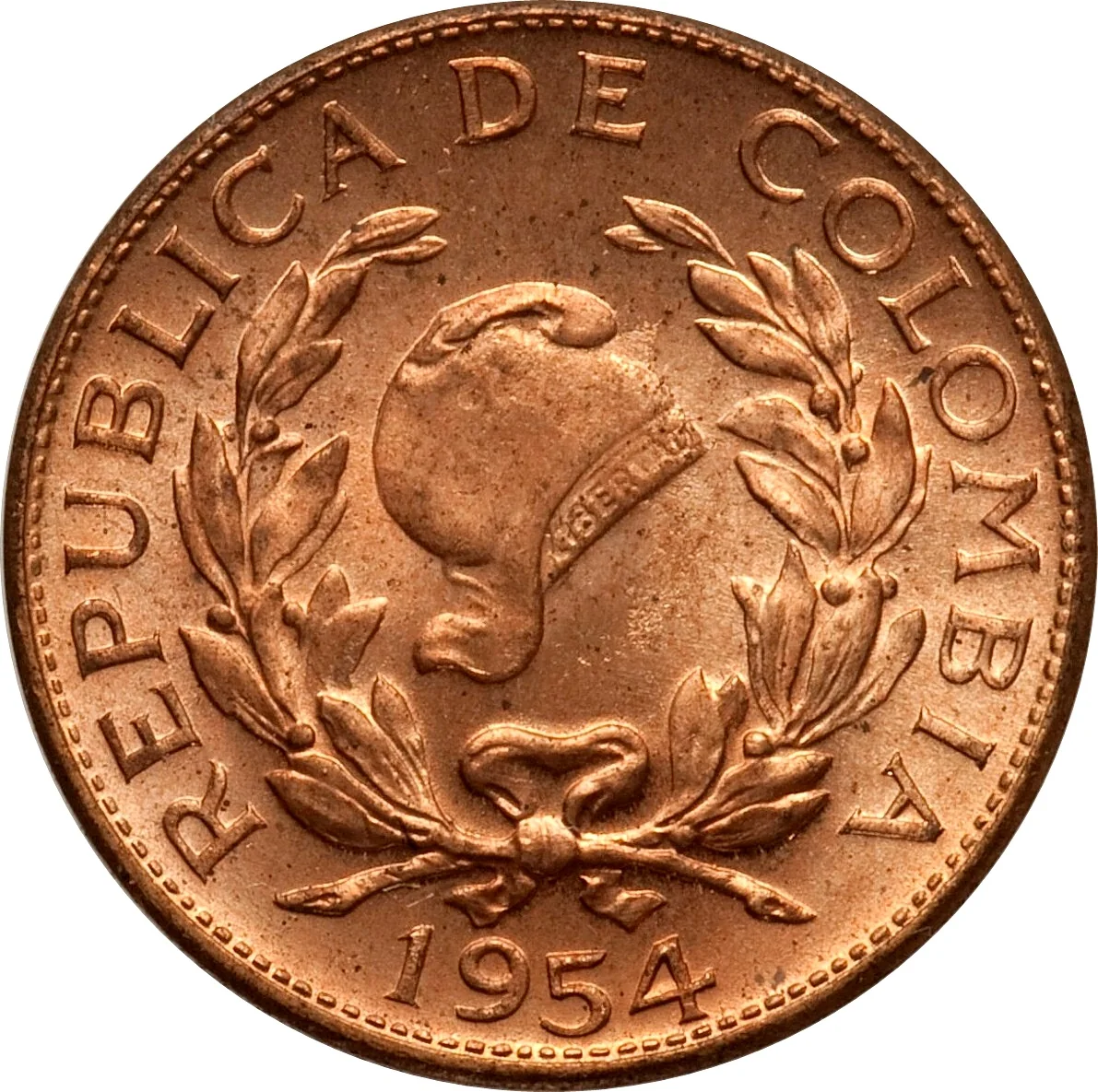
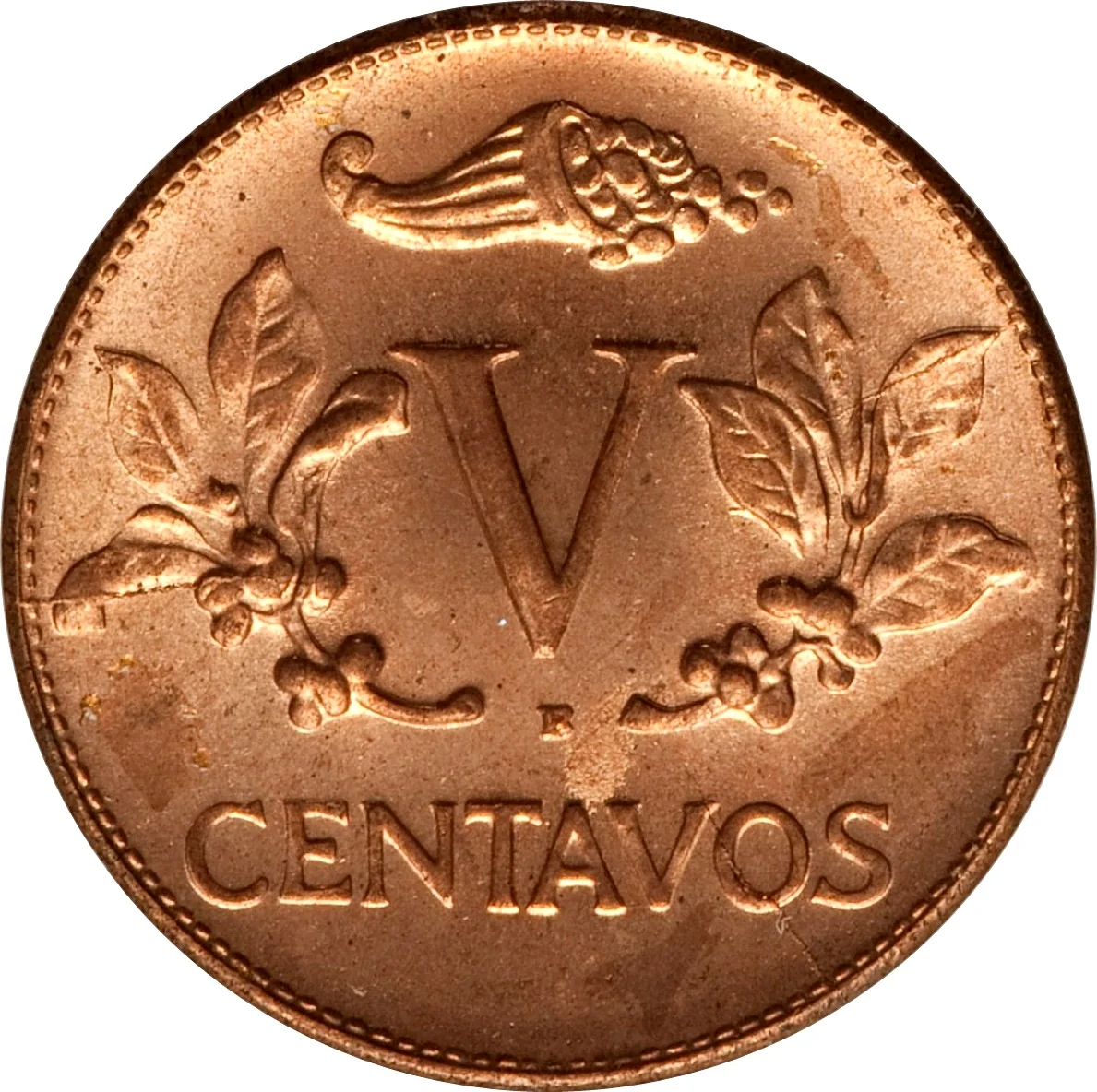
5 Centavos – Colombia
Colombia
Context
Years: 1942–1966
Issuer: Colombia 
Period:
(since 1886)
Currency:
(since 1847)
Total mintage: 163,004,000
Material
References
KM: #Click to copy to clipboard206
Numista: #1363
Value
Exchange value: 0.05 COP
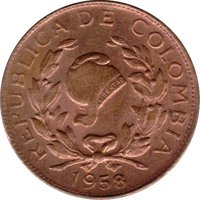
Obverse
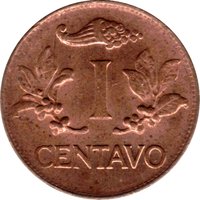
Reverse
Description:
Coffee sprigs flank denomination, cornucopia above.
Inscription:
V
B
CENTAVOS
B
CENTAVOS
Script: Latin
Edge
Plain
Categories
| Symbol> Cornucopia |
| Symbol> Wreath |
| Symbol> Phrygian cap |
Mints
| Name | Mark |
|---|---|
| Bogota Mint | — |
| Casa de Moneda de Colombia | — |
| Bogota Mint | B |
Mintings
| Year | Mint Mark | Mintage | Quality | Collection |
|---|---|---|---|---|
| 1942 | B | 800,000 | ||
| 1942 | — | — | ||
| 1943 | — | — | ||
| 1943 | B | 6,053,000 | ||
| 1944 | — | — | ||
| 1944 | B | 9,013,000 | ||
| 1945 | B | 11,101,000 | ||
| 1945 | — | — | ||
| 1946 | — | — | ||
| 1952 | B | 3,985,000 | ||
| 1952 | — | — | ||
| 1953 | B | 5,180,000 | ||
| 1953 | — | — | ||
| 1954 | B | 1,159,000 | ||
| 1955 | B | 6,819,000 | ||
| 1955 | — | — | ||
| 1956 | — | 8,772,000 | ||
| 1956 | B | — | ||
| 1957 | — | 8,912,000 | ||
| 1958 | — | 15,016,000 | ||
| 1959 | — | 14,271,000 | ||
| 1960 | — | 11,716,000 | ||
| 1961 | — | 11,200,000 | ||
| 1962 | — | 10,928,000 | ||
| 1963 | — | 15,113,000 | ||
| 1964 | — | 9,336,000 | ||
| 1965 | — | 6,460,000 | ||
| 1966 | — | 7,170,000 |
Historical background
In 1942, Colombia's currency situation was fundamentally shaped by the global pressures of World War II and the nation's strategic economic policies. As a non-belligerent ally to the Allied powers, Colombia experienced significant disruptions to its international trade. The loss of European markets for its primary export, coffee, and shortages of imported manufactured goods created a complex economic environment. To manage this, the administration of President Alfonso López Pumarejo maintained a fixed exchange rate regime, pegging the Colombian peso to the U.S. dollar at a rate of 1.75 pesos per dollar, a parity established in 1935.
This fixed rate was defended by the newly established Banco de la República (the central bank), which utilized its reserves of gold and foreign exchange, bolstered by increased exports to the United States. Key exports like coffee, petroleum, and precious metals found a ready market in the Allied war effort, providing a crucial inflow of dollars. However, this official stability masked underlying inflationary pressures. The scarcity of imported goods, coupled with increased government spending and domestic liquidity, began to erode purchasing power, leading to a growing disparity between the official exchange rate and the higher black-market rate for dollars.
Consequently, 1942 represents a pivotal year of controlled but mounting strain within Colombia's monetary system. The government prioritized exchange rate stability to ensure the continuity of essential imports and to maintain international creditworthiness, successfully avoiding the wild inflation seen in other Latin American nations. Yet, the distortions caused by the war economy—inflation, trade imbalances, and a burgeoning parallel market—laid the groundwork for the significant monetary reforms and devaluations that would follow in the postwar period, as Colombia transitioned to a more industrialized economic model.
This fixed rate was defended by the newly established Banco de la República (the central bank), which utilized its reserves of gold and foreign exchange, bolstered by increased exports to the United States. Key exports like coffee, petroleum, and precious metals found a ready market in the Allied war effort, providing a crucial inflow of dollars. However, this official stability masked underlying inflationary pressures. The scarcity of imported goods, coupled with increased government spending and domestic liquidity, began to erode purchasing power, leading to a growing disparity between the official exchange rate and the higher black-market rate for dollars.
Consequently, 1942 represents a pivotal year of controlled but mounting strain within Colombia's monetary system. The government prioritized exchange rate stability to ensure the continuity of essential imports and to maintain international creditworthiness, successfully avoiding the wild inflation seen in other Latin American nations. Yet, the distortions caused by the war economy—inflation, trade imbalances, and a burgeoning parallel market—laid the groundwork for the significant monetary reforms and devaluations that would follow in the postwar period, as Colombia transitioned to a more industrialized economic model.
🌱 Very Common