

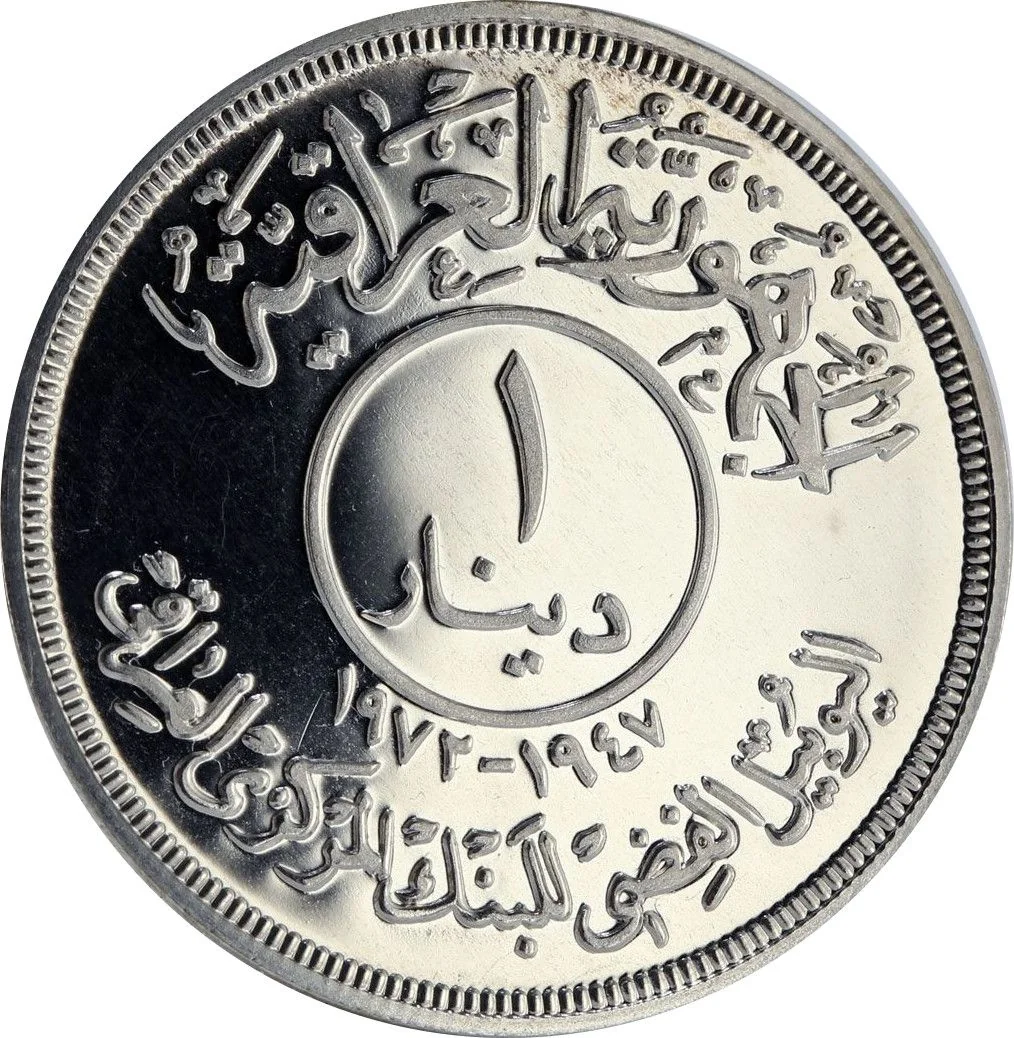
1 dinar (Central Bank of Iraq) – Iraq
Add to wishlist
Non-circulating coins
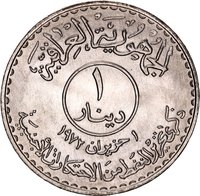
Commemoration: 25th Anniversary of the Central Bank of Iraq
Iraq
Context
Year: 1972
Islamic (Hijri) Year:: 1392
Issuer: Iraq
Period:
(since 1958)
Currency:
(since 1931)
Demonetized: Yes
Total mintage: 50,000
Material
Diameter: 40 mm
Weight: 31 g
Silver Weight:: 15.50 g
Shape: Round
Composition: 50% Silver
Standard: Silver ounce
Magnetic: No
Technique: Milled
References
KM: #
Numista: #31153
Value
Exchange value: 1 IQD
Bullion value: $37.72
Obverse
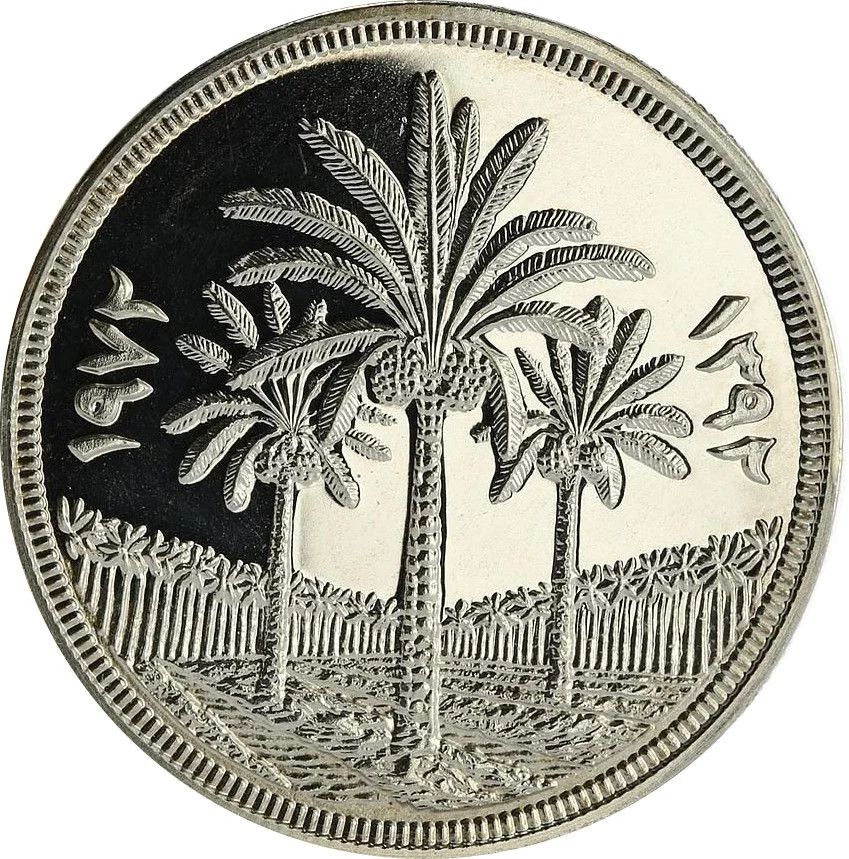
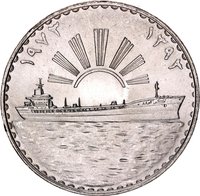
Reverse
Description:
Palms yield dates.
Inscription:
١٣٩٢ ١٩٧٢
Translation:
١٣٩٢ ١٩٧٢
Script: Arabic
Engraver: Geoffrey Colley
Edge
Mints
| Name | Mark |
|---|---|
| Royal Mint | — |
Mintings
| Year | Mint Mark | Mintage | Quality | Collection |
|---|---|---|---|---|
| 1972 | — | 50,000 | ||
| 1972 | — | — | Proof |
Historical background
In 1972, Iraq's currency, the Iraqi dinar (IQD), was a stable and internationally respected currency, pegged to the British pound sterling at a rate of 1 dinar = 1 pound. This strength was a direct reflection of the nation's economic position, which was overwhelmingly dependent on a single resource: oil. Following the nationalization of the Iraq Petroleum Company (IPC) in June 1972, the state assumed full control over its vast hydrocarbon reserves. This bold move promised to dramatically increase government revenues and solidify economic independence, creating a sense of optimism about the dinar's future underpinned by direct oil wealth.
The currency's management fell under the purview of the Central Bank of Iraq (CBI), established in 1947. The peg to sterling provided predictability for international trade and investment, which was crucial as Iraq sought to modernize its infrastructure and diversify its economy beyond oil. However, this external peg also meant that the dinar's stability was partially tied to the economic conditions of the United Kingdom, which was itself experiencing periods of inflation and currency volatility in the early 1970s.
Beneath this surface stability, the foundations for future turbulence were being laid. The enormous revenue windfall expected from oil nationalization would soon flood the state coffers, increasing the money supply and inflationary pressures. Furthermore, the Ba'athist government's escalating military expenditures and large-scale national development projects began to shape fiscal policy more than conservative monetary management. Thus, while the dinar of 1972 was strong and pegged, the decisions of that year set the stage for the economic imbalances and external shocks that would challenge the currency's stability in the decades to follow.
The currency's management fell under the purview of the Central Bank of Iraq (CBI), established in 1947. The peg to sterling provided predictability for international trade and investment, which was crucial as Iraq sought to modernize its infrastructure and diversify its economy beyond oil. However, this external peg also meant that the dinar's stability was partially tied to the economic conditions of the United Kingdom, which was itself experiencing periods of inflation and currency volatility in the early 1970s.
Beneath this surface stability, the foundations for future turbulence were being laid. The enormous revenue windfall expected from oil nationalization would soon flood the state coffers, increasing the money supply and inflationary pressures. Furthermore, the Ba'athist government's escalating military expenditures and large-scale national development projects began to shape fiscal policy more than conservative monetary management. Thus, while the dinar of 1972 was strong and pegged, the decisions of that year set the stage for the economic imbalances and external shocks that would challenge the currency's stability in the decades to follow.
🌟 Limited