

10 euro (Ploughman bank note series) – Ireland
Add to wishlist
Non-circulating coins
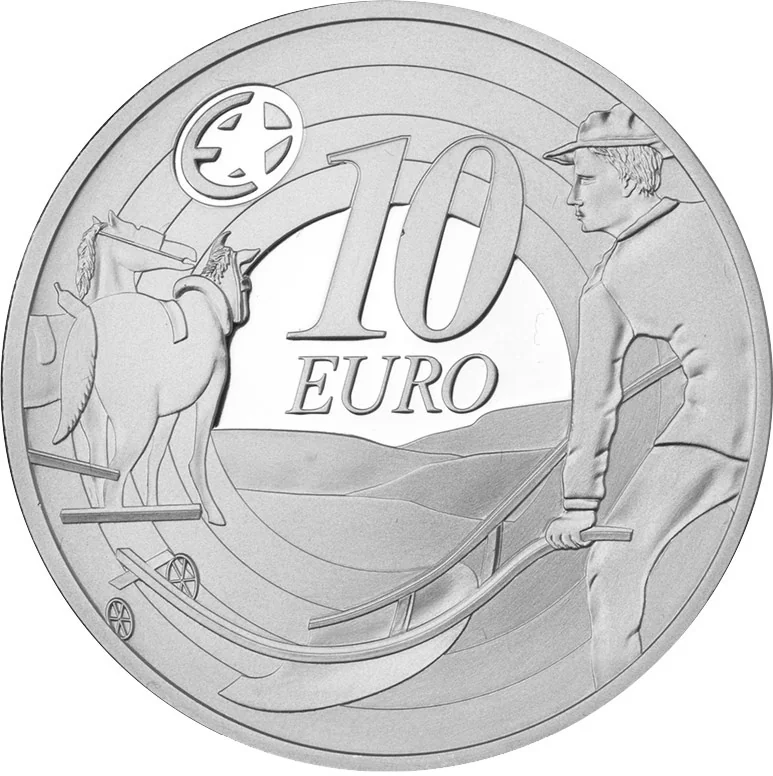
Commemoration: 80th Anniversary of Consolidated Bank Note Issue - 'Ploughman' series
Series: Europa Star
Ireland
Context
Year: 2009
Issuer: Ireland
Issuing organization: Central bank of Ireland
Period:
(since 1937)
Currency:
(since 2002)
Total mintage: 15,000
Material
References
KM: #
Numista: #13607
Value
Exchange value: 10 EUR
Bullion value: $66.84
Inflation-adjusted value: 12.44 EUR
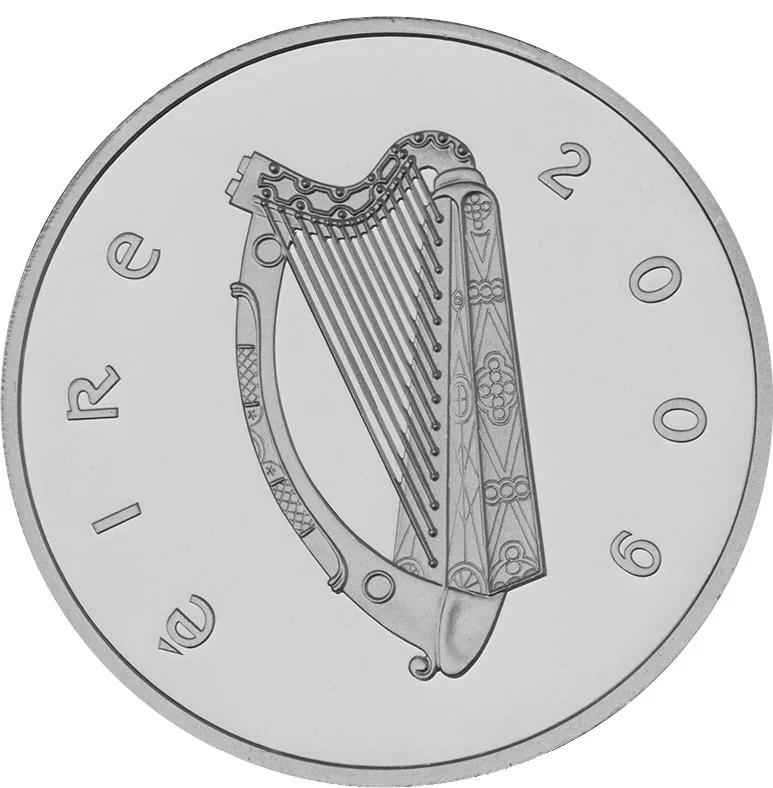
Obverse
Description:
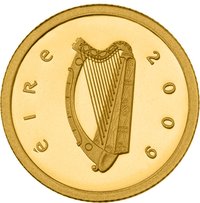
The Celtic harp.
Inscription:
éire 2009
Translation:
Ireland 2009
Language: Irish
Engraver: E. Mullins
Reverse
Edge
Plain.
Mintings
| Year | Mint Mark | Mintage | Quality | Collection |
|---|---|---|---|---|
| 2009 | — | 15,000 | Proof |
Historical background
In 2009, Ireland was in the midst of a severe economic and banking crisis, but its currency situation was uniquely defined by its membership in the Eurozone. Having adopted the euro in 1999 (as physical cash in 2002), Ireland no longer had a national currency like the Irish pound (punt) to devalue. This meant the country could not use exchange rate policy as a shock absorber. While the shared currency provided stability and prevented a speculative currency crisis, it also removed a key tool for regaining competitiveness, forcing all adjustment onto domestic wages, prices, and fiscal policy—a process known as "internal devaluation."
The core of Ireland's predicament was the collapse of its domestic property and banking sectors, which led to a massive government deficit and a ballooning national debt as the state guaranteed bank liabilities. The fixed exchange rate of the euro meant Ireland faced this crisis with interest rates set by the European Central Bank (ECB) for the entire Eurozone, which were arguably too high for a contracting Irish economy. Furthermore, being in the euro prevented the possibility of capital controls or a standalone monetary response, ultimately leading the state to seek an external bailout in 2010 from the EU, ECB, and IMF to stabilize its public finances and banking system.
Thus, the currency situation was a double-edged sword. The euro provided a stable platform and avoided the currency turmoil seen in non-euro countries like Iceland or Hungary during the global financial crisis. However, it also locked Ireland into a rigid monetary framework that exacerbated the domestic downturn and necessitated a harsh austerity programme. The crisis starkly highlighted the tensions within a currency union where member states face asymmetric shocks without possessing independent monetary or exchange rate tools to address them.
The core of Ireland's predicament was the collapse of its domestic property and banking sectors, which led to a massive government deficit and a ballooning national debt as the state guaranteed bank liabilities. The fixed exchange rate of the euro meant Ireland faced this crisis with interest rates set by the European Central Bank (ECB) for the entire Eurozone, which were arguably too high for a contracting Irish economy. Furthermore, being in the euro prevented the possibility of capital controls or a standalone monetary response, ultimately leading the state to seek an external bailout in 2010 from the EU, ECB, and IMF to stabilize its public finances and banking system.
Thus, the currency situation was a double-edged sword. The euro provided a stable platform and avoided the currency turmoil seen in non-euro countries like Iceland or Hungary during the global financial crisis. However, it also locked Ireland into a rigid monetary framework that exacerbated the domestic downturn and necessitated a harsh austerity programme. The crisis starkly highlighted the tensions within a currency union where member states face asymmetric shocks without possessing independent monetary or exchange rate tools to address them.
Series: Europa Star
💎 Very Rare