

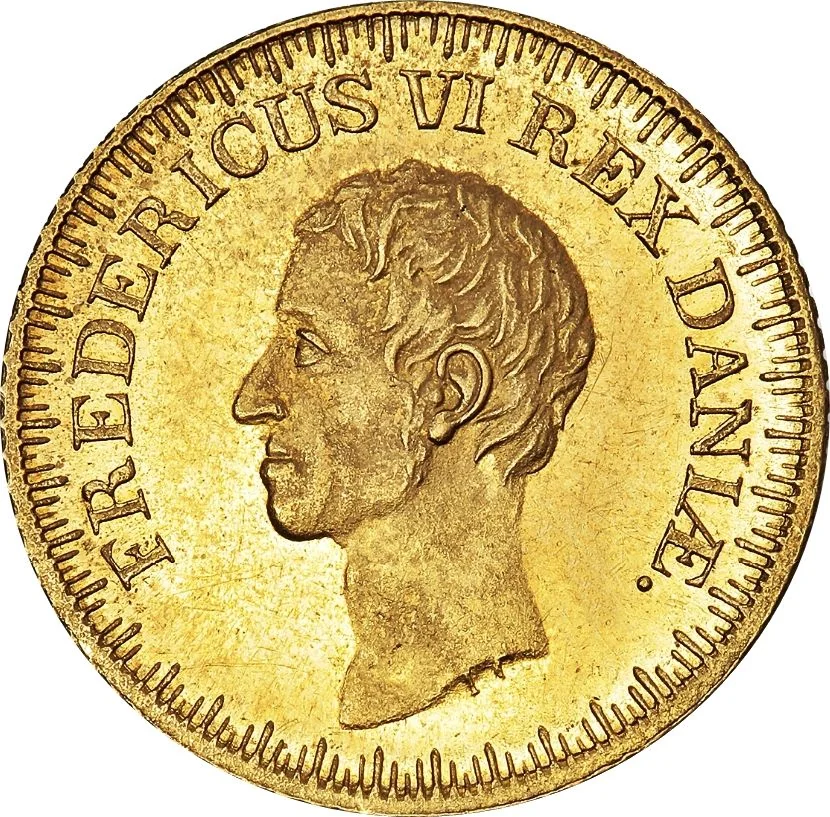
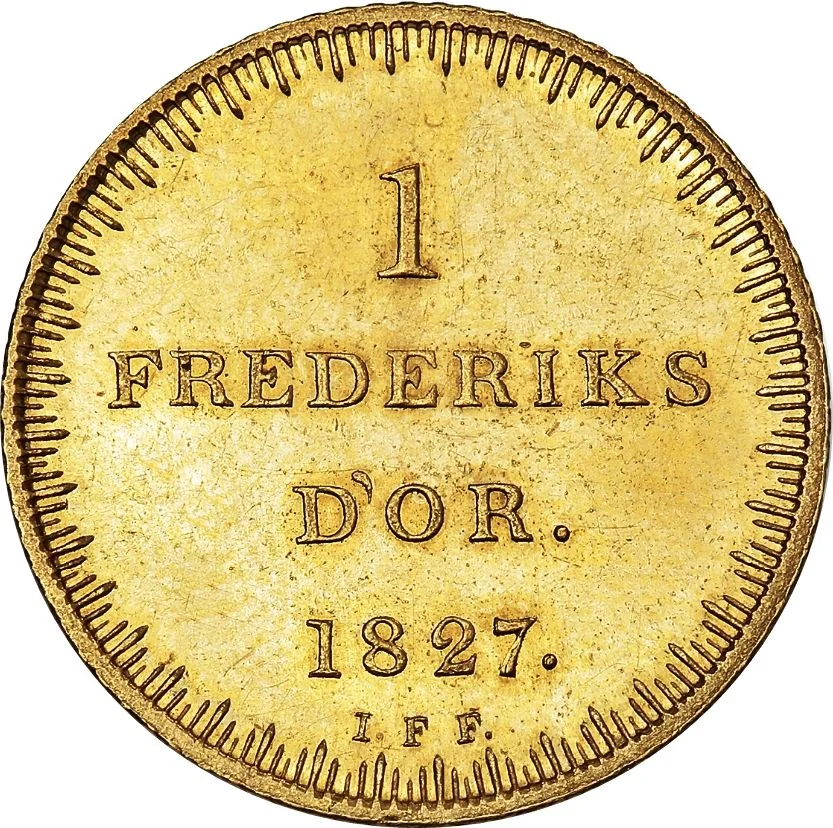
1 Frederik d'Or – Denmark
Denmark
Context
Year: 1827
Issuer: Denmark 
Ruler: Frederick VI
Currency:
(1813—1854)
Subdivision: 1 Frederik d'Or = 5 Speciedaler
Demonetized: Yes
Total mintage: 1,500
Material
References
KM: #Click to copy to clipboard698
Numista: #309018
Value
Bullion value: $994.42
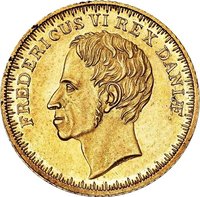
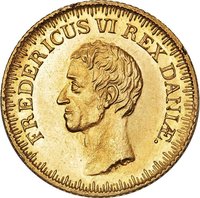
Obverse
Description:
King Frederik VI facing left.
Inscription:
FREDERICUS VI REX DANIÆ.
IC
IC
Translation:
Frederick VI, King of Denmark.
Script: Latin
Language: Latin
Engraver: Johannes Conradsen
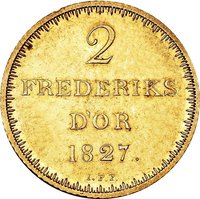
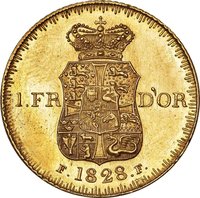
Reverse
Description:
Value and date
on four lines.
Mintmaster initials
below.
on four lines.
Mintmaster initials
below.
Inscription:
1
FREDERIKS
D'OR.
1827 .
I.F.F.
FREDERIKS
D'OR.
1827 .
I.F.F.
Script: Latin
Engraver: Johannes Conradsen
Edge
Coarse reeding
Mints
| Name | Mark |
|---|---|
| Altona, Schleswig-Holstein | — |
Mintings
| Year | Mint Mark | Mintage | Quality | Collection |
|---|---|---|---|---|
| 1827 | — | 1,500 |
Historical background
In 1827, Denmark operated under a complex and strained monetary system, a legacy of the state bankruptcy declared in 1813 following the Napoleonic Wars. The old rigsdaler currency was replaced by the Rigsbankdaler, established by the Currency Regulation of 1813, but confidence in this new paper money was low. The system was effectively bimetallic, with values tied to both silver and gold, but it suffered from a chronic shortage of stable, tangible coinage. Much of the circulating medium consisted of depreciated paper notes issued by the state-backed Rigsbank, alongside a confusing array of older coins still in use, leading to widespread public distrust and economic uncertainty.
The year fell within a prolonged period of deflation and adjustment, as the government struggled to restore monetary stability and international credibility. A key feature was the existence of the Kurantdaler (the unit of account for paper banknotes) and the Specie or Silver Rigsdaler (a coin containing actual silver), which traded at a fluctuating and often unfavorable rate against each other. This disparity between "real" silver money and "imaginary" paper money created practical difficulties for trade and contracts, hampering both domestic commerce and Denmark's integration into the wider European economy.
Consequently, the currency situation in 1827 was one of transition and anticipation. Political and economic debates were intensifying around the need for a definitive monetary reform to unify the system, restore convertibility to specie, and guarantee value. These pressures would culminate a decade later in the Currency Act of 1837, which formally introduced the Rigsdaler Courant as a stable silver-based currency, finally providing the foundation for the monetary order Denmark lacked in the late 1820s.
The year fell within a prolonged period of deflation and adjustment, as the government struggled to restore monetary stability and international credibility. A key feature was the existence of the Kurantdaler (the unit of account for paper banknotes) and the Specie or Silver Rigsdaler (a coin containing actual silver), which traded at a fluctuating and often unfavorable rate against each other. This disparity between "real" silver money and "imaginary" paper money created practical difficulties for trade and contracts, hampering both domestic commerce and Denmark's integration into the wider European economy.
Consequently, the currency situation in 1827 was one of transition and anticipation. Political and economic debates were intensifying around the need for a definitive monetary reform to unify the system, restore convertibility to specie, and guarantee value. These pressures would culminate a decade later in the Currency Act of 1837, which formally introduced the Rigsdaler Courant as a stable silver-based currency, finally providing the foundation for the monetary order Denmark lacked in the late 1820s.
✨ Legendary