

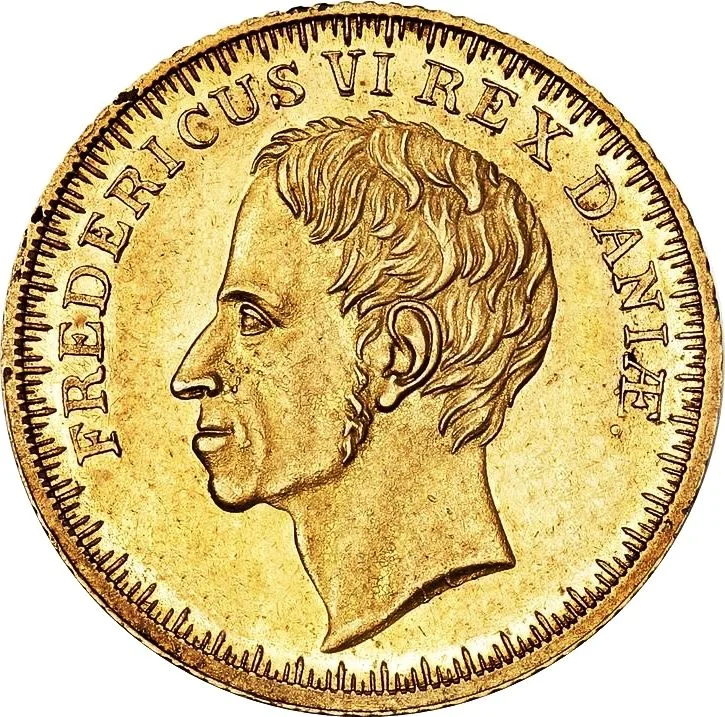
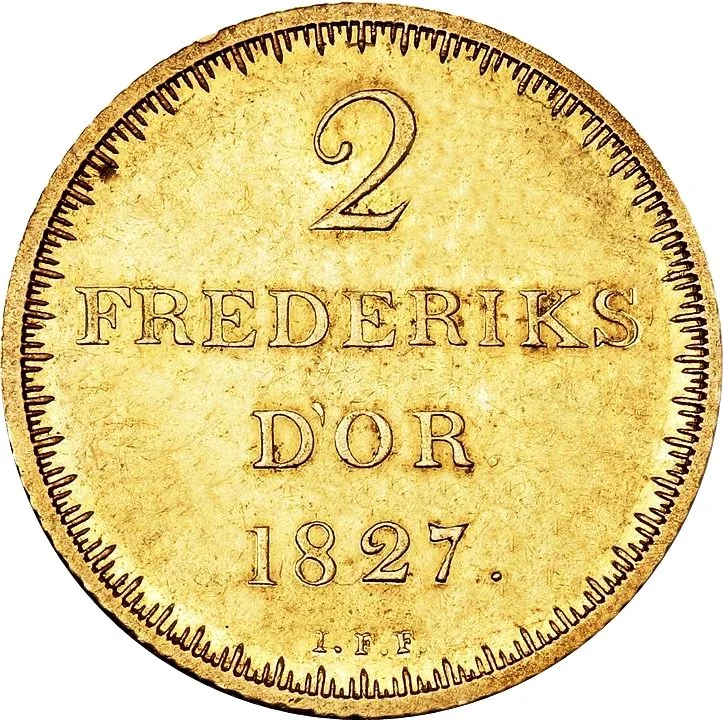
2 Frederiks d'Or – Denmark
Denmark
Context
Years: 1826–1827
Issuer: Denmark 
Ruler: Frederick VI
Currency:
(1813—1854)
Subdivision: 2 Frederiks d'Or = 10 Speciedaler
Demonetized: Yes
Material
References
KM: #Click to copy to clipboard697
Numista: #152277
Value
Bullion value: $1985.40
Obverse
Description:
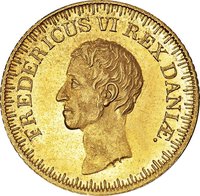
King Frederik VI left-facing portrait. Engraver initials on neck.
Inscription:
FREDERICUS VI REX DANIÆ.
I.C.
I.C.
Translation:
Frederick VI, King of Denmark.
I.C.
I.C.
Script: Latin
Language: Latin
Engraver: Johannes Conradsen
Reverse
Description:
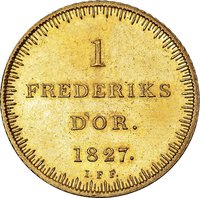
Value and date
on four lines.
Mintmaster initials
below.
on four lines.
Mintmaster initials
below.
Inscription:
2
FREDERIKS
D'OR
1827
I.F.F.
FREDERIKS
D'OR
1827
I.F.F.
Script: Latin
Engraver: Johannes Conradsen
Edge
Diagonal milling
Mints
| Name | Mark |
|---|---|
| Altona, Schleswig-Holstein | — |
Mintings
| Year | Mint Mark | Mintage | Quality | Collection |
|---|---|---|---|---|
| 1826 | — | — | ||
| 1827 | — | — |
Historical background
In 1826, Denmark operated under a complex and strained monetary system, a legacy of the state bankruptcy declared in 1813 following the Napoleonic Wars. To address the crippling national debt, the government had introduced the Rigsbankdaler as a new paper currency, intended to replace the older and devalued Rigsdaler. However, this new currency was not fully trusted by the public and circulated alongside a bewildering array of older coins, both domestic and foreign, creating a chaotic multi-currency environment where values were constantly negotiated.
The core problem was a severe shortage of stable, tangible silver coinage. The Rigsbankdaler was a specie-backed currency in law, but the Rigsbank often lacked the silver reserves to redeem notes on demand, leading to a persistent gap between the paper money's face value and its actual market worth. Consequently, daily commerce was conducted using a confusing mix of Rigsbankdaler notes, older silver Rigsdaler coins (which held a premium), and even foreign currencies like the Hamburg Mark Banco, which was widely used in international trade.
This period was one of cautious transition and deflationary pressure. The government, committed to eventually restoring a full silver standard, was slowly retiring debt and building reserves. For merchants and the public in 1826, however, this meant navigating a fragile and inefficient system where the value of money was uncertain, complicating trade and contracts. The situation would gradually stabilize over the subsequent decades, culminating in the adoption of the modern krone and a secure silver standard with the Currency Act of 1873.
The core problem was a severe shortage of stable, tangible silver coinage. The Rigsbankdaler was a specie-backed currency in law, but the Rigsbank often lacked the silver reserves to redeem notes on demand, leading to a persistent gap between the paper money's face value and its actual market worth. Consequently, daily commerce was conducted using a confusing mix of Rigsbankdaler notes, older silver Rigsdaler coins (which held a premium), and even foreign currencies like the Hamburg Mark Banco, which was widely used in international trade.
This period was one of cautious transition and deflationary pressure. The government, committed to eventually restoring a full silver standard, was slowly retiring debt and building reserves. For merchants and the public in 1826, however, this meant navigating a fragile and inefficient system where the value of money was uncertain, complicating trade and contracts. The situation would gradually stabilize over the subsequent decades, culminating in the adoption of the modern krone and a secure silver standard with the Currency Act of 1873.
💎 Extremely Rare