

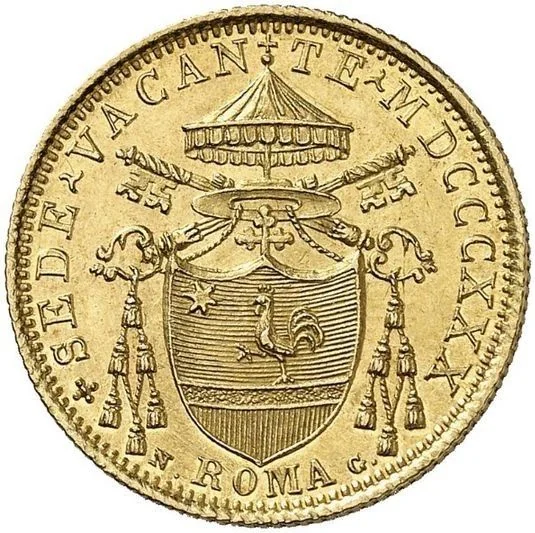
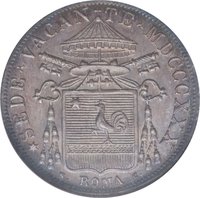
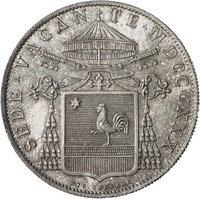
Obverse
Description:
Cardinal's coat of arms
Inscription:
SEDE VACANTE MDCCCXXX
N ROMA C
N ROMA C
Translation:
During the vacant see 1830
Rome
Rome
Script: Latin
Language: Latin
Engraver: Niccolò Cerbara
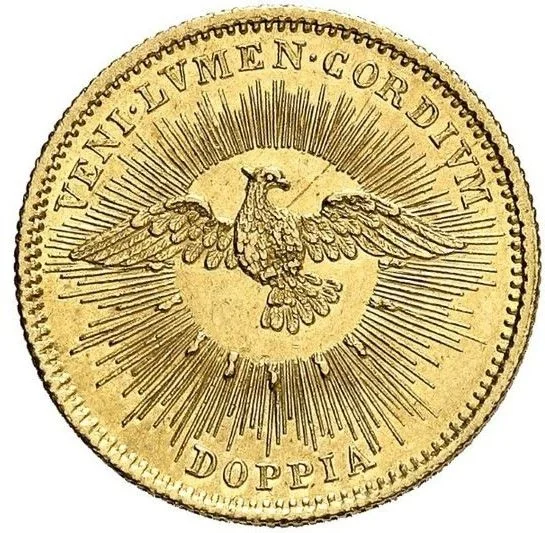
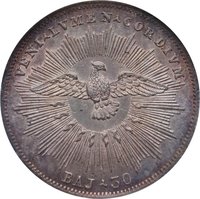
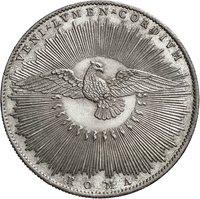
Reverse
Description:
Rising dove beyond price.
Inscription:
VENI LVMEN CORDIVM
DOPPIA
DOPPIA
Translation:
Come, light of hearts
Double
Double
Script: Latin
Language: Latin
Engraver: Niccolò Cerbara
Edge
Reeded
Mints
| Name | Mark |
|---|---|
| Rome | R |
Mintings
| Year | Mint Mark | Mintage | Quality | Collection |
|---|---|---|---|---|
| 1830 | ROMA | — |
Historical background
In 1830, the Papal States faced a complex and fragmented currency situation, a legacy of its decentralized political and economic structure. The state lacked a unified, modern monetary system. While the official unit of account was the scudo (divided into 100 baiocchi), actual circulation was a chaotic mix of physical coins from various eras and regions. These included not only Papal-issued coins in copper (baiocchi and quattrini), silver (giulii, paoli, and scudi), and gold (doppie), but also a significant influx of foreign currencies, particularly French and Austrian coins, due to the political influence and trade links with these powers.
This monetary fragmentation created significant practical problems for commerce and administration. The value and metal content of older Papal coins often differed from newer issues, and the widespread acceptance of foreign specie meant exchange rates fluctuated. Furthermore, counterfeiting was a persistent issue, eroding public trust. The situation was symptomatic of the broader economic stagnation within the Papal States, where protectionist policies and a reliance on archaic feudal agricultural systems hindered development and integrated financial markets.
Pope Pius VIII, whose brief pontificate spanned 1829-1830, inherited these challenges but his reign was too short to implement major monetary reform. The task would fall to his successor, Gregory XVI (1831-1846), who would later initiate a cautious modernization of the coinage in the 1830s. Thus, in 1830, the currency system remained a pre-modern patchwork, reflecting the broader tensions within the Papal States between tradition and the pressing need for economic and administrative modernization in a rapidly changing Europe.
This monetary fragmentation created significant practical problems for commerce and administration. The value and metal content of older Papal coins often differed from newer issues, and the widespread acceptance of foreign specie meant exchange rates fluctuated. Furthermore, counterfeiting was a persistent issue, eroding public trust. The situation was symptomatic of the broader economic stagnation within the Papal States, where protectionist policies and a reliance on archaic feudal agricultural systems hindered development and integrated financial markets.
Pope Pius VIII, whose brief pontificate spanned 1829-1830, inherited these challenges but his reign was too short to implement major monetary reform. The task would fall to his successor, Gregory XVI (1831-1846), who would later initiate a cautious modernization of the coinage in the 1830s. Thus, in 1830, the currency system remained a pre-modern patchwork, reflecting the broader tensions within the Papal States between tradition and the pressing need for economic and administrative modernization in a rapidly changing Europe.
✨ Legendary