

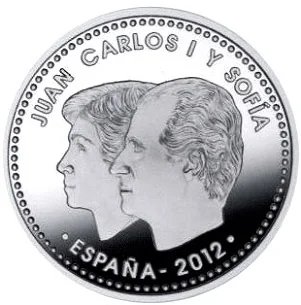
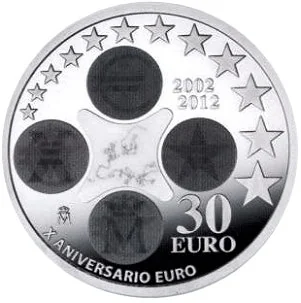
30 euro (Circulation of the Euro) – Spain
Add to wishlist
Non-circulating coins
Commemoration: 10th anniversary of the Circulation of the Euro
Series: Face Value Exchange Series
Spain
Context
Material
Diameter: 33 mm
Weight: 18 g
Silver Weight:: 16.65 g
Thickness: 2 mm
Shape: Round
Composition: 92.5% Silver
Magnetic: No
Techniques: Latent image, Milled
Alignment: Medal alignment
flip
References
Numista: #30844
Value
Exchange value: 30 EUR
Bullion value: $42.21
Inflation-adjusted value: 38.67 EUR
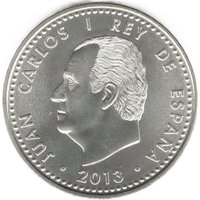
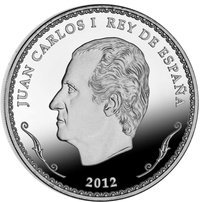
Obverse
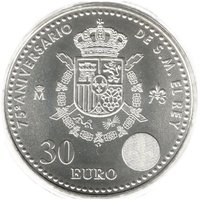
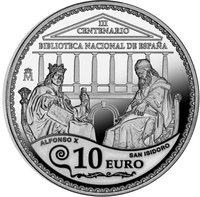
Reverse
Edge
Plain
Mints
| Name | Mark |
|---|---|
| Royal Mint of Madrid | (M) |
Mintings
| Year | Mint Mark | Mintage | Quality | Collection |
|---|---|---|---|---|
| 2012 | M | 554,399 |
Historical background
In 2012, Spain was at the epicentre of the European sovereign debt crisis, a period of severe financial and economic distress. The country was grappling with the devastating aftermath of the 2008 property bubble collapse, which left its banking sector saddled with toxic assets and triggered a deep recession. This resulted in soaring unemployment, which peaked above 25%, and a rapidly widening budget deficit. Crucially, as a member of the Eurozone, Spain did not control its own currency and could not devalue the peseta to regain competitiveness; instead, it was forced to implement harsh internal devaluation through spending cuts and wage reductions, exacerbating social hardship.
The currency situation was defined by Spain's use of the euro, which presented a double-edged sword. While membership initially provided stability and low interest rates, it now trapped the country within a monetary union without a corresponding fiscal union. Investors, fearing a possible breakup of the Eurozone or a Spanish sovereign default, drove the government's borrowing costs to unsustainable levels, with 10-year bond yields exceeding 7.5% in July 2012. This raised the spectre of Spain requiring a full sovereign bailout, following those of Greece, Ireland, and Portugal, which would have overwhelmed the euro area's existing rescue funds.
The crisis reached a critical turning point in the summer of 2012. In June, Spain formally requested a European financial assistance package of up to €100 billion specifically to recapitalise its crippled banks, separating this from sovereign debt. The pivotal moment came in late July when European Central Bank President Mario Draghi pledged to do "whatever it takes" to preserve the euro. This announcement alone dramatically lowered Spanish bond yields, as it signalled the ECB's potential readiness to act as a lender of last resort through a new program (Outright Monetary Transactions). This intervention, though conditional, effectively ended the immediate threat to Spain's access to capital markets and stabilised the euro, allowing the government space to continue its arduous fiscal and structural reforms.
The currency situation was defined by Spain's use of the euro, which presented a double-edged sword. While membership initially provided stability and low interest rates, it now trapped the country within a monetary union without a corresponding fiscal union. Investors, fearing a possible breakup of the Eurozone or a Spanish sovereign default, drove the government's borrowing costs to unsustainable levels, with 10-year bond yields exceeding 7.5% in July 2012. This raised the spectre of Spain requiring a full sovereign bailout, following those of Greece, Ireland, and Portugal, which would have overwhelmed the euro area's existing rescue funds.
The crisis reached a critical turning point in the summer of 2012. In June, Spain formally requested a European financial assistance package of up to €100 billion specifically to recapitalise its crippled banks, separating this from sovereign debt. The pivotal moment came in late July when European Central Bank President Mario Draghi pledged to do "whatever it takes" to preserve the euro. This announcement alone dramatically lowered Spanish bond yields, as it signalled the ECB's potential readiness to act as a lender of last resort through a new program (Outright Monetary Transactions). This intervention, though conditional, effectively ended the immediate threat to Spain's access to capital markets and stabilised the euro, allowing the government space to continue its arduous fiscal and structural reforms.
Series: Face Value Exchange Series
🌟 Uncommon